

Key takeaways
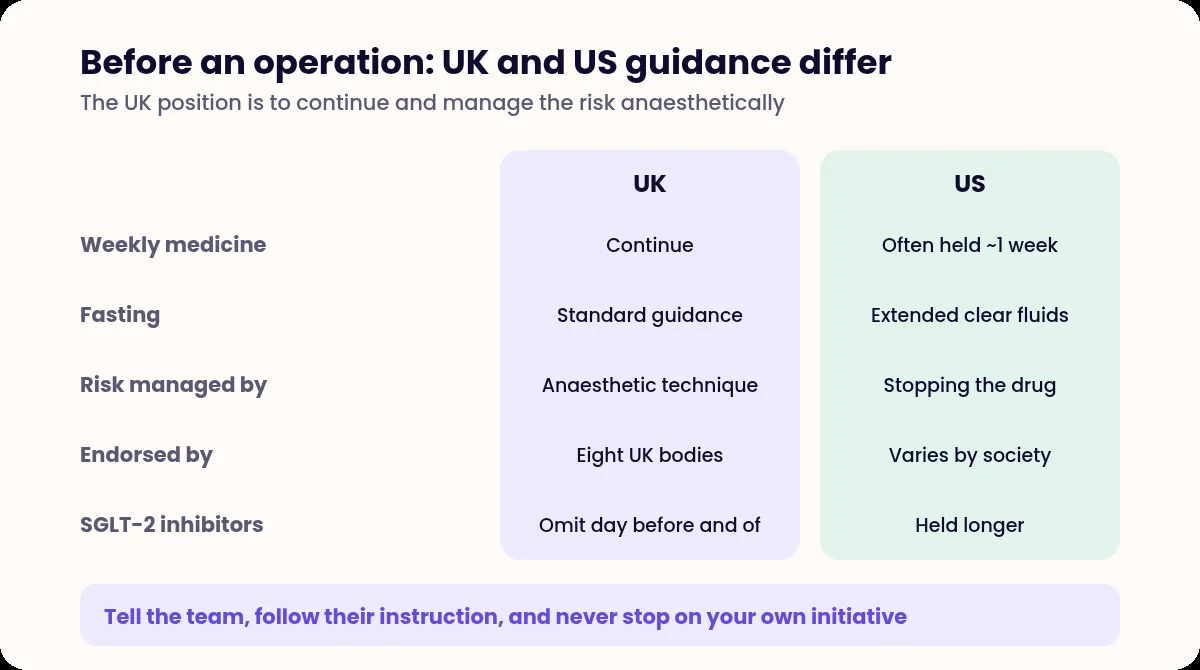
- UK national consensus, endorsed by eight bodies including the Royal College of Anaesthetists, recommends continuing GLP-1 receptor agonists throughout the perioperative period, with no withholding period.
- No UK Summary of Product Characteristics specifies a withholding period before surgery, and the MHRA does not recommend one.
- Local UK practice is not uniform: some NHS boards and many private providers do ask patients to stop, so follow the instruction from the team doing your procedure.
- SGLT-2 inhibitors follow a different rule entirely and should be omitted the day before and the day of a procedure; do not apply GLP-1 advice to them.
This page is medicine information rather than an advert. Semaglutide, tirzepatide and liraglutide are prescription only medicines in the UK [7], and whether any of them is suitable is a decision for a prescriber after an assessment.
If you take a GLP-1 medicine and have an operation, endoscopy or procedure under sedation coming up, you will find two directly contradictory sets of advice online. The UK national position and the US national position are not the same, and a great deal of the material people read is American.
This page sets out what UK guidance says, why it differs, and what to do when your own hospital tells you something different.
The UK national position
The definitive UK document is a multidisciplinary consensus statement published in Anaesthesia in 2025, endorsed by eight UK bodies including the Royal College of Anaesthetists, the Association of Anaesthetists, the Centre for Perioperative Care and BOMSS [1].
Its headline recommendation is unambiguous: “Patients should continue to take glucagon-like peptide-1 receptor agonists throughout the perioperative period.”
No withholding period is recommended, irrespective of whether the medicine is dosed daily or weekly.
The reasoning is a balance of harms rather than a claim that aspiration risk is zero. Stopping these medicines around surgery carries its own costs: perioperative hyperglycaemia, increased surgical site infection, acute kidney injury and cancelled procedures. The consensus view is that those outweigh a rare aspiration risk which can be managed by other means.
What the MHRA said
The MHRA issued a Drug Safety Update in January 2025 on the potential risk of pulmonary aspiration during general anaesthesia and deep sedation [2]. Its main points:
- patients may have residual gastric contents despite preoperative fasting
- clinicians should undertake an individualised aspiration risk assessment, with particular attention to diabetic gastroparesis, obesity and reflux disease
- clinicians should ask patients directly whether they take one of these medicines, because many buy privately and private prescriptions do not appear in NHS records
- elevated risk should be identified early, at pre-assessment clinic
- suspected reactions should be reported via the Yellow Card scheme
Its advice to patients was to tell the healthcare team and the anaesthetist, and to “take your prescribed medicine(s) as usual and do not stop your treatment without first discussing this with your doctor.”
The MHRA is explicit that the evidence base is thin. As at 12 December 2024 there had been “a very small number of reports of aspiration during a surgical procedure”, including one case resulting in aspiration pneumonia. Yellow Card data are spontaneous reports: there is no denominator, and they do not establish causation.
A section 4.4 warning was added across the class. Note what was not added: no UK Summary of Product Characteristics specifies any withholding period before surgery, and the MHRA does not recommend one.
The MHRA’s Drug Safety Update has been rebranded the MHRA Safety Roundup as of 2026, which is worth knowing when searching for the original.
Risk is managed by anaesthetic technique, not by stopping
This is the part of UK guidance that explains why continuing is considered reasonable. The consensus statement sets out a list of mitigations, all of which sit with the anaesthetic team [1]:
- individualised aspiration risk assessment
- “upper gastrointestinal symptoms alone should not be used to determine gastric content”
- point-of-care gastric ultrasound should be considered before induction
- adhere to standard fasting guidelines — no extended fast and no prolonged clear-liquid diet
- prefer regional anaesthesia where suitable
- consider prokinetics, such as erythromycin before induction
- tracheal intubation in preference to a supraglottic airway
- modified rapid sequence induction
- head-up positioning
- a gastric tube before induction and before extubation
- awake extubation
- shared decision-making throughout
The statement is also candid about its own limits: “Given the dearth of high-quality peri-operative studies, there remains uncertainty regarding optimal peri-operative management.”
Where the US differs
The American Society of Anesthesiologists advised in 2023 that these medicines be held one day before a procedure for daily agents and one week before for weekly agents [5]. That is the advice behind most of what you will read online.
A 2024 US multisociety revision moved away from blanket holding towards risk stratification plus a 24-hour clear liquid diet in higher-risk patients [6]. Australia and New Zealand published a third position in 2025.
So there are at least three national positions, and the UK one is the most permissive. That is not because UK bodies think aspiration is impossible. It is because they weighted the harms of stopping more heavily.
UK practice is not uniform, and this matters to you
This is the point most articles omit, and it is the one most likely to affect a real patient.
Local UK practice varies. An NHS Scotland Right Decision Service local guideline approved in December 2025 distinguishes by indication: continue for people taking the medicine for diabetes, but for the weight-loss indication it offers patients the option of discontinuing for up to five half-lives — roughly four weeks for tirzepatide, roughly five for semaglutide — before non-urgent elective procedures, framed as a patient-choice decision [4].
Many private endoscopy and cosmetic surgery providers apply US-style holds, sometimes as a blanket policy.
That is local policy, not UK national guidance, and both can be true at once. A national consensus statement does not override the instruction of the team performing your procedure.
What this means in practice
- Tell the team. Pre-assessment clinic, the surgeon, and the anaesthetist. Say the product name and the dose, and say when your last dose was
- Tell them even if you bought it privately. Privately prescribed medicines are invisible in NHS records. Nobody will find out unless you say. This is also a good reason for telling your GP about private treatment generally
- Follow the instruction from whoever is doing your procedure. If they ask you to stop, stop. If they say continue, continue
- Never stop on your own initiative, and equally never continue in defiance of an instruction to stop because of something you read
- Ask early. If you are told to stop for four or five weeks, that is a scheduling problem as well as a clinical one, and it is better discovered at booking than the week before
If a hold is advised, what happens to the medicine afterwards is a separate question, covered in stopping weight loss medication and, for restarting, in missed dose weight loss medicine.
SGLT-2 inhibitors are a different rule
Do not conflate the two, because people taking both is common.
SGLT-2 inhibitors should be omitted the day before and the day of a procedure, because of the risk of euglycaemic diabetic ketoacidosis [1]. They are restarted once the patient is eating and drinking normally.
That is a genuine withholding instruction, and it applies to a different class. Applying it to a GLP-1 medicine, or applying GLP-1 advice to an SGLT-2 inhibitor, are both errors.
Bariatric surgery specifically
People taking these medicines while awaiting bariatric surgery are covered by the same consensus statement, which BOMSS endorsed. Individual bariatric units may have their own protocols on medicine use before and after surgery for reasons unrelated to aspiration risk. Bariatric surgery explained covers UK pathways and what to expect.
When to speak to a clinician
- As soon as any procedure under sedation or general anaesthetic is booked, tell the team which medicine you take and when you last took it
- If you receive conflicting instructions from a private prescriber and the hospital, the team performing the procedure decides
- Persistent vomiting, severe reflux or a feeling that food is not leaving your stomach — raise this before any planned procedure
- Severe abdominal pain, or vomiting with breathlessness after a procedure — go to A&E
Frequently asked questions
Do I need to stop my weight loss injection before surgery?
UK national guidance says no. The 2025 multidisciplinary consensus statement recommends continuing GLP-1 receptor agonists throughout the perioperative period, with no withholding period regardless of daily or weekly dosing, and managing aspiration risk anaesthetically instead. However, some hospitals and private providers apply different local policies, so follow the instruction from the team performing your procedure.
Why does US advice say to stop a week before?
The American Society of Anesthesiologists issued guidance in 2023 advising that daily agents be held one day before and weekly agents one week before. A 2024 US multisociety revision moved towards risk stratification plus a 24-hour clear liquid diet in higher-risk patients. UK guidance took a different view, weighing the risks of stopping, including hyperglycaemia and cancelled procedures, against a rare aspiration risk.
What is the aspiration risk with GLP-1 medicines?
These medicines slow gastric emptying, so patients may have residual stomach contents despite standard preoperative fasting. The MHRA is explicit that the evidence base is thin: as of December 2024 there had been a very small number of reports of aspiration during surgery, including one case of aspiration pneumonia. Yellow Card reports have no denominator and do not establish causation.
Does my surgical team know if I bought the medicine privately?
Not automatically. Privately prescribed medicines do not appear in NHS records, which is why the MHRA advises clinicians to ask patients directly. You must tell the pre-assessment team and the anaesthetist yourself, even if you obtained the medicine online and have not told your GP.
References
- El-Boghdadly K, Dhesi J, Fabb P, et al. Elective peri-operative management of adults taking GLP-1 receptor agonists, GIP agonists and SGLT-2 inhibitors: a multidisciplinary consensus statement. Anaesthesia. 2025. doi.org/10.1111/anae.16541
- MHRA. GLP-1 and dual GIP/GLP-1 receptor agonists: potential risk of pulmonary aspiration during general anaesthesia and deep sedation. Drug Safety Update, January 2025 (Vol 18, Issue 6). www.gov.uk/drug-safety-update
- Centre for Perioperative Care. Guidance for patients and healthcare professionals on preparation for surgery. www.cpoc.org.uk/
- NHS Scotland Right Decision Service. Local guideline on GLP-1 receptor agonists and elective procedures, approved 12 December 2025. rightdecisions.scot.nhs.uk/
- American Society of Anesthesiologists. Consensus-based guidance on preoperative management of patients on glucagon-like peptide-1 receptor agonists. 2023. www.asahq.org/about-asa/newsroom/news-releases/2023/06/american-societ
- Kindel TL, et al. Multisociety clinical practice guidance for the safe use of GLP-1 receptor agonists in the perioperative period. 2024. doi.org/10.1016/j.soard.2024.08.033
- The Human Medicines Regulations 2012, regulation 284. www.legislation.gov.uk/uksi/2012/1916/regulation/284
Medical reviewer
Naeem Teni
Clinical Lead at Manova. Registered pharmacist and independent prescriber, GPhC 2215591. Reviews Manova’s clinical content for accuracy and safety.
Written by
Manova Editorial Team
Researched and written to our editorial policy, using NICE, NHS, MHRA and peer-reviewed sources.
This article is for general information and isn’t a substitute for advice from your own clinician. If you feel unwell, contact your GP or NHS 111. In an emergency, call 999.