

Key takeaways
- A vacuum device produces an erection mechanically, so it can work when tablets cannot and when the nitric oxide pathway is unavailable.
- The constriction ring must never be left on for more than 30 minutes, and must be removed immediately after sex.
- Bleeding disorders and anticoagulant treatment are the main reasons a vacuum device is not suitable.
- A therapeutic device has a pressure-limiting release valve and sized rings; a novelty pump has neither, and that is where injuries come from.
A vacuum erection device is the least glamorous treatment for erectile dysfunction and, for a particular group of men, the most useful one available. It does not ask the blood vessels to respond to a chemical signal. It produces an erection by physics.
That single fact explains most of what follows: who it suits, why it works when other things have not, and why the safety rules around it are mechanical rather than pharmacological.
How it works
The penis goes into a rigid plastic cylinder sealed against the body. A pump — hand-operated or battery-powered — removes air from the cylinder, and the negative pressure draws blood into the erectile tissue passively. Once the penis is engorged, a constriction ring is rolled off the base of the cylinder onto the base of the penis to hold the blood in, and the cylinder comes off.
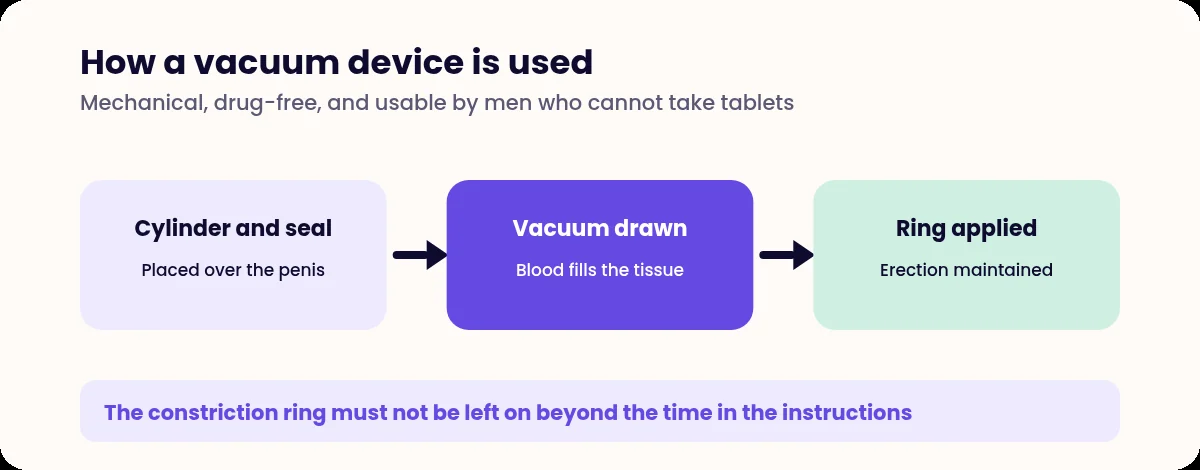
The result is an erection, but it is not identical to a natural one. It is hinged at the base rather than anchored, because the erection stops at the ring rather than continuing into the crura. It is usually cooler to the touch, which partners commonly notice and which is worth mentioning in advance rather than discovering mid-event. And the ring blocks the passage of semen, so ejaculation is trapped until the ring is released. None of that is harmful. All of it is easier to handle if nobody is surprised by it.
Why it works when tablets do not
Oral treatments for erectile dysfunction work by amplifying a natural chemical signal — the nitric oxide pathway — and they need that pathway to be functioning and they need sexual stimulation to start it. Our guide to how PDE5 inhibitors work covers that mechanism.
A vacuum device needs none of it. It draws blood in mechanically. That has three consequences worth stating plainly:
- It works regardless of the cause of the erectile dysfunction, according to European guidance, which is unusual among ED treatments [1].
- It is available to men who cannot take PDE5 inhibitors at all, including men taking nitrates or nicorandil for angina, for whom that class is absolutely contraindicated.
- It does not interact with other medicines, because nothing is absorbed.
For a man with significant heart disease on nitrate therapy, or who has tried oral treatment properly and had no useful response, this is often the next honest option rather than a curiosity.
What the numbers actually say
European guidance reports erections adequate for intercourse in as high as 90% of users, regardless of cause [1]. That figure describes whether the device produces a usable erection, which it almost always does, since it is a pump.
Satisfaction is the more meaningful measure and the numbers are far messier: 27–94% in the European data, 35–84% in the 2018 British guideline [1, 2]. That spread is the honest finding. Some men and couples get on with a vacuum device very well; others find the mechanics intrusive and stop.
Continued use tells you more than either. Roughly 50–64% are still using the device at two years [1], and British guidance notes that long-term persistence is considerably higher than with self-injection. People who like it tend to keep using it.
The safety rules, which are short and non-negotiable
The constriction ring comes off within 30 minutes. Always. European guidance sets this as a maximum [1]. The ring works by stopping venous outflow, which also means the trapped blood is no longer being refreshed with oxygen. Beyond 30 minutes you are running ischaemic tissue, and skin damage and, rarely, necrosis are the documented consequences. Remove the ring immediately after intercourse, whether or not the 30 minutes is up.
Bleeding disorders and anticoagulant therapy are contraindications [1, 2]. The vacuum reliably produces bruising and petechiae in ordinary users; on an anticoagulant that becomes a bigger problem. Sickle cell disease and other hypercoagulable states also warrant caution and a conversation with a clinician first.
Expected effects include bruising, pinpoint bleeding under the skin, penile pain, coldness of the penis, and blocked ejaculation. These are common and not dangerous. Skin necrosis is rare and is almost always a ring left on too long.
Medical device or novelty product
This distinction is not made clearly in most public health material, and it matters more than anything else on the page.
A therapeutic vacuum erection device is a regulated medical device carrying a UKCA or CE mark. Critically, it has a pressure-limiting vacuum release valve that caps how much negative pressure can be generated, correctly specified constriction rings in a range of sizes, and instructions for use [4].
A novelty penis pump sold as a sex toy has no pressure limiter and no ring specification. Pull hard enough on an unlimited vacuum and you can injure the tissue, and reports of harm from pump use disproportionately involve exactly this category of product. If you are buying privately, buy something sold as a medical device, and check that the valve is described in the specification.
Use after prostate surgery
Vacuum devices are widely used in UK penile rehabilitation protocols after radical prostatectomy — typically started a few weeks after surgery, often daily, and often without the constriction ring, the aim being to draw oxygenated blood through the tissue while the nerves recover.
Be careful how much weight you put on this. The supporting trials are small, short and inconsistent, and European guidance does not make a strong recommendation for any specific rehabilitation protocol [1]. UK practice genuinely varies between centres. It is reasonable to do, plausible mechanistically, and not proven to prevent long-term tissue changes. Our guide to erectile dysfunction after prostate surgery covers the wider picture, and the protocol should come from the surgical team rather than from a website.
Getting one in the UK
On the NHS, vacuum devices sit under the same restricted prescribing criteria as most ED medicines, and provision varies considerably between integrated care boards — NHS material says availability “varies”, which is accurate. Our guide to NHS options for erectile dysfunction explains the criteria in full.
In practice most UK men buy privately. A reasonable approach is to ask a clinician or specialist nurse which device they see working, buy a regulated one, and expect a learning curve of several attempts before judging it. It is also worth trying it alone first.
If you are considering a vacuum device because tablets have not worked, read our guide to what to do when ED treatment is not working first — a large share of apparent non-response turns out to be fixable, and worth ruling out before changing approach entirely.
Frequently asked questions
Does a vacuum pump actually work for erectile dysfunction?
European guidance reports erections adequate for intercourse in as many as 90 per cent of men, and notably this holds regardless of what is causing the ED. Satisfaction is a different measure and much more variable, reported across a range from roughly 27 to 94 per cent. Around half to two thirds of men who start are still using the device at two years.
How long can the ring stay on?
A maximum of 30 minutes, and it should come off immediately after intercourse. Beyond that the tissue is deprived of fresh oxygenated blood, and skin damage or necrosis becomes a genuine risk. Set a timer if there is any chance of losing track.
Can I use a vacuum pump if I take blood thinners?
Anticoagulant treatment and bleeding disorders are listed as contraindications, because the vacuum readily produces bruising and pinpoint bleeding under the skin. Raise it with your prescriber rather than assuming it is fine.
Is a pump from a sex shop the same thing?
No. A therapeutic device is a regulated medical device with a valve that limits how much negative pressure can be generated, plus correctly specified constriction rings and instructions. Novelty pumps have no pressure limiter, and that is the route by which most documented injuries occur.
References
- European Association of Urology. Guidelines on Sexual and Reproductive Health: Management of Erectile Dysfunction. uroweb.org/guidelines/sexual-and-reproductive-health/chapter/managemen
- British Society for Sexual Medicine. Guidelines on the management of erectile dysfunction in men (2018). bssm.org.uk/wp-content/uploads/2023/02/BSSM-ED-guidelines-2018-1.pdf
- NHS. Erection problems (erectile dysfunction). www.nhs.uk/conditions/erection-problems-erectile-dysfunction/
- MHRA. Medical devices: conformity assessment and the UKCA mark. www.gov.uk/guidance/medical-devices-conformity-assessment-and-the-ukca
- British Association of Urological Surgeons. Erectile dysfunction patient information. www.baus.org.uk/patients/conditions/
Medical reviewer
Naeem Teni
Clinical Lead at Manova. Registered pharmacist and independent prescriber, GPhC 2215591. Reviews Manova’s clinical content for accuracy and safety.
Written by
Manova Editorial Team
Researched and written to our editorial policy, using NICE, NHS, MHRA and peer-reviewed sources.
This article is for general information and isn’t a substitute for advice from your own clinician. If you feel unwell, contact your GP or NHS 111. In an emergency, call 999.