

Key takeaways
- The first dose must be given by trained clinical staff and the dose titrated in clinic before any home use — this is a licensing requirement, not a formality.
- An erection lasting four hours or longer is a medical emergency: go to A&E or call 999, and do not wait to see if it settles.
- Injections are given no more than once a day and no more than three times a week, with sites rotated to reduce the risk of penile fibrosis.
- Between 41 and 68 per cent of men stop using injections over time, which is why periodic review is part of the treatment rather than optional.
This page is medicine information rather than an advert. Alprostadil is a prescription only medicine in the UK, and whether it is suitable is a decision for a prescriber after an assessment.
The one thing to read before anything else
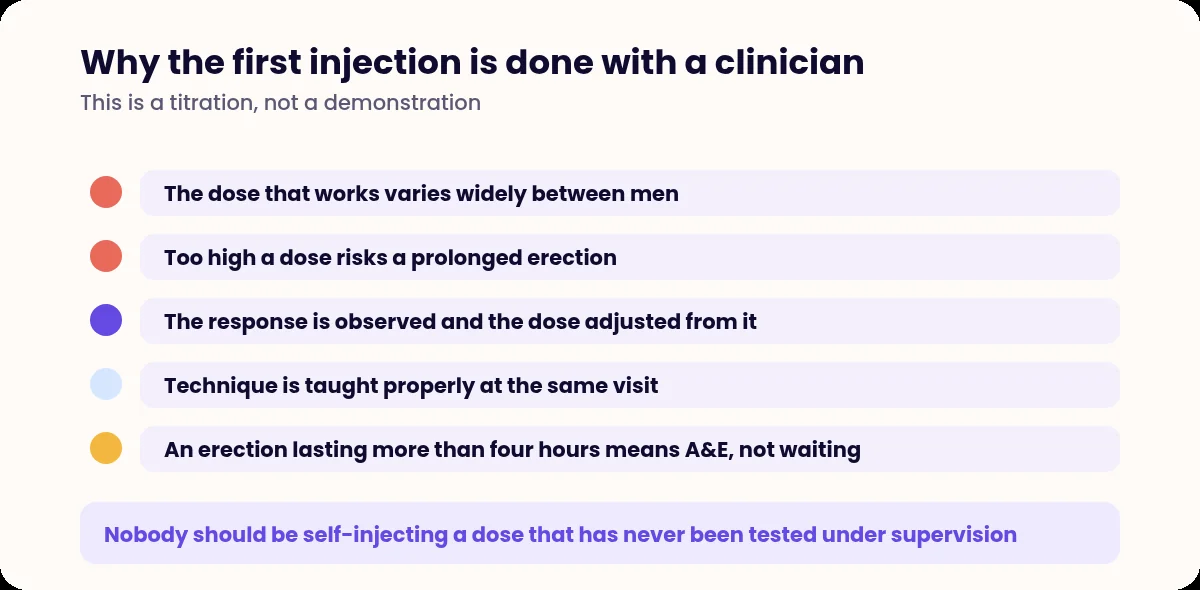
The first dose of an intracavernosal injection must be given under clinical supervision, and the dose must be titrated before any home use.
This is not a cautious suggestion. The UK product information states that initial injections “must be administered by medically trained personnel”, and that home injection follows only after proper training [1]. British guidance describes this in practice as typically two to three clinic visits to find the dose and teach technique [3].
The reason is straightforward. The dose that produces a usable erection in one man produces a four-hour erection in another, and there is no way to predict which from the outside. Titration under supervision is how that is found safely. A prescription for alprostadil obtained without a supervised first dose and titration has skipped the part of the process that keeps it safe.
What it is and how it is given
Alprostadil is a synthetic prostaglandin E1. Injected directly into one of the corpora cavernosa, it relaxes the smooth muscle of the erectile tissue and dilates the arteries supplying it, producing an erection independently of sexual stimulation and independently of the nitric oxide pathway that oral treatments rely on.
UK licensed intracavernosal products are Caverject and Caverject Dual Chamber (10 and 20 microgram strengths) and Viridal Duo (10, 20 and 40 micrograms). There is also Invicorp, a licensed non-alprostadil injection combining aviptadil with phentolamine, which is used where alprostadil causes unacceptable pain or does not work; it contains no prostaglandin and is generally less painful, but it is formulary-restricted in most integrated care boards [5].
The injection goes into the dorsolateral aspect of the proximal third of the shaft, alternating sides between doses. Visible veins are avoided, as is the midline on the top of the shaft, where the nerve and vessel bundle runs, and the midline underneath, where the urethra is [1].
Dosing
Starting doses depend on the cause of the erectile dysfunction [1]:
- Neurogenic causes: 1.25 micrograms.
- Vasculogenic, psychogenic or mixed causes: 2.5 micrograms, increasing to 5 micrograms if there is a partial response and 7.5 micrograms if there is none, then in increments of 5 to 10 micrograms.
Doses above 40 micrograms are not routinely justified. The maximum frequency is no more than once in 24 hours and no more than three times in a week [1].
An erection usually appears at 5 to 15 minutes and lasts around 30 to 40 minutes [2].
How well it works
European guidance puts the response rate at over 70%; British guidance at 70–80% in general erectile dysfunction, and higher where the cause is not vascular [2, 3]. Among medical treatments for erectile dysfunction this is the highest response rate available, and European guidance gives intracavernosal injection a strong recommendation for second-line use.
That efficacy sits alongside a dropout rate that is equally well documented: 41–68% stop over time in European data, and British guidance records up to half stopping within two to three months [2, 3]. Needles, spontaneity, cost and pain all contribute. Knowing this in advance is part of making an informed decision rather than a reason not to try.
Priapism — the emergency
Alprostadil produces an erection whether or not it is wanted, and if the dose is too high it can produce one that does not stop.
An erection lasting four hours or longer requires immediate medical attention. Go to A&E or call 999. NHS guidance gives the same instruction for any erection persisting beyond three to four hours [4]. Product information states that treatment should not be delayed more than six hours [1].
The numbers: prolonged erection of four to six hours occurs in about 4% of men, and priapism beyond six hours in about 0.4% [1]; European data quotes around 1% [2]. The reason for the urgency is that trapped blood becomes deoxygenated and the erectile tissue is progressively damaged. Risk of permanent erectile dysfunction rises sharply beyond 24 to 48 hours, and among men whose treatment is delayed, permanent inability to get an erection is described in the range of roughly 1 in 10 to 1 in 50.
Anyone starting injections should know this before the first dose, know where their nearest A&E is, and have a plan that does not involve waiting until morning.
Penile fibrosis and why review matters
Repeated injections into the same tissue can produce fibrosis — firm nodules or plaques in the erectile tissue, sometimes with curvature resembling Peyronie’s disease. Product information records about 3% in trials and around 8% in longer-term self-injection studies; European data quotes 2% [1, 2]. Our guide to Peyronie’s disease covers what that curvature looks like and when it needs assessment.
Mitigation is practical: rotate injection sites and alternate sides, apply compression for around five minutes after injecting, and stay within three doses a week [1].
This is why men on long-term injections need periodic clinical review rather than an indefinite repeat supply. Review is the point at which fibrosis is picked up by examination, technique is checked, dose creep is noticed, and the question of whether this is still the right treatment gets asked. Our guide to repeat prescriptions and reviews covers what that should involve.
Other effects and who should not use it
Penile pain is the commonest complaint: around 30% report it at least once, though European framing is more informative — about half of patients report pain, but only after around 11% of individual injections [1, 2]. Injection-site haematoma is recorded in about 3% and bruising in about 2% [1].
Contraindications listed in the product information include conditions predisposing to priapism — sickle cell disease or trait, myeloma, leukaemia, thrombocythaemia, polycythaemia — anatomical deformation of the penis or severe Peyronie’s disease, an existing penile implant, hypersensitivity, and men for whom sexual activity is inadvisable. Anticoagulant treatment calls for caution because of bleeding at the injection site [1].
Where injections sit in the pathway
Injections are a second-line option, considered after oral treatment has been given an adequate trial. Before moving on, it is worth checking whether the oral trial really was adequate — our guide to what to do when ED treatment is not working sets out what that means. Less invasive alprostadil routes exist and are covered in our guide to alprostadil cream and pellets, though they are less effective.
Frequently asked questions
Why can't the first injection be done at home?
The UK product information states that initial injections must be administered by medically trained personnel. Two things are happening at that appointment: the dose is being found, since the right dose varies enormously between men and an overdose can cause a prolonged erection, and injection technique is being taught. British guidance describes typically two to three clinic visits before home use.
What do I do if the erection will not go down?
If an erection lasts four hours or longer, go to A&E or call 999. Do not drive yourself if you can avoid it, and do not wait overnight. Treatment should not be delayed beyond six hours. The risk of permanent damage to erectile tissue rises steeply after 24 to 48 hours.
Does the injection hurt?
The needle itself is very fine. The more relevant issue is prostaglandin-related aching in the penis afterwards. Product information records that around 30 per cent of men report pain at least once; European data frames it more usefully, with about half of patients reporting pain but only after around 11 per cent of individual injections.
Can injections cause lasting changes to the penis?
Penile fibrosis — firm areas or nodules in the erectile tissue, sometimes with curvature — is recorded in about 3 per cent overall and around 8 per cent in longer-term self-injection studies. Rotating injection sites, compressing after the injection and not exceeding three doses a week reduce the risk, and it is one reason periodic review matters.
References
- Summary of Product Characteristics: Caverject Dual Chamber 10/20 micrograms. Electronic Medicines Compendium. www.medicines.org.uk/emc/product/3041/smpc
- European Association of Urology. Guidelines on Sexual and Reproductive Health: Management of Erectile Dysfunction. uroweb.org/guidelines/sexual-and-reproductive-health/chapter/managemen
- British Society for Sexual Medicine. Guidelines on the management of erectile dysfunction in men (2018). bssm.org.uk/wp-content/uploads/2023/02/BSSM-ED-guidelines-2018-1.pdf
- NHS. Priapism (painful erections). www.nhs.uk/symptoms/priapism-painful-erections/
- Scottish Medicines Consortium. Aviptadil/phentolamine mesilate (Invicorp) advice. scottishmedicines.org.uk/media/3091/aviptadil_phentolamine_mesilate_in
- British National Formulary. Alprostadil. bnf.nice.org.uk/drugs/alprostadil/
Medical reviewer
Naeem Teni
Clinical Lead at Manova. Registered pharmacist and independent prescriber, GPhC 2215591. Reviews Manova’s clinical content for accuracy and safety.
Written by
Manova Editorial Team
Researched and written to our editorial policy, using NICE, NHS, MHRA and peer-reviewed sources.
This article is for general information and isn’t a substitute for advice from your own clinician. If you feel unwell, contact your GP or NHS 111. In an emergency, call 999.