

Key takeaways
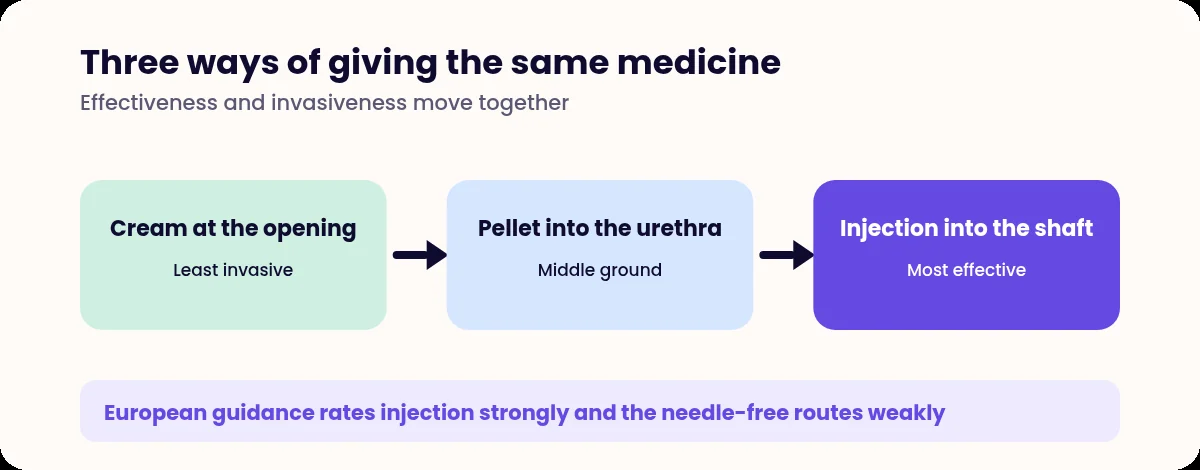
- Topical and intraurethral alprostadil are clearly less effective than injection, with response rates around 30 to 66 per cent against over 70 per cent.
- Vitaros cream delivers 300 micrograms to the urethral opening, works in 5 to 30 minutes and lasts about one to two hours.
- A condom must be used if the partner is a woman who could become pregnant, and partners commonly report vulvovaginal burning.
- European guidance rates topical alprostadil a weak recommendation, against a strong one for intracavernosal injection.
This page is medicine information rather than an advert. Alprostadil is a prescription only medicine in the UK, and whether it is suitable is a decision for a prescriber after an assessment.
Alprostadil can reach the erectile tissue without a needle, either as a cream applied to the opening of the urethra or as a small pellet inserted into it. Both routes exist for one reason: a substantial number of men who would benefit from alprostadil will not inject it.
The honest framing is a trade-off rather than an equivalence. These routes are less invasive and less effective, and the size of the gap is worth knowing before choosing.
The two UK products
Vitaros 3 mg/g cream delivers 300 micrograms of alprostadil to the urethral meatus using a single-dose applicator. Onset is 5 to 30 minutes and the effect lasts roughly one to two hours. It can be used a maximum of two to three times a week, and no more than once in any 24 hours [1].
MUSE is an intraurethral pellet available in 125, 250, 500 and 1000 microgram strengths, inserted a few centimetres into the urethra with a small applicator. It remains licensed in the UK, but supply has been intermittent over the years and current availability is worth confirming with a pharmacist or prescriber rather than assumed — the Specialist Pharmacy Service supply tool is the authoritative place to check [6]. A 2020 MHRA communication about MUSE related to a packaging anti-tamper seal defect and was not a withdrawal.
In both cases the drug is absorbed through the urethral lining and passes into the adjacent erectile tissue, where it relaxes smooth muscle and dilates the arteries. Rubbing the penis for a short period after application helps distribute it. As with the injected route, this does not depend on the nitric oxide pathway that oral treatments amplify, so it can work where those have not.
How effective they are
This is the part that determines whether the route is right for a given man.
MUSE: European data reports 30% to 65.9% achieving an erection adequate for intercourse; British guidance gives 30–60%, and notes that in practice only the 500 and 1000 microgram strengths are useful [3, 4]. The lower doses exist largely for titration.
Vitaros: 74% of men in the phase III programme reported improved erections. The NICE evidence summary puts the effect against placebo at +2.5 points on the erectile function domain of the IIEF and +15% more successful intercourse attempts [2]. Those are real but modest numbers, and the placebo-controlled framing is more informative than the headline percentage.
Against injection: intracavernosal injection produces a response in over 70% of men, with firmer erections [3]. European guidance reflects this directly in its recommendation strengths — strong for intracavernosal injection, weak for topical alprostadil. Our guide to alprostadil injections covers that route, including the supervised first dose it requires.
So: needle-free, no supervised titration appointment, no risk of injecting into the wrong structure — against a meaningfully lower chance of it working and a softer erection when it does. For a man who will not contemplate a needle, a 30 to 60 per cent chance of something usable is considerably better than nothing. For a man weighing the two routes purely on results, injection wins.
Side effects
For Vitaros, the common effects (affecting between 1 in 100 and 1 in 10 users) are local: penile burning, penile pain, redness and tingling [1]. Priapism is uncommon by this route, reported at around 0.4% in British guidance [4] — considerably lower than with injection, because far less drug reaches the erectile tissue.
For MUSE, penile pain is reported in 30 to 40% and dizziness in 2 to 10% [3, 4]. The dizziness reflects systemic absorption and is worth knowing about before standing up quickly.
Local burning is the commonest reason men stop. It is often worse with the first few uses.
Any erection lasting four hours or longer is a medical emergency — go to A&E or call 999. That instruction applies to every alprostadil product regardless of how low the risk is by a particular route.
The partner and pregnancy warnings
These appear in the product information and are routinely omitted from consumer material, which is why they are given their own section here.
Partners commonly experience vulvovaginal burning and vaginitis after exposure to alprostadil cream [1]. The drug is present at the meatus and transfers during intercourse. This is not rare and it is not imagined, and it is the sort of thing that causes a couple to abandon a treatment without ever understanding why it was uncomfortable.
A condom barrier must be used if the partner is a woman of childbearing potential [1]. Alprostadil is a prostaglandin, and prostaglandins act on the uterus; its use in pregnancy is not established as safe. The same principle applies to MUSE, where a condom is advised if the partner is pregnant.
Neither warning is a reason to avoid the treatment. Both are reasons to have the condom in the room before you start rather than discover the requirement afterwards.
Who these routes tend to suit
Men who have had an inadequate response to oral treatment but do not want to inject. Men who need something that works independently of the nitric oxide pathway. Men who want an option that requires no supervised titration appointment and no learning of an injection technique.
They suit less well where the erectile dysfunction is severe and vascular, where a firm erection is needed rather than an improved one, or where local burning has already proved intolerable.
Before moving to any second-line treatment, it is worth confirming that the first-line trial really was adequate — dose, timing, stimulation and number of attempts account for a large share of apparent failure, as our guide to when ED treatment is not working sets out. Our overview of ED treatments compared places all the options side by side.
Practicalities
Both products are single-use, supplied in individual applicators. Storage requirements differ between them and are specified in the product information supplied with the pack, which is worth reading rather than guessing at — it is one of the few places where getting it wrong quietly reduces how well the treatment works.
Neither should be shared, and neither is a substitute for finding out why the erectile dysfunction is happening in the first place.
Frequently asked questions
How is alprostadil cream different from the injection?
Same active substance, different route and a much lower dose reaching the erectile tissue. Cream is applied to the opening of the urethra and absorbed through the lining; injection puts the drug directly into the erectile tissue. The cream avoids the needle and the supervised titration, but produces weaker erections and works in fewer men.
How long does Vitaros take to work?
UK product information gives an onset of 5 to 30 minutes and a duration of roughly one to two hours. It can be used a maximum of two to three times a week and no more than once in any 24-hour period.
Why does my partner need to use a condom?
Two reasons. Alprostadil is a prostaglandin and its use in pregnancy is not established as safe, so a condom barrier is required if your partner is a woman of childbearing potential. Separately, partners commonly report vulvovaginal burning and vaginitis, and a condom reduces that too.
Is MUSE still available in the UK?
MUSE, the intraurethral pellet, remains licensed, but supply has been intermittent historically and current availability should be confirmed with a pharmacist or prescriber rather than assumed. A 2020 MHRA notice about MUSE concerned a packaging seal defect, not withdrawal of the product.
References
- Summary of Product Characteristics: Vitaros 3 mg/g cream. Electronic Medicines Compendium. www.medicines.org.uk/emc/product/13937/smpc
- NICE. Erectile dysfunction: alprostadil cream. Evidence summary ESNM50. www.nice.org.uk/advice/esnm50
- European Association of Urology. Guidelines on Sexual and Reproductive Health: Management of Erectile Dysfunction. uroweb.org/guidelines/sexual-and-reproductive-health/chapter/managemen
- British Society for Sexual Medicine. Guidelines on the management of erectile dysfunction in men (2018). bssm.org.uk/wp-content/uploads/2023/02/BSSM-ED-guidelines-2018-1.pdf
- British National Formulary. Alprostadil. bnf.nice.org.uk/drugs/alprostadil/
- Specialist Pharmacy Service. Medicines supply tool. sps.nhs.uk/category/medicines-tools/medicines-supply/
Medical reviewer
Naeem Teni
Clinical Lead at Manova. Registered pharmacist and independent prescriber, GPhC 2215591. Reviews Manova’s clinical content for accuracy and safety.
Written by
Manova Editorial Team
Researched and written to our editorial policy, using NICE, NHS, MHRA and peer-reviewed sources.
This article is for general information and isn’t a substitute for advice from your own clinician. If you feel unwell, contact your GP or NHS 111. In an emergency, call 999.