

Key takeaways
- An adequate trial means at least four and preferably eight attempts at the maximum tolerated dose, of at least two different medicines used in sequence.
- Inadequate counselling is identified in UK guidance as the major cause of apparent non-response — dose, timing and stimulation account for most of it.
- Oral treatments do not start an erection; without sexual stimulation they do nothing, and this is frequently never explained.
- Erectile dysfunction typically precedes a cardiac event by three to five years, so a non-response is also a prompt for cardiovascular assessment.
Most men who conclude that erectile dysfunction treatment does not work for them are wrong, and the reason is not stubbornness. It is that the conditions for a fair trial were never set up.
British guidance is unusually blunt about this. It identifies inadequate counselling as the major cause of apparent non-response, and European guidance agrees that patient education can salvage an apparent non-responder [1, 3]. Before anything changes, it is worth working through what a proper attempt actually looks like.
What counts as an adequate trial
UK guidance defines it precisely [1]:
- A minimum of four, and preferably eight, doses
- at the maximum tolerated dose
- of at least two different PDE5 inhibitors, used one after the other
- with a review within six weeks of starting.
Read that against what most men actually do: two tablets at the starting dose, one of them after a large meal, and a decision. That is not a failed treatment. That is an incomplete one.
The five things to check, in order
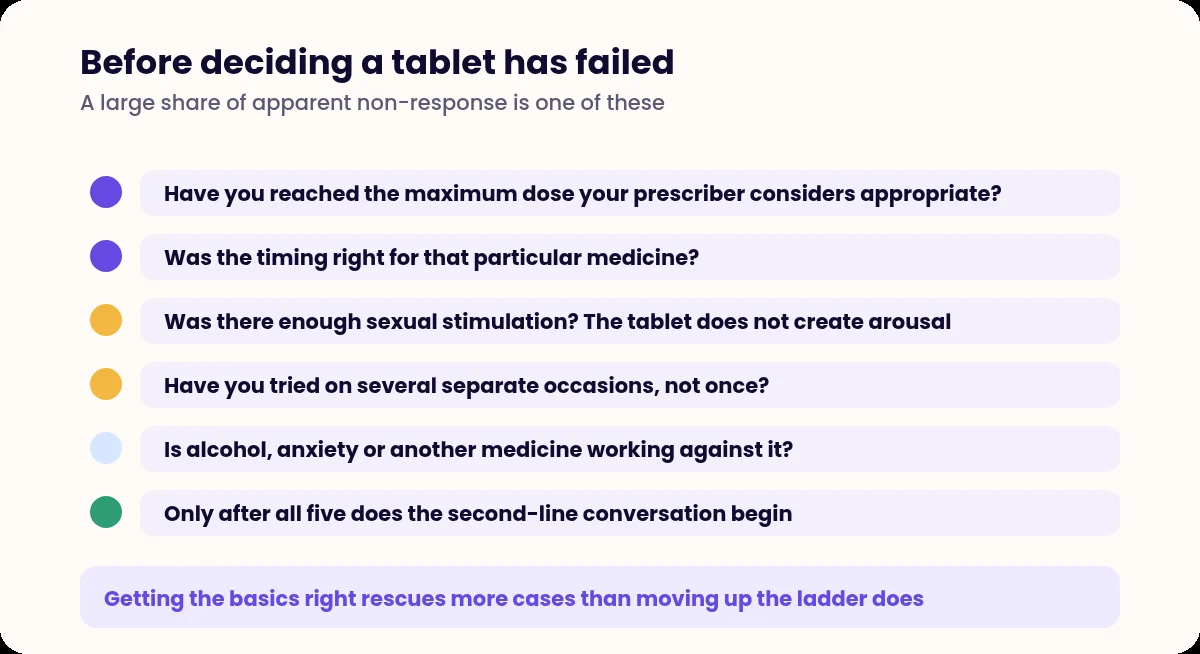
1. Dose
The commonest correctable factor, and the easiest. Starting doses exist to check tolerability. They are not the effective dose for everybody, and a great many men are never titrated up at all — they take the dose they were first given, it does little, and that is the end of it.
Every PDE5 inhibitor has a licensed maximum, and an adequate trial means reaching the highest dose you tolerate before concluding anything. If a starting dose produced nothing whatsoever, going up is usually the next step rather than switching or stopping. Raise it with whoever prescribed it.
2. Timing, food and alcohol
Onset varies between the medicines in this class, from around 15 minutes at the fast end to an hour at the slow end. Taking a tablet fifteen minutes before sex when it needs an hour will look exactly like non-response.
Most of these medicines are also delayed by a high-fat meal — one of them is a notable exception, which is precisely why it suits men who eat late. Alcohol works against an erection in its own right and compounds the problem. Both are worth removing from the equation while you work out whether the dose and timing are right.
3. Sexual stimulation
This is the one that produces the most “nobody told me”.
PDE5 inhibitors do not initiate an erection. They amplify and prolong a chemical signal that sexual arousal produces. Without stimulation, there is no signal to amplify, and the tablet does nothing at all. A man who takes one, sits down and waits to see what happens will report, entirely accurately, that it did not work.
Our guide to how PDE5 inhibitors work sets out the mechanism, and it is worth reading if this is news.
4. Number of attempts
Response improves over repeated attempts. Part of that is practical learning about dose and timing; part of it is that the first few occasions carry an enormous weight of expectation, and anxiety is physiologically opposed to erection.
Four attempts is the floor. Eight is better. Our guide to performance anxiety and erections explains why the early attempts are the hardest ones and what helps take the pressure out of them.
5. Untreated testosterone deficiency
A genuine cause of poor response, and checkable. British guidance advises measuring a fasting morning total testosterone before 11 a.m., repeating it with LH and prolactin if it is below 8 nmol/L or in the borderline 8–12 range [1]. The threshold for correcting deficiency is below 10.4 nmol/L, or up to 12 nmol/L where desire is also low.
Testosterone is not a treatment for erectile dysfunction in men with normal levels, and age alone is not a diagnosis. But an untreated deficiency will blunt the response to everything else. A single afternoon sample proves nothing, which is why the timing of the test is specified.
The other things that get missed
- Partner and relationship factors. Unresolved conflict, a partner’s own sexual difficulty, or simply not wanting to be there. No medicine addresses any of these.
- Depression and anxiety, and some of the medicines used to treat them.
- Untreated comorbidity — diabetes, high blood pressure, sleep apnoea.
- Cost and supply. Men ration tablets, which guarantees too few attempts.
- Drug interactions, including nitrates and nicorandil, which rule the whole class out rather than reducing its effect.
Before abandoning tablets
Two escalations are worth trying before moving off oral treatment entirely.
Switch molecule. The definition of an adequate trial specifically requires at least two different PDE5 inhibitors. They are not interchangeable in practice, and men who get nothing from one sometimes do well on another.
Switch to a daily regimen. Taking a low dose of a long-acting PDE5 inhibitor every day rather than on demand changes the whole model — there is no tablet to plan around and no clock. Our guide to daily versus on-demand dosing explains what that involves and who it suits.
Both of these are prescriber decisions, and both are worth raising explicitly rather than waiting to be offered.
The onward pathway, honestly
If a genuinely adequate trial has failed, the established sequence is [1, 3]:
Second line — injections into the erectile tissue, which European guidance rates a strong recommendation and which have the highest response rate of any medical treatment; alprostadil given by injection covers what that involves, including the supervised first dose it requires. Needle-free cream and pellet routes, and vacuum devices, are both rated weak — less effective, less invasive.
Third line — a penile implant, rated strong, and permanent. It destroys the erectile tissue, so nothing else works afterwards.
One thing to treat sceptically: low-intensity shockwave therapy is a weak recommendation in European guidance, is not NHS-funded, and the evidence remains contested. It is marketed in the UK considerably more confidently than the data support.
The check nobody asks for but everybody needs
A man whose erections have stopped responding has a vascular finding, not just a sexual one.
British guidance is direct: erectile dysfunction typically precedes a cardiac event by three to five years, and carries a risk comparable to moderate current smoking [1]. Every man presenting with erectile dysfunction — and particularly one whose treatment is not working — needs blood pressure, lipids, HbA1c or glucose, and a cardiovascular risk assessment. Our guide to ED and heart disease explains why the penile arteries show trouble first.
When to ask for a specialist referral
Ask your GP for referral to urology or andrology if: the erectile dysfunction has been lifelong and you are young; it followed pelvic or perineal trauma; a venous leak is suspected; there is penile curvature or a testicular abnormality; medical treatment has failed and you are interested in surgery; or you want the cause investigated rather than managed.
Frequently asked questions
How many times should I try a tablet before deciding it doesn't work?
UK guidance sets the threshold at a minimum of four attempts and preferably eight, at the maximum tolerated dose, before anyone is labelled a non-responder. Response genuinely improves across repeated attempts, partly because expectation and anxiety settle. Two disappointing goes is not a trial.
Why would the dose matter if the low one did nothing at all?
Because PDE5 inhibitors are dose-dependent and a great many men are never titrated upwards. Starting doses exist to check tolerability, not because they are the effective dose for everyone. If a starting dose has produced nothing, the next step is usually to go up rather than to switch or stop.
Do I still need stimulation if I've taken a tablet?
Yes, and this is one of the commonest reasons a tablet appears to fail. PDE5 inhibitors amplify a signal that sexual stimulation creates; they do not create it. Taking one and waiting for something to happen will produce nothing. It is a simple point and it is regularly not explained.
When should I be referred to a specialist?
Referral to urology or andrology is appropriate for lifelong ED in a young man, ED after pelvic or perineal trauma, suspected venous leak, penile curvature or a testicular abnormality, failure of medical treatment where surgery is being considered, or where you want the cause properly investigated.
References
- British Society for Sexual Medicine. Guidelines on the management of erectile dysfunction in men (2018). bssm.org.uk/wp-content/uploads/2023/02/BSSM-ED-guidelines-2018-1.pdf
- British Society for Sexual Medicine. Erectile Dysfunction Practical Guide. bssm.org.uk/wp-content/uploads/2024/05/ED-Practical-Guide-v3-for-BSSM.
- European Association of Urology. Guidelines on Sexual and Reproductive Health: Management of Erectile Dysfunction. uroweb.org/guidelines/sexual-and-reproductive-health/chapter/managemen
- NHS. Erection problems (erectile dysfunction). www.nhs.uk/conditions/erection-problems-erectile-dysfunction/
- Community Pharmacy England. Revisions to SLS list for October 2025. cpe.org.uk/our-news/revisions-to-sls-list-for-october-2025/
Medical reviewer
Naeem Teni
Clinical Lead at Manova. Registered pharmacist and independent prescriber, GPhC 2215591. Reviews Manova’s clinical content for accuracy and safety.
Written by
Manova Editorial Team
Researched and written to our editorial policy, using NICE, NHS, MHRA and peer-reviewed sources.
This article is for general information and isn’t a substitute for advice from your own clinician. If you feel unwell, contact your GP or NHS 111. In an emergency, call 999.