

Key takeaways
- UK Chief Medical Officers state that diet is the important factor in weight management and physical activity plays a supporting role.
- Exercise trials consistently produce less weight loss than the energy burned would predict, because of compensation.
- Activity is the strongest predictor of keeping weight off, and improves health whether or not weight changes.
- The 2026 guidelines add a specific recommendation to prioritise strength work if you are taking a GLP-1 medicine.
There is a version of this article that tells you which exercise burns the most calories per hour. It would be accurate and almost useless, because calories burned in a session is not what determines whether you lose weight.
Start with the uncomfortable sentence
The UK Chief Medical Officers’ physical activity guidelines, updated in July 2026, say this about weight:
Diet is the important factor in weight management. Physical activity plays a supporting role in maintaining a healthy weight. [1]
That is the national physical activity guidance saying that physical activity is not the main lever for weight. It is worth sitting with before choosing a programme.
Why exercise under-delivers on the scales
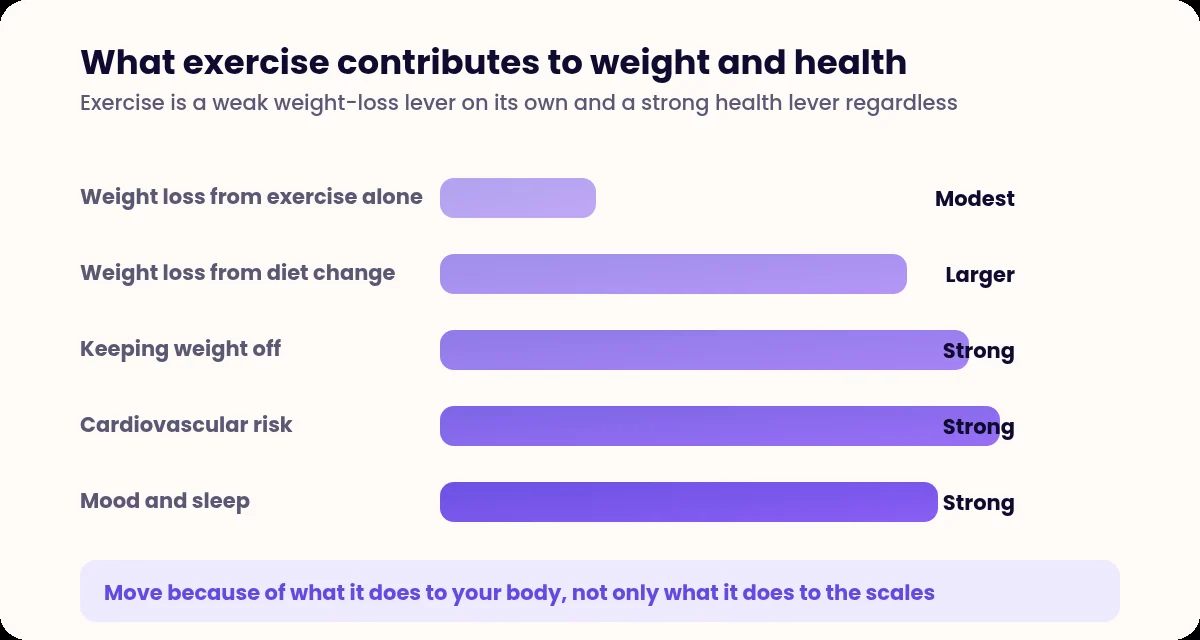
If you burn 400 calories in a session, four times a week, arithmetic predicts a substantial monthly weight loss. Trials consistently find far less than predicted [2].
Two mechanisms explain most of the gap.
Compensatory eating. Appetite rises, and the size of the rise is usually enough to offset a meaningful share of what was burned. This is not weakness — it is a regulated system doing its job.
Reduced movement elsewhere. After a hard session people sit more, take the lift, fidget less. This non-exercise activity is invisible and can account for hundreds of calories.
The honest expectation from exercise alone is 1 to 3 kg over several months. The IDEA trial makes the point starkly: adults with knee osteoarthritis who exercised alone lost 2% of body weight over 18 months, while those who dieted and exercised lost 11.4% [3].
So why exercise at all
Because weight is not the only thing worth changing, and because of what happens afterwards.
It predicts keeping weight off. High levels of activity appear repeatedly in cohorts of people who have maintained large losses for years [4]. Diet gets weight off; activity is disproportionately represented in the people who keep it off.
It changes what you lose. Resistance training plus adequate protein shifts the balance of weight lost towards fat rather than muscle.
It works independently of weight. Blood pressure, blood lipids, insulin sensitivity, mood, sleep, balance, function and mortality risk all improve with activity whether or not the scales move.
What to actually do
Resistance training, twice a week
The item most often skipped and the one with the most specific benefit while dieting. Two 30-minute sessions covering push, pull, squat, hinge and carry. See strength training over 40.
The 2026 guidelines add a new and directly relevant point: people taking GLP-1 medicines for weight management should prioritise muscle-strengthening activity to limit muscle loss [1].
Walking, most days
Cheap, joint-friendly, and it raises daily energy expenditure without provoking the compensation that hard sessions do. Most of the health return arrives well before 10,000 steps.
Something harder, if you enjoy it
Intervals, classes, sport, cycling. Not because high intensity uniquely melts fat, but because enjoyment predicts adherence and adherence predicts everything.
If you have joint pain or a lot of weight to lose
Water-based exercise, a static bike, seated or supported resistance work, and walking built up gradually. NICE treats therapeutic exercise and weight management as the core treatments for osteoarthritis, not optional extras.
The comparison that matters
| Burns most in the session | Protects muscle | Predicts maintenance | Easiest to sustain | |
|---|---|---|---|---|
| Running / HIIT | Yes | Partly | Yes | Varies |
| Resistance training | No | Yes | Yes | Moderate |
| Walking | No | No | Yes | Yes |
No row wins. The combination people actually keep doing wins.
When to speak to a clinician
Get advice before starting if you:
- have chest pain, or breathlessness that is new or worse than usual
- have had a recent cardiac event, operation or joint replacement
- have uncontrolled high blood pressure
- have type 1 or type 2 diabetes on insulin or a sulfonylurea, where activity changes hypoglycaemia risk
- feel faint or unusually short of breath on mild exertion
Frequently asked questions
What is the best exercise for losing weight?
The one you will keep doing. Across trials, differences between exercise types are small compared with differences in adherence. If forced to choose a combination, resistance training twice a week plus regular walking covers the most ground.
Why am I exercising and not losing weight?
Two well-documented effects. People tend to eat somewhat more after exercise, and they tend to move less during the rest of the day without noticing. Together these can cancel out most of the energy burned in a session.
Is cardio or weights better for fat loss?
Cardio burns more during the session. Weights protect the muscle you would otherwise lose while dieting, which changes what the weight you lose is made of. Most people benefit from both, and weights are the one more often skipped.
How much exercise do I need?
UK guidelines ask for at least 150 minutes of moderate activity a week, or 75 minutes of vigorous, plus muscle-strengthening on at least two days. For weight loss specifically, more activity helps, but diet does the heavier lifting.
References
- UK Chief Medical Officers. Physical activity guidelines. Updated 10 July 2026. www.gov.uk/government/publications/physical-activity-guidelines-uk-chi
- Thomas DM, Bouchard C, Church T, et al. Why do individuals not lose more weight from an exercise intervention at a defined dose? An energy balance analysis. Obesity Reviews. 2012;13(10):835-847. doi.org/10.1111/j.1467-789X.2012.01012.x
- Messier SP, Mihalko SL, Legault C, et al. Effects of intensive diet and exercise on knee joint loads, inflammation, and clinical outcomes among overweight and obese adults with knee osteoarthritis: the IDEA randomized clinical trial. JAMA. 2013;310(12):1263-1273. doi.org/10.1001/jama.2013.277669
- Wing RR, Phelan S. Long-term weight loss maintenance. American Journal of Clinical Nutrition. 2005;82(1 Suppl):222S-225S. doi.org/10.1093/ajcn/82.1.222S
Medical reviewer
Naeem Teni
Clinical Lead at Manova. Registered pharmacist and independent prescriber, GPhC 2215591. Reviews Manova’s clinical content for accuracy and safety.
Written by
Manova Editorial Team
Researched and written to our editorial policy, using NICE, NHS, MHRA and peer-reviewed sources.
This article is for general information and isn’t a substitute for advice from your own clinician. If you feel unwell, contact your GP or NHS 111. In an emergency, call 999.