

Key takeaways
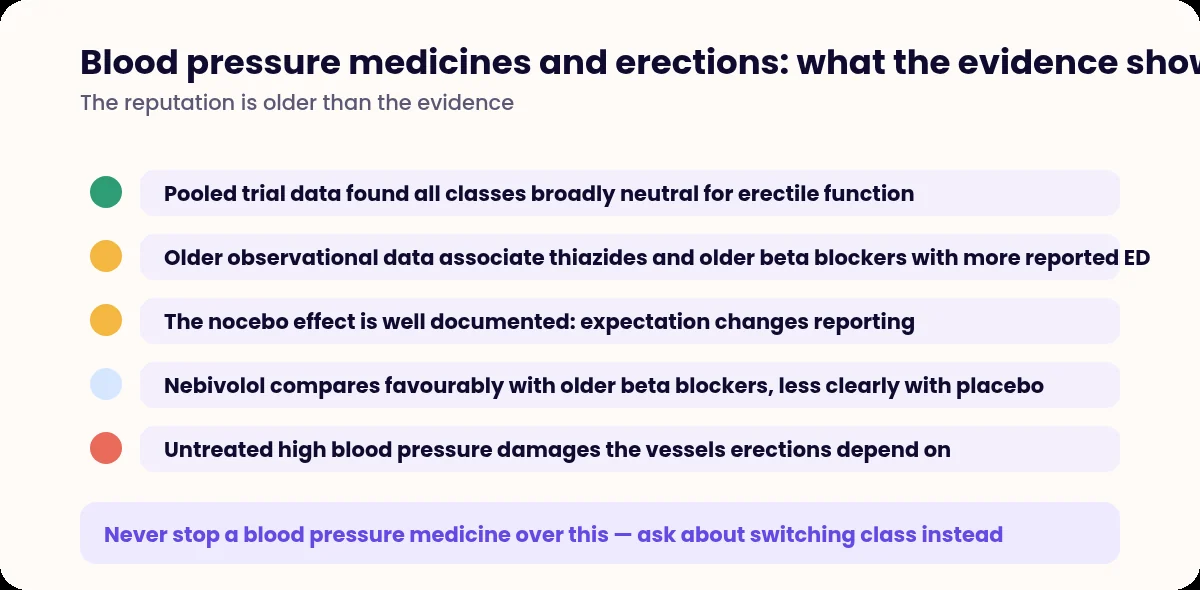
- A network meta-analysis of randomised trials found all the main antihypertensive classes had neutral or insignificant effects on erectile function, with no significant differences between them.
- Older observational data associate thiazides and older non-vasodilating beta blockers with more reported erection problems, but that evidence is weaker than most articles imply.
- The nocebo effect is well documented here: men told a beta blocker causes erection problems report more of them.
- Untreated high blood pressure damages the endothelium and causes erectile dysfunction in its own right, so stopping treatment is the worst available response.
If you search this question you will find the same two answers everywhere: beta blockers and water tablets cause erection problems, and the other classes do not. It is one of the most confidently repeated claims in men’s health writing.
The pooled randomised data do not support it.
That is not a reason to dismiss what you have noticed. It is a reason to have a more useful conversation than “come off the beta blocker” — because the thing most likely to harm your erections in the long run is untreated high blood pressure.
What the trial evidence actually found
A network meta-analysis published in Cardiovascular Drugs and Therapy in 2021 pooled the randomised evidence across antihypertensive classes and concluded that they exert neutral or insignificant effects on erectile function, with no significant differences in pairwise comparisons between ACE inhibitors, angiotensin receptor blockers, beta blockers, calcium channel blockers and thiazides [1].
That is a genuinely surprising result if you have read the standard advice, so it deserves a caveat of its own: risk of bias was rated concerning or high in most of the included studies. This is not a field with a deep bench of large, well-designed, sexual-function-focused trials. The honest summary is that the randomised evidence does not show a class effect, rather than that a class effect has been definitively ruled out.
Where the reputation came from
Two things.
Older observational data. The Treatment of Mild Hypertension Study and similar work associated thiazide diuretics, and the older non-vasodilating beta blockers such as propranolol, atenolol and metoprolol, with more reported erectile dysfunction [2]. Observational data of this kind cannot easily separate the drug from the disease, the age of the men taking it, or the reason it was prescribed.
The nocebo effect, which is unusually well documented here. In studies where men were told that the beta blocker they were starting could cause erectile dysfunction, reported rates rose. Where men were not told, rates were lower. Same drug. The expectation itself produces the symptom, and once you have noticed a problem in the bedroom, anxiety is more than capable of maintaining it — as our article on performance anxiety and erections explains.
This is awkward to write about, because it can read as dismissing men’s experience. It is not that. The symptom is real. It is the attribution that is less secure than it looks.
The one class comparison worth knowing
Vasodilating beta blockers behave differently from the older ones in head-to-head data. Nebivolol compared with non-vasodilating beta blockers gave an odds ratio of 2.92 favouring erectile function, with a confidence interval of 1.3 to 6.5 [1].
Against placebo, though, the same comparison gave an odds ratio of 2.87 with a confidence interval of 0.75 to 11.04 — which crosses 1 and is therefore not statistically significant. So the fair reading is: it may be better than the older beta blockers, and that is not the same as being shown to be better than nothing.
ACE inhibitors and angiotensin receptor blockers are generally regarded as neutral to favourable, but again on weak evidence.
The thing that is not in dispute
Untreated hypertension damages endothelial function. Endothelial cells produce the nitric oxide that triggers the smooth muscle relaxation an erection depends on. Damage that system and erections deteriorate — which is why erectile dysfunction is common in men with high blood pressure regardless of what they are taking for it.
It also sits in a wider picture. Erectile dysfunction is recognised as an early marker of arterial disease, typically appearing several years before a cardiovascular event. Our article on ED and heart disease covers what that means and when sexual activity itself needs assessing.
So the calculation is not “drug versus no drug for my erections”. It is “controlled blood pressure versus uncontrolled blood pressure”, and uncontrolled loses on both the cardiovascular and the sexual side.
Never stop your blood pressure medicine to fix this
This is the part to take away from the whole article.
Stopping an antihypertensive without medical advice raises your risk of stroke and heart attack, and in the case of some medicines — beta blockers in particular — abrupt withdrawal carries its own specific risks. It is also unlikely to achieve what you want, for all the reasons above.
What to do instead: keep taking it, and book a routine GP or pharmacist appointment specifically to discuss it. Say clearly that you have noticed a change in erectile function since starting or changing a blood pressure medicine, and that you want to keep your blood pressure controlled while exploring whether a different class or a different agent within the class would suit you better.
That conversation has real options in it. Switching class, switching within class, adjusting doses, or reducing the number of agents by improving the things that raised your blood pressure in the first place — our guide to weight loss and blood pressure covers how much difference that can make.
What else to check while you are there
Erectile dysfunction in a man on antihypertensives is worth a proper look rather than an assumption:
- Timing. Did it genuinely start within weeks of the medicine, or had it been developing before? Most men are less certain than they think once asked directly.
- Other medicines. Antidepressants, antipsychotics, opioids and finasteride are all more strongly associated with sexual side effects than antihypertensives are.
- Metabolic checks. HbA1c, lipids and a morning fasting testosterone.
- Alcohol, sleep and mood. Sleep apnoea is common in men with hypertension and affects both blood pressure and sexual function.
- Smoking status. The dose-response relationship between smoking and erectile dysfunction is one of the more solid findings in this field, and our overview of what causes erectile dysfunction puts it alongside the others.
When it needs more than a conversation
Chest pain or breathlessness on exertion needs a same-week GP appointment, or 999 if it is new and severe. A blood pressure reading of 180/120 or above with symptoms such as chest pain, breathlessness, headache or visual change needs urgent same-day assessment.
Otherwise this is a routine appointment, not an emergency — but a routine appointment you should actually make, rather than quietly halving the dose.
Frequently asked questions
Do beta blockers cause erectile dysfunction?
Less clearly than their reputation suggests. Pooled randomised trial data found no significant difference between beta blockers and other antihypertensive classes for erectile function. Older observational studies did associate the older non-vasodilating beta blockers with more reported problems, and nocebo effects appear to account for part of that. If you noticed a change after starting one, it is still worth raising.
Should I stop my blood pressure tablets if my erections have got worse?
No. Stopping antihypertensive treatment raises your risk of stroke and heart attack, and untreated high blood pressure damages the blood vessels erections depend on. Keep taking it and book an appointment to discuss switching class or adjusting the regimen while your blood pressure stays controlled.
Which blood pressure medicines are least likely to affect erections?
The evidence is weak, but ACE inhibitors and angiotensin receptor blockers are generally regarded as neutral to favourable, and among beta blockers the vasodilating ones compare favourably with the older non-vasodilating ones in head-to-head data. Against placebo that advantage was not statistically significant, so treat the claim cautiously.
Could the high blood pressure itself be the cause?
Very likely, at least in part. Hypertension damages endothelial function, and endothelial function is what produces the nitric oxide an erection depends on. Erectile dysfunction is also an early marker of arterial disease more broadly, which is why a new problem is worth investigating rather than blaming on the prescription.
References
- Network meta-analysis of antihypertensive drug classes and erectile function. Cardiovascular Drugs and Therapy, 2021. link.springer.com/guides/10557
- Grimm RH et al. Treatment of Mild Hypertension Study (TOMHS): long-term effects on sexual function. Hypertension. www.ahajournals.org/guides/hyp
- NICE. Hypertension in adults: diagnosis and management. NG136. www.nice.org.uk/guidance/ng136
- NICE Clinical Knowledge Summaries. Erectile dysfunction. cks.nice.org.uk/topics/erectile-dysfunction/
- NHS. High blood pressure (hypertension). www.nhs.uk/conditions/high-blood-pressure-hypertension/
- British Society for Sexual Medicine. Guidelines on the management of erectile dysfunction in men. www.bssm.org.uk/guidelines/
Medical reviewer
Naeem Teni
Clinical Lead at Manova. Registered pharmacist and independent prescriber, GPhC 2215591. Reviews Manova’s clinical content for accuracy and safety.
Written by
Manova Editorial Team
Researched and written to our editorial policy, using NICE, NHS, MHRA and peer-reviewed sources.
This article is for general information and isn’t a substitute for advice from your own clinician. If you feel unwell, contact your GP or NHS 111. In an emergency, call 999.