

Key takeaways
- Delayed ejaculation affects roughly 1 to 4% of men, becomes more common with age, and is the least studied of the male sexual dysfunctions.
- Unlike premature ejaculation there is no agreed time threshold, so the diagnosis rests on frequency, persistence and distress rather than a stopwatch.
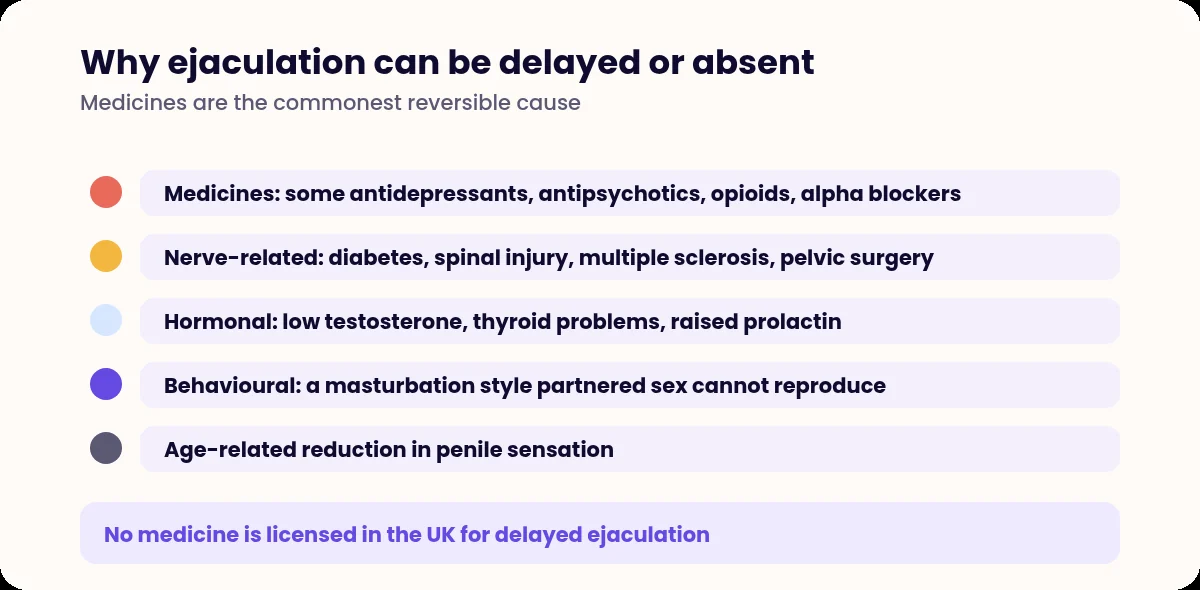
- Medicines are the commonest reversible cause, particularly SSRIs, SNRIs, antipsychotics, opioids and alpha blockers.
- No medicine is licensed in the UK for delayed ejaculation, and the off-label options all rest on small or uncontrolled evidence.
Premature ejaculation has guidelines, a licensed medicine, a one-minute definition and a great deal of research behind it. Delayed ejaculation has almost none of that. It is the least studied of the male sexual dysfunctions, and men who have it usually find very little written for them.
It affects roughly 1 to 4% of men, becomes more common with age, and can be intensely distressing — particularly where a couple are trying to conceive, or where a partner interprets it as a lack of attraction.
What counts as delayed ejaculation
The definition is marked delay in, infrequency of, or complete absence of ejaculation despite adequate sexual stimulation and the desire to ejaculate, causing distress. DSM-5-TR requires this on approximately 75 to 100% of occasions over at least six months [3].
Notice what is missing: a time. Unlike premature ejaculation, there is no consensus latency threshold [1]. Figures above 20 to 25 minutes are commonly quoted, but they are convention rather than a diagnostic standard. The diagnosis rests on frequency, duration and distress.
It is also worth distinguishing three things that get lumped together:
- Delayed ejaculation — it happens, eventually, with prolonged effort.
- Anejaculation — it does not happen at all.
- Retrograde ejaculation — orgasm occurs but semen passes backwards into the bladder, so little or none appears.
These have overlapping but different causes, and telling a clinician which one you have shortens the process considerably.
The causes
Medicines — the first thing to check
This is the commonest reversible cause, and the list is long:
- SSRIs, with paroxetine generally reported as the most likely to delay ejaculation. The effect is so reliable that certain SSRIs are used off-label in the UK to treat premature ejaculation, as our article on what causes premature ejaculation describes.
- SNRIs.
- Antipsychotics.
- Opioids.
- Alpha blockers, used for prostate symptoms. Tamsulosin is the common example and causes retrograde as well as delayed ejaculation.
- Thiazide diuretics.
- Alcohol, both acutely and chronically.
Never stop a prescribed medicine because of this. Raise it with your prescriber, who can often switch to an alternative within the same class or a different one.
Neurological
Diabetic autonomic neuropathy, spinal cord injury, multiple sclerosis and previous pelvic or prostate surgery all interrupt the pathways involved. Diabetes is a common and frequently missed contributor, and in men with diabetes the ejaculatory problem often sits alongside erectile difficulty — our overview of what causes erectile dysfunction covers how the two overlap.
Endocrine
Testosterone deficiency, hypothyroidism and raised prolactin. All are checkable with a straightforward blood panel — a morning fasting total testosterone, thyroid function and prolactin.
Psychological and behavioural
This group is large and under-recognised.
Idiosyncratic masturbation style. A high-pressure grip, an unusual technique, prone positioning or a very high frequency can train the ejaculatory reflex to respond to a specific stimulus that partnered sex cannot reproduce. It is one of the most common findings in younger men with this problem, and it is treatable.
Performance pressure. Particularly acute for couples trying to conceive, where sex becomes a task with a deadline. Our article on performance anxiety and erections covers the same mechanism operating on a different part of the response.
Partner and relationship factors, including unspoken ambivalence about the relationship or about conception.
Age
Penile sensory sensitivity declines gradually with age, and ejaculatory latency lengthens as a result. This is part of normal ageing and only becomes a problem when it crosses into distress. It is also why a man in his sixties comparing himself with his twenties is often comparing against a baseline that no longer exists.
What a UK assessment looks like
There is no NICE guidance on delayed ejaculation, which tells you something about how neglected it is. In practice a reasonable assessment covers:
- A full drug history, prescribed and otherwise, with timings relative to symptom onset.
- Whether the problem is lifelong or acquired, and whether it is global or situational — solo versus partnered is the single most informative question.
- A specific question about masturbation technique and frequency, asked without embarrassment on either side.
- Bloods: morning fasting total testosterone, prolactin, thyroid function and HbA1c.
- Examination for neurological signs and, where relevant, a post-orgasm urine sample to look for sperm if retrograde ejaculation is suspected.
- Screening for depression and for relationship difficulty.
Treatment
Start with the honest headline: no medicine is licensed in the UK for delayed ejaculation [4]. That shapes everything below.
Change or stop the causative drug. Where a medicine is responsible, switching agent is the highest-yield intervention available. This is a prescriber decision.
Treat endocrine causes. Correcting hypothyroidism or a raised prolactin can resolve the problem entirely where one of those is the driver.
Psychosexual therapy. The mainstay, and genuinely effective in the behavioural group. Masturbation retraining — deliberately shifting technique towards something partnered sex can reproduce — is the core intervention where an idiosyncratic style is involved. Therapy also addresses performance pressure and partner dynamics. In the UK, look for a COSRT-registered therapist, or ask your GP about local psychosexual services.
Vibratory stimulation. Increasing the intensity of stimulation using a medical-grade vibrator applied to the frenulum can be effective, particularly where reduced sensitivity is contributing, and is used routinely in spinal cord injury services.
Off-label medicines. Cabergoline, bupropion, amantadine, oxytocin and buspirone have all been tried. The evidence behind every one of them is small, largely uncontrolled, and would not meet the standard applied to a licensed indication. They are specialist decisions and worth approaching with realistic expectations.
When to see someone
See a clinician if this has persisted for more than six months and is causing distress, if it started after a new medicine, if you and your partner are trying to conceive, or if it is accompanied by numbness, weakness, bladder symptoms or other neurological changes — the last of those warrants a same-week GP appointment rather than a wait-and-see.
And if the problem is a dry orgasm rather than a delayed one, say that explicitly. It sends the assessment in a different and usually quicker direction.
Frequently asked questions
How long is too long before ejaculation?
There is no agreed cut-off. Unlike premature ejaculation, which has a widely used one-minute threshold, delayed ejaculation has no consensus time. Figures above 20 to 25 minutes are commonly cited but are not a diagnostic standard. What defines the problem is that the delay or absence happens on most occasions, has lasted at least six months, and causes distress.
Which medicines cause delayed ejaculation?
SSRIs are the commonest, with paroxetine generally reported as the most likely to delay ejaculation. SNRIs, antipsychotics, opioids, thiazide diuretics and alcohol are also implicated. Alpha blockers used for prostate symptoms, including tamsulosin, cause both delayed and retrograde ejaculation. Never stop a prescribed medicine yourself — ask your prescriber whether an alternative exists.
Is dry orgasm the same as delayed ejaculation?
No, though they are easily confused. In retrograde ejaculation semen passes backwards into the bladder, so orgasm occurs normally but little or no semen appears. Common causes are alpha blockers, diabetic autonomic neuropathy and previous prostate surgery. It matters mainly for fertility, and it points at a different set of causes.
Can masturbation habits cause it?
They can contribute. A high-pressure grip, an unusual technique or very high frequency can establish a pattern of stimulation that partnered sex cannot reproduce. This is one of the more common findings in younger men with delayed ejaculation, and masturbation retraining as part of psychosexual therapy is the usual approach to it.
References
- American Urological Association / Sexual Medicine Society of North America. Disorders of Ejaculation guideline. www.auanet.org/guidelines
- European Association of Urology. Guidelines on Sexual and Reproductive Health. uroweb.org/guidelines/sexual-and-reproductive-health
- American Psychiatric Association. Diagnostic and Statistical Manual of Mental Disorders, Fifth Edition, Text Revision. www.psychiatry.org/psychiatrists/practice/dsm
- British National Formulary. bnf.nice.org.uk/
- NHS. Ejaculation problems. www.nhs.uk/conditions/ejaculation-problems/
- British Society for Sexual Medicine. Guidelines. www.bssm.org.uk/guidelines/
Medical reviewer
Naeem Teni
Clinical Lead at Manova. Registered pharmacist and independent prescriber, GPhC 2215591. Reviews Manova’s clinical content for accuracy and safety.
Written by
Manova Editorial Team
Researched and written to our editorial policy, using NICE, NHS, MHRA and peer-reviewed sources.
This article is for general information and isn’t a substitute for advice from your own clinician. If you feel unwell, contact your GP or NHS 111. In an emergency, call 999.