
Key takeaways
- Around 52.5% of men with diabetes have erectile dysfunction, roughly three and a half times the rate in men without it.
- The cause is usually a combination of nerve damage, blood vessel damage and a higher rate of testosterone deficiency, not one single mechanism.
- Tablets still help most men with diabetes, but the response rate is measurably lower than in men without diabetes, and poor glycaemic control makes that worse.
- Erectile difficulty in a man with diabetes is a cardiovascular warning sign and should prompt checks of blood pressure, lipids, HbA1c and mood.
Erectile dysfunction is one of the commonest complications of diabetes and one of the least often raised. A pooled analysis of 145 studies found it in around 52.5% of men with diabetes — roughly three and a half times the rate in men without [2].
It also tends to arrive earlier, respond less well to the standard tablets, and sit alongside other things worth finding. Which is exactly why it is worth mentioning at your annual review, even though the review is usually running late and nobody has asked.
Why diabetes affects erections so reliably
An erection is a vascular event that depends on a nerve signal. Diabetes damages both halves of that sentence.
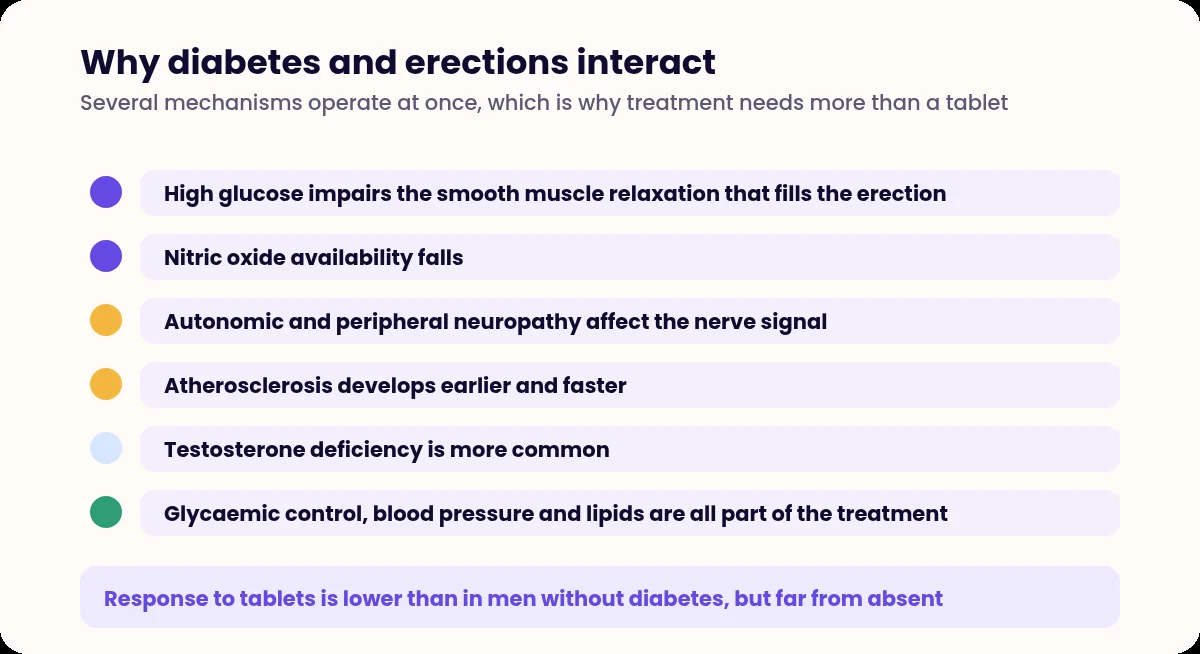
Blood vessels. Persistently high glucose impairs the ability of cavernosal smooth muscle to relax, and reduces the activity of endothelial nitric oxide synthase — the enzyme that produces the nitric oxide the whole process runs on. Diabetes also accelerates atherosclerosis, narrowing the arteries feeding the penis.
Nerves. Diabetic autonomic and somatic neuropathy weakens the signal that triggers the vascular response in the first place. The association is strong: men with diabetic neuropathy have substantially higher odds of erectile dysfunction, with one pooled estimate at an odds ratio of 3.47 [2].
Hormones. Testosterone deficiency is more common in men with type 2 diabetes than in the general population, and low testosterone reduces both desire and the quality of the erectile response.
Everything around it. Depression is more common in diabetes, medicines used alongside it can contribute, and obesity and high blood pressure usually travel with it. The result is rarely one clean cause. Our overview of what causes erectile dysfunction covers how these overlap.
It is also a cardiovascular signal
This is the part most worth taking seriously. The arteries supplying the penis are narrower than the coronary arteries, so endothelial disease tends to show up there first. In a man with diabetes — already at raised cardiovascular risk — new erectile difficulty is a reason to look at the whole picture rather than just write a prescription.
Consensus cardiology guidance now treats erectile dysfunction as a risk-enhancing factor for atherosclerotic cardiovascular disease, with a typical lead time of several years before a cardiac event. Our article on ED and heart disease sets out what that means in practice and when sexual activity itself needs assessing.
What a proper work-up covers
If you raise this with a clinician, a reasonable UK assessment includes:
- HbA1c — both to assess control and because poor control predicts a poorer response to treatment.
- Morning fasting total testosterone, taken between 7am and 11am, with a second confirmatory sample if it is low.
- Lipids and blood pressure, with a formal cardiovascular risk assessment.
- A neuropathy check — foot examination, and specific questions about other autonomic symptoms.
- A mood screen. Depression is both a cause and a consequence here.
- A direct question about ejaculation. Retrograde ejaculation is common in diabetic autonomic neuropathy and is frequently mistaken for an erection problem.
- A medicines review. Several drugs commonly prescribed in diabetes and its comorbidities affect sexual function.
Treatment: what actually happens
Glycaemic control and weight
Improving glucose control does not usually reverse established erectile dysfunction, and it is worth being honest about that rather than promising otherwise. What it does do is slow further nerve and vessel damage, and improve the odds that other treatments work.
Weight loss has better evidence behind it for erectile function specifically, particularly where there is significant central adiposity — our guide to weight loss and erections covers what the trials measured. For men with type 2 diabetes, the overlap with diabetes remission makes this doubly worth pursuing.
Oral treatment
Tablets that work on the PDE5 enzyme remain first line in the UK for men with diabetes as for anyone else. They work for most men — but measurably less well than in men without diabetes. A 2025 meta-analysis found a relative risk of 2.91 for improvement compared with placebo in men with diabetes, a real effect but a smaller one than the figures usually quoted for the general population [2].
Predictors of a poorer response are consistent across studies: older age, longer duration of diabetes, poor glycaemic control, established microvascular complications, and more severe erectile dysfunction at baseline.
Two practical points. First, these medicines need to be tried properly — an adequate dose, adequate sexual stimulation, and several attempts before concluding they do not work. Men with diabetes are more likely to be told a tablet “failed” when it was never given a fair trial. Second, all of them are prescription only medicines in the UK, and whether one is suitable depends on your other conditions and medicines, particularly nitrates. Our explainer on how PDE5 inhibitors work covers the mechanism in more detail.
If tablets are not enough
They are not the end of the road, and men with diabetes are more likely than average to need what comes next.
Intracavernosal injection therapy bypasses the nerve signal entirely by acting directly on the smooth muscle, which is why it works in many men whose neuropathy has made tablets ineffective. Reported satisfaction rates are around 79%. It requires proper teaching and a test dose in clinic.
Vacuum erection devices are mechanical, drug-free and compatible with almost any medical history. They suit some couples very well and others not at all.
Penile prosthesis surgery has the highest satisfaction rates of any treatment for erectile dysfunction, in the region of 80-90%. One diabetes-specific caveat matters: the risk of device infection roughly doubles where the pre-operative HbA1c is 8% or above, so surgeons will usually want control optimised first.
What to do next
Raise it at your diabetes review rather than waiting for a separate appointment — it is a diabetes complication, and the review is the right place for it. Say the word “erection”, because clinicians are often waiting for the patient to open the subject and will not push it.
If erections have deteriorated over months alongside reduced morning erections, low mood or fatigue, ask for the bloods above rather than just a prescription. And if you have chest pain or breathlessness on exertion, that needs a same-week GP appointment regardless of what prompted you to notice it.
Frequently asked questions
How common is erectile dysfunction in men with diabetes?
A pooled analysis of 145 studies put the prevalence at around 52.5% of men with diabetes, compared with roughly a seventh of that in men without. It also tends to appear earlier in life. The figure covers all severities, so it includes men with occasional difficulty as well as those with complete loss of erections.
Will getting my blood sugar under control fix my erections?
It can help, and it makes tablets more likely to work, but it rarely reverses established difficulty on its own. Nerve and blood vessel damage accumulates over years and does not fully undo. Better control is still worth doing — it protects what function you have and reduces the risk of everything else diabetes causes.
Why do erection tablets not work as well for me?
PDE5 inhibitors work by amplifying a nerve signal rather than creating one. If diabetic neuropathy has weakened that signal, or if the blood vessels are stiff, there is less for the tablet to amplify. Meta-analysis confirms the response rate in men with diabetes is lower than in men without, though most still improve.
Could my diabetes be causing a dry orgasm rather than an erection problem?
Yes. Diabetic autonomic neuropathy can cause retrograde ejaculation, where semen passes backwards into the bladder. Orgasm still happens but little or no semen appears. It is harmless in itself but matters for fertility, and it is worth naming specifically when you see a clinician.
References
- NICE Clinical Knowledge Summaries. Erectile dysfunction. cks.nice.org.uk/topics/erectile-dysfunction/
- Kouidrat Y et al. High prevalence of erectile dysfunction in diabetes: a systematic review and meta-analysis of 145 studies. Diabetic Medicine, 2017. onlinelibrary.wiley.com/guides/14645491
- NICE. Type 2 diabetes in adults: management. NG28. www.nice.org.uk/guidance/ng28
- British Society for Sexual Medicine. Guidelines on the management of erectile dysfunction in men. www.bssm.org.uk/guidelines/
- European Association of Urology. Guidelines on Sexual and Reproductive Health. uroweb.org/guidelines/sexual-and-reproductive-health
- NHS. Type 2 diabetes. www.nhs.uk/conditions/type-2-diabetes/
Medical reviewer
Naeem Teni
Clinical Lead at Manova. Registered pharmacist and independent prescriber, GPhC 2215591. Reviews Manova’s clinical content for accuracy and safety.
Written by
Manova Editorial Team
Researched and written to our editorial policy, using NICE, NHS, MHRA and peer-reviewed sources.
This article is for general information and isn’t a substitute for advice from your own clinician. If you feel unwell, contact your GP or NHS 111. In an emergency, call 999.