

Key takeaways
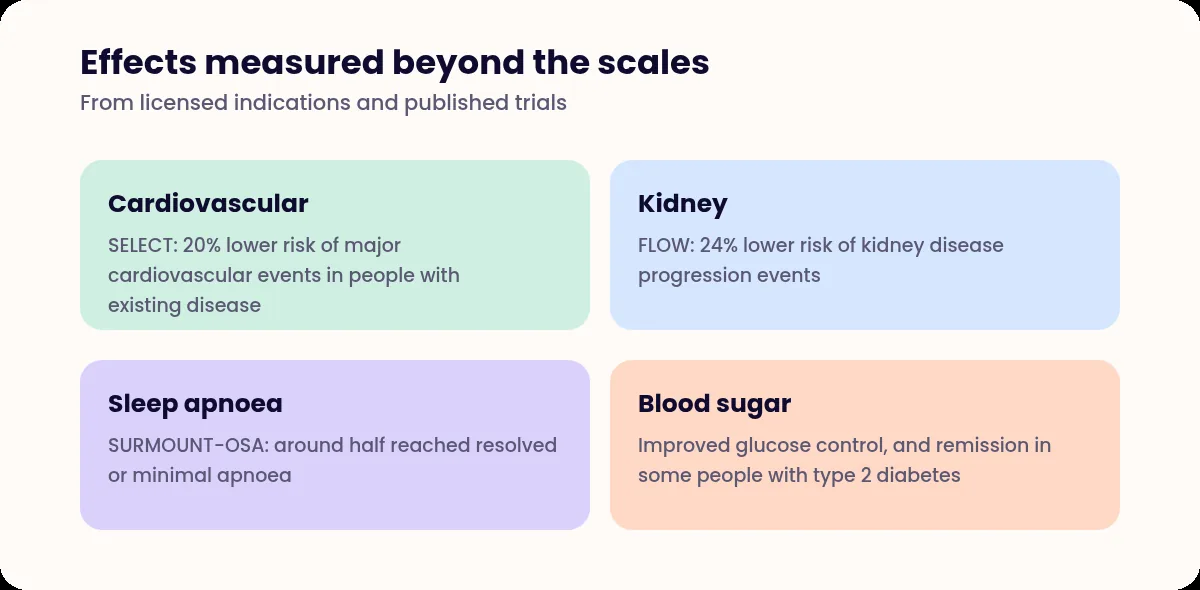
- In the SELECT trial, semaglutide reduced major cardiovascular events by 20% in people with excess weight and established cardiovascular disease.
- The MHRA added a cardiovascular risk-reduction indication for semaglutide in July 2024.
- In FLOW, semaglutide reduced serious kidney outcomes and cardiovascular death by 24% in people with type 2 diabetes and chronic kidney disease.
- In SURMOUNT-OSA, tirzepatide reduced sleep apnoea severity substantially, and around half of participants reached a threshold for resolution or mild residual disease.
For most of their history, weight-management medicines were judged on one thing: how much weight came off. Three large trials changed that question to a different one — what happens to the organs.
This page is information about prescription-only medicines and the evidence behind them. It is not advice about whether any of this applies to you.
The heart: SELECT
SELECT randomised 17,604 adults with overweight or obesity and established cardiovascular disease, but without diabetes, to semaglutide 2.4 mg or placebo, and followed them for a mean of about 40 months [1].
| Outcome | Semaglutide | Placebo |
|---|---|---|
| Cardiovascular death, non-fatal heart attack or non-fatal stroke | 6.5% | 8.0% |
That is a hazard ratio of 0.80 (95% CI 0.72–0.90) — a 20% relative reduction.
The significance is that this was a cardiovascular outcomes trial in people without diabetes, and the benefit appeared larger than weight loss alone would predict. In July 2024 the MHRA approved semaglutide for cardiovascular risk reduction in adults with established cardiovascular disease and a BMI of 27 or above — a separate licensed indication from weight management [4].
The kidneys: FLOW
FLOW studied 3,533 people with type 2 diabetes and chronic kidney disease and was stopped early because the benefit was clear [2].
The primary endpoint combined kidney failure, a 50% or greater fall in kidney function, death from kidney causes, and death from cardiovascular causes. Semaglutide reduced it with a hazard ratio of 0.76 (95% CI 0.66–0.88) — a 24% relative reduction.
Chronic kidney disease in type 2 diabetes has had few effective treatments for decades, which is why this result attracted attention well beyond obesity medicine.
Sleep apnoea: SURMOUNT-OSA
SURMOUNT-OSA was two 52-week trials in adults with moderate to severe obstructive sleep apnoea and obesity: one in people not using CPAP (234 participants) and one in people who continued CPAP (235) [3].
The measure was the apnoea-hypopnoea index — breathing interruptions per hour of sleep.
| Trial | Tirzepatide | Placebo |
|---|---|---|
| Not using CPAP | −25.3 events/hour | −5.3 |
| Using CPAP | −29.3 events/hour | −5.5 |
Around half of participants on tirzepatide met criteria for disease resolution or mild residual disease at 52 weeks. Weight loss was about 18–20%.
Sleep apnoea matters beyond tiredness: it is associated with high blood pressure, cardiovascular disease and road accidents, and it is strongly linked to excess weight [7].
How to read all this
These trials studied specific populations. SELECT enrolled people who already had cardiovascular disease. FLOW enrolled people with diabetes and existing kidney disease. Neither tells you what happens in a healthy 35-year-old, and neither makes these medicines preventive treatments for the general population.
A licensed indication is narrow. The UK cardiovascular indication applies to adults with established cardiovascular disease and a BMI of 27 or above. It is not a licence to prescribe for heart protection generally.
NHS access is separate again. What is licensed and what is funded are different questions, governed by NICE guidance and local commissioning.
Benefit is not the same as no risk. The warnings that apply to these medicines — pancreatitis, gallbladder problems, dehydration from vomiting and diarrhoea, the eye advice issued in February 2026 — apply whatever the reason for taking them.
Why this matters for how obesity is understood
These results are part of the reason the framing has shifted from weight as an appearance issue to obesity as a condition that damages organs. Our guide to obesity as a chronic disease covers that shift, which was formalised by a Lancet commission in 2025.
Where this information comes from
All three trials are published in the New England Journal of Medicine; the UK licensing change is reported by The Pharmaceutical Journal and reflected in the product’s SmPC. The SmPC on the electronic Medicines Compendium is the current authority on licensed use.
Frequently asked questions
Do weight loss injections protect the heart?
In the SELECT trial of 17,604 adults with overweight or obesity and established cardiovascular disease but not diabetes, semaglutide 2.4 mg reduced the risk of cardiovascular death, non-fatal heart attack or non-fatal stroke by 20% compared with placebo over about 40 months.
Is semaglutide licensed for heart protection in the UK?
Yes. The MHRA approved semaglutide for cardiovascular risk reduction in adults with established cardiovascular disease and a BMI of 27 or above in July 2024. That is a separate indication from weight management.
What did the kidney trial show?
FLOW studied 3,533 people with type 2 diabetes and chronic kidney disease and was stopped early for efficacy. Semaglutide reduced a composite of kidney failure, a 50% fall in kidney function, kidney death or cardiovascular death by 24%.
Do these medicines treat sleep apnoea?
SURMOUNT-OSA tested tirzepatide in adults with moderate to severe obstructive sleep apnoea and obesity. It substantially reduced the number of breathing interruptions per hour, and around half of participants met criteria for disease resolution or mild residual disease at 52 weeks.
Does this mean anyone should take them for these reasons?
No. Licensed indications are specific, and eligibility depends on your individual risk and history. These trials studied particular populations, and the results do not transfer automatically to everyone.
References
- Lincoff AM, Brown-Frandsen K, Colhoun HM, et al. Semaglutide and cardiovascular outcomes in obesity without diabetes (SELECT). New England Journal of Medicine. 2023;389(24):2221-2232. doi.org/10.1056/NEJMoa2307563
- Perkovic V, Tuttle KR, Rossing P, et al. Effects of semaglutide on chronic kidney disease in patients with type 2 diabetes (FLOW). New England Journal of Medicine. 2024;391(2):109-121. doi.org/10.1056/NEJMoa2403347
- Malhotra A, Grunstein RR, Fietze I, et al. Tirzepatide for the treatment of obstructive sleep apnea and obesity (SURMOUNT-OSA). New England Journal of Medicine. 21 June 2024. doi.org/10.1056/NEJMoa2404881
- The Pharmaceutical Journal. MHRA approves semaglutide as first weight-loss drug to prevent cardiovascular events. 23 July 2024. pharmaceutical-journal.com/article/news/mhra-approves-semaglutide-as-f
- Novo Nordisk Limited. Wegovy: Summary of Product Characteristics. Electronic Medicines Compendium. www.medicines.org.uk/emc/product/13803/smpc
- NHS. Sleep apnoea. www.nhs.uk/conditions/sleep-apnoea/
Medical reviewer
Naeem Teni
Clinical Lead at Manova. Registered pharmacist and independent prescriber, GPhC 2215591. Reviews Manova’s clinical content for accuracy and safety.
Written by
Manova Editorial Team
Researched and written to our editorial policy, using NICE, NHS, MHRA and peer-reviewed sources.
This article is for general information and isn’t a substitute for advice from your own clinician. If you feel unwell, contact your GP or NHS 111. In an emergency, call 999.