

Key takeaways
- A Lancet Diabetes & Endocrinology Commission published in January 2025 proposed splitting obesity into clinical obesity — where excess fat is already damaging organs or function — and pre-clinical obesity, which is a risk state.
- It also proposed that BMI alone should not diagnose obesity: confirmation needs a second measure of body size, or direct measurement of body fat.
- The Royal College of Physicians endorsed the distinction, and NICE's 2025 guideline moved in the same direction by adding waist-to-height ratio.
- Treating obesity as a disease changes who gets treated and how, and pushes back on the idea that it is simply a failure of willpower.
For most of the last century, obesity was treated as a description of a body rather than a diagnosis of an illness. You were heavy; the advice was to be less heavy; how you got there was regarded as your own affair.
In January 2025 that framing was formally challenged. A Commission convened by The Lancet Diabetes & Endocrinology, chaired by Professor Francesco Rubino of King’s College London and involving 56 experts, proposed a new definition of obesity endorsed by 76 medical organisations worldwide [1].
It’s worth understanding, because it changes what the word means.
The central idea: two different things share one name
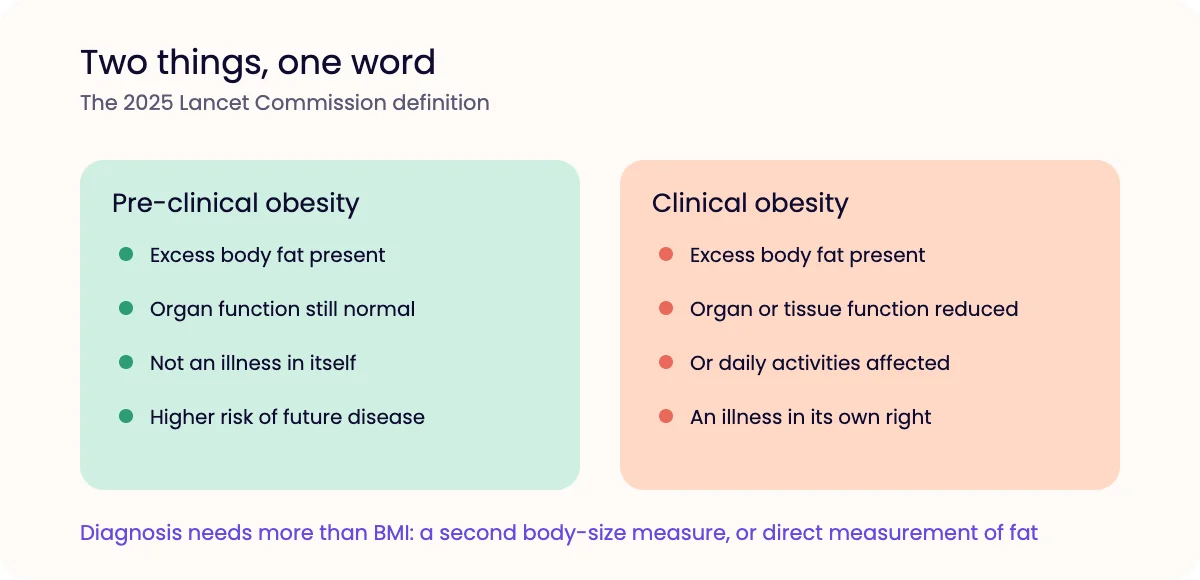
The Commission’s proposal is that “obesity” currently covers two situations that behave quite differently, and that they should be named separately [1].
Clinical obesity is when excess body fat is already causing harm: measurable reduction in the function of an organ or tissue, or significant difficulty with standard daily activities — washing, dressing, eating, continence, walking up stairs. The Commission set out 18 diagnostic criteria for adults, covering effects across the heart, lungs, kidneys, joints, metabolism, reproductive system and nervous system. On this definition, clinical obesity is an illness in its own right, not a risk factor for one.
Pre-clinical obesity is excess body fat with organ function still intact. Not currently an illness — a state of increased risk, of type 2 diabetes, cardiovascular disease, certain cancers and mental ill health.
The second change: BMI stops being the diagnosis
The Commission was equally direct about measurement. BMI is a population screening tool that was never designed to diagnose an individual, and it can’t distinguish muscle from fat or tell you where fat sits.
Its recommendation was that confirming excess body fat should require either BMI plus at least one measure of body size — waist circumference, waist-to-hip ratio or waist-to-height ratio — or at least two body-size measurements regardless of BMI, or a direct measurement such as a DEXA scan. Above a BMI of 40, excess fat can reasonably be assumed [1].
UK practice was already moving this way. NICE’s guideline on overweight and obesity management, published on the same day, recommends measuring waist-to-height ratio alongside BMI in adults with a BMI below 35 [3] — the subject of our guide to the waist-to-height check.
How the UK responded
The Royal College of Physicians endorsed the Commission’s framework the following day, describing the clinical and pre-clinical distinction as a significant step forward and supporting the move away from BMI-only diagnosis [2].
The change is not simply administrative. Defining clinical obesity as a present illness affects who is prioritised for treatment: someone with a BMI of 32 whose knees, breathing and blood sugar are all affected has a stronger claim on care than a BMI number alone would suggest, while someone with a BMI of 33 and entirely normal organ function may be better served by prevention.
Why “chronic” is the important word
Calling obesity chronic isn’t pessimism. It’s a description of how the body behaves after weight loss.
When people lose a significant amount of weight, the hormones governing appetite change — and they don’t change back quickly. In one well-known study, appetite-related hormone changes were still present a year after weight loss, with participants reporting more hunger than before they started [5]. The body defends the weight it has reached, which is precisely the behaviour of a chronic condition rather than a one-off problem.
This explains something most people who’ve lost weight recognise: keeping it off requires continued effort long after the “diet” is over. That isn’t a failure of discipline. It’s the condition doing what chronic conditions do.
The stigma question
Obesity is one of the few health conditions where public blame is still routine. Reviews of the evidence have documented weight stigma across employment, education and healthcare itself, and found that experiencing it is associated with worse outcomes rather than motivation to change [4].
That’s the practical case against the willpower framing. It doesn’t work as an intervention, and it discourages people from seeking help. Reframing obesity as a condition with biological drivers isn’t about removing responsibility for diet and activity — those still matter — it’s about placing responsibility where it can actually be acted on.
What this means for you
- A BMI figure alone doesn’t tell you where you stand. Pair it with a waist-to-height measurement, and pay attention to function: breathing, joints, sleep, energy.
- If excess weight is already affecting your health, that’s a medical issue deserving assessment, not a personal failing to be solved privately.
- Expect to need a maintenance plan, not just a weight-loss plan. The chronic framing predicts exactly the regain that most diets don’t prepare people for.
- Small losses count. Health markers improve well before anyone reaches a “goal weight”.
When to speak to a clinician
If excess weight is affecting your breathing, joints, sleep, blood pressure or blood sugar, or if you have a family history of type 2 diabetes or heart disease, that’s worth a proper assessment. Your GP or a Manova clinician can go through your measurements, your risk and the options available.
Frequently asked questions
Is obesity officially a disease in the UK?
It is treated as a chronic condition by the NHS and by NICE, and the Royal College of Physicians has endorsed the 2025 framework that defines clinical obesity as an illness in its own right. There is no single legal declaration that settles the question, which is part of why the debate continues.
What is the difference between clinical and pre-clinical obesity?
Clinical obesity means excess body fat is already causing measurable problems — reduced organ or tissue function, or difficulty with everyday activities such as washing, dressing or climbing stairs. Pre-clinical obesity means the excess fat is there and organ function is still normal, so it is a state of increased risk rather than a present illness.
Why is BMI no longer enough on its own?
BMI measures weight against height and cannot distinguish muscle from fat or tell you where fat is stored. The Commission recommended confirming excess adiposity with at least one additional body-size measure, such as waist-to-height ratio, or with a direct measurement of body fat.
Does calling it a disease remove personal responsibility?
It reframes it. Behaviour still matters, and so do diet and activity. But defining obesity as a chronic condition recognises that appetite, fat storage and weight regain are driven by biology that behaviour alone rarely overrides, and that people who are unwell deserve treatment rather than blame.
Does this change what treatment I can get?
Not immediately by itself — access in the UK is still set by NICE guidance and NHS commissioning. But the framework is intended to help direct treatment towards people who are already unwell, rather than allocating it by BMI alone.
References
- Rubino F, Cummings DE, Eckel RH, et al. Definition and diagnostic criteria of clinical obesity. The Lancet Diabetes & Endocrinology. Published online 14 January 2025. doi.org/10.1016/S2213-8587(25)00004-X
- Royal College of Physicians. RCP endorses Lancet definition and diagnostic criteria for obesity. 15 January 2025. www.rcp.ac.uk/news-and-media/news-and-opinion/royal-college-of-physici
- National Institute for Health and Care Excellence. Overweight and obesity management (NG246). Published 14 January 2025. www.nice.org.uk/guidance/ng246
- Puhl RM, Heuer CA. The stigma of obesity: a review and update. Obesity. 2009;17(5):941-964. doi.org/10.1038/oby.2008.636
- Sumithran P, Prendergast LA, Delbridge E, et al. Long-term persistence of hormonal adaptations to weight loss. New England Journal of Medicine. 2011;365(17):1597-1604. doi.org/10.1056/NEJMoa1105816
- NHS. Obesity. www.nhs.uk/conditions/obesity/
- World Health Organization. Obesity and overweight fact sheet. www.who.int/news-room/fact-sheets/detail/obesity-and-overweight
Medical reviewer
Naeem Teni
Clinical Lead at Manova. Registered pharmacist and independent prescriber, GPhC 2215591. Reviews Manova’s clinical content for accuracy and safety.
Written by
Manova Editorial Team
Researched and written to our editorial policy, using NICE, NHS, MHRA and peer-reviewed sources.
This article is for general information and isn’t a substitute for advice from your own clinician. If you feel unwell, contact your GP or NHS 111. In an emergency, call 999.