

Key takeaways
- UK reference intakes are about 2,500 kcal a day for men and 2,000 for women, averaged across the population.
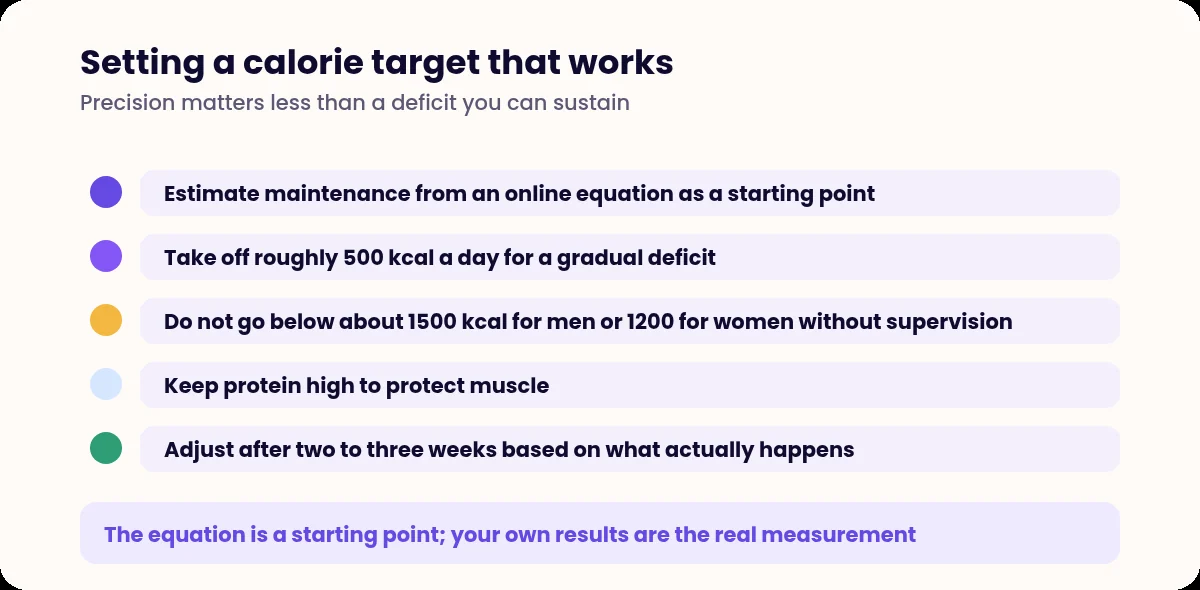
- A deficit of roughly 500 kcal a day corresponds to about 0.5 kg a week.
- Calculators are estimates with meaningful error; the first two weeks of real data beat any formula.
- Intakes below 1,200 kcal for women and 1,500 for men should not be undertaken without clinical supervision.
Every calculator gives a different answer, and none of them is measuring anything. That does not make them useless — it makes them a starting hypothesis to test.
The reference numbers
UK dietary reference values for energy, averaged across the population, are approximately 2,500 kcal a day for men and 2,000 for women [1]. These are population references rather than personal prescriptions — the actual range across individuals is wide.
They are also the basis for the “adults need around 2,000 kcal a day” statement you see on menus in England.
Working out a starting point
Step one: estimate maintenance
A rough and serviceable approach for most adults:
Maintenance ≈ body weight in kg × 30, if you are lightly active.
Use × 28 if you are sedentary — desk job, little deliberate activity — and × 33 if you are on your feet most of the day or train regularly.
For an 85 kg lightly active adult: 85 × 30 = about 2,550 kcal to maintain.
Step two: subtract
A deficit of 500 kcal a day corresponds to roughly 0.5 kg a week, which sits within the NHS’s description of a safe and sustainable rate [2].
So: 2,550 − 500 = about 2,050 kcal a day.
A 750 kcal deficit corresponds to about 0.75 kg a week and is reasonable for people with more weight to lose. Deficits much beyond that get harder to sustain and increase muscle loss.
Step three: treat it as a hypothesis
This is the part that matters. Track intake and weight for two to three weeks, then look at what actually happened.
- Losing faster than about 1 kg a week — add 150–250 kcal
- Losing nothing over three weeks at a genuine, well-tracked intake — subtract 150–250 kcal
- Losing around 0.5 kg a week — leave it alone
Your own three weeks of data beat any equation, because they capture your actual body and your actual behaviour rather than a population average.
The floors
For unsupervised weight loss, the commonly used lower limits are about 1,200 kcal a day for women and 1,500 for men. Below those, meeting protein, vitamin and mineral requirements becomes difficult, and muscle loss increases.
Intakes below 800 kcal are defined by NICE as very-low-energy diets and are recommended only within specialist services, for a maximum of 12 weeks, where there is a clinical need for rapid weight loss [3]. See very low calorie diets.
If your calculated target lands below the floor, the answer is usually to increase activity rather than cut further.
Why the number stops working
It does not stop working. It stops being right, which is different.
As you lose weight, maintenance falls, because there is less of you to run. A 500 kcal deficit at 95 kg becomes a smaller deficit at 85 kg without you changing anything. This is normal, it is not a broken metabolism, and it is covered properly in what a calorie deficit really is.
The practical consequence: expect to recalculate every 5 to 10 kg.
What to put the calories into
The number is only half the question.
Protein. Roughly 1.2–1.6 g per kg of body weight per day while losing weight, to protect muscle. For an 85 kg adult that is about 100–135 g.
Fibre. Towards the UK target of 30 g a day. It is the main driver of fullness per calorie.
Enough fat. Around 0.6–0.8 g per kg per day at minimum, for hormones and fat-soluble vitamins.
The rest as carbohydrate, adjusted to your preference and activity.
Do not eat back exercise calories
The single most common way a deficit quietly disappears. Fitness tracker estimates of energy expenditure have been found to be off by 27% to 93% [4]. If you use an activity allowance at all, use a fraction of it.
When to speak to a clinician
Speak to a clinician before setting a target if you:
- have diabetes, particularly on insulin or a sulfonylurea
- are pregnant or breastfeeding
- have a history of an eating disorder, or find that calorie targets become rigid or distressing
- have chronic kidney disease or liver disease, where protein and other intakes may need limiting
- are over 65 or frail, where protecting muscle changes the priorities
- have calculated a target below 1,200 kcal (women) or 1,500 kcal (men)
Frequently asked questions
How many calories should I eat to lose weight?
A common starting point is your estimated maintenance intake minus about 500 kcal a day, which corresponds to roughly 0.5 kg a week. For many UK adults that lands somewhere between 1,500 and 2,000 kcal, but the right number depends on your size, sex and activity.
Is 1,200 calories a day too low?
For most adults it is at or below the floor for an unsupervised diet. Intakes below about 1,200 kcal for women and 1,500 for men are hard to make nutritionally complete and are generally recommended only with clinical supervision.
Why do calculators give different numbers?
They use different equations, and all of them estimate rather than measure. Individual energy expenditure varies by several hundred calories from any prediction, mostly because of differences in body composition and daily movement.
Should I eat back the calories from exercise?
Generally not, or only a fraction. Fitness tracker estimates of calories burned have been found to be off by between 27% and 93%, so eating them back is the most common way a deficit disappears.
References
- Scientific Advisory Committee on Nutrition. Dietary Reference Values for Energy. 2011. www.gov.uk/government/publications/sacn-dietary-reference-values-for-e
- NHS. Understanding calories. www.nhs.uk/live-well/healthy-weight/managing-your-weight/understanding
- NICE. Overweight and obesity management. NG246. January 2025. www.nice.org.uk/guidance/ng246
- Shcherbina A, Mattsson CM, Waggott D, et al. Accuracy in wrist-worn, sensor-based measurements of heart rate and energy expenditure in a diverse cohort. Journal of Personalized Medicine. 2017;7(2):3. doi.org/10.3390/jpm7020003
Medical reviewer
Naeem Teni
Clinical Lead at Manova. Registered pharmacist and independent prescriber, GPhC 2215591. Reviews Manova’s clinical content for accuracy and safety.
Written by
Manova Editorial Team
Researched and written to our editorial policy, using NICE, NHS, MHRA and peer-reviewed sources.
This article is for general information and isn’t a substitute for advice from your own clinician. If you feel unwell, contact your GP or NHS 111. In an emergency, call 999.