

Key takeaways
- Stopping the flow of urine is a way of locating the muscles once, not the exercise itself — doing it repeatedly is not recommended.
- A large proportion of men contract the wrong muscles when self-taught, usually the buttocks, abdomen or thighs instead of the pelvic floor.
- The landmark UK trial showed meaningful improvement, but it combined supervised biofeedback sessions with lifestyle advice, so the effect cannot be attributed to the exercises alone.
- Allow three to six months of consistent daily practice before judging whether it has worked.
The male pelvic floor is a sheet of muscle slung across the base of the pelvis. Two of its components, the ischiocavernosus and bulbocavernosus, wrap around the base of the erectile bodies. When they contract they squeeze, raising pressure inside the erectile tissue and slowing venous outflow. That is the mechanism by which training them could plausibly help erections, and it is most relevant where the problem is holding an erection rather than getting one.
“Could plausibly help” is doing deliberate work in that sentence. The evidence is real but thin, and this article is going to be straight with you about both the technique and its limits.
Finding the right muscles
This is where most men go wrong, and it is worth several minutes of attention before you start counting repetitions.
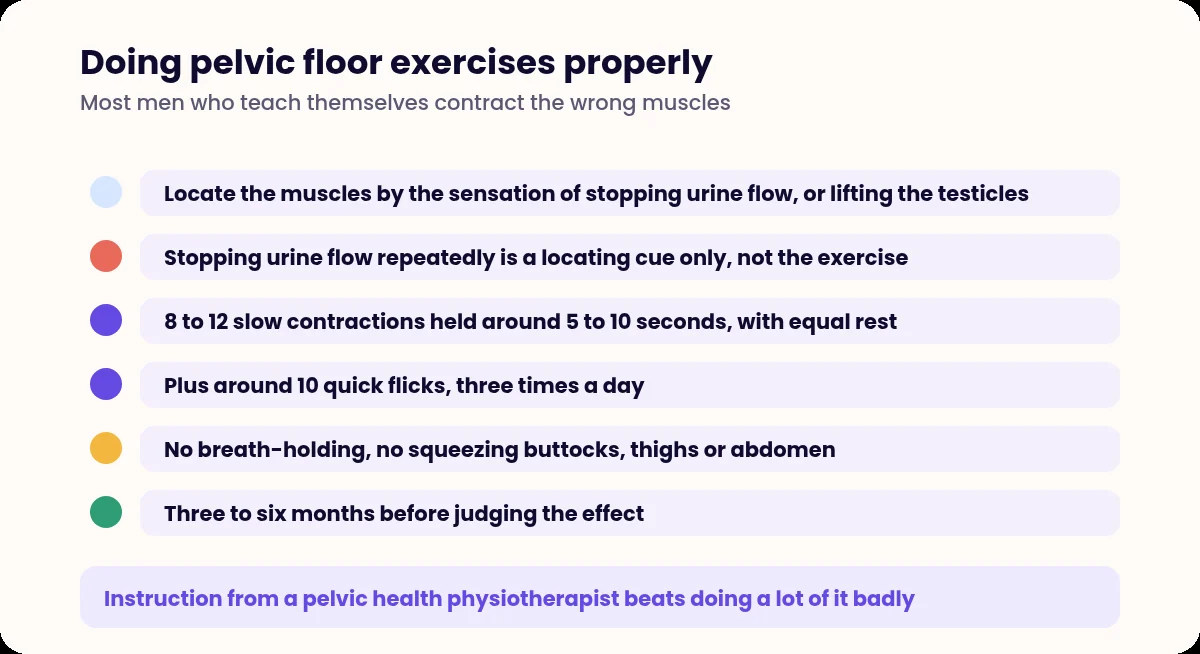
The standard instruction is to imagine stopping the flow of urine mid-stream, or to imagine lifting your testicles towards your body. Both work as locating cues. Use them once or twice, in the shower or on the toilet, to identify the sensation.
Then stop doing it on the toilet. Repeatedly interrupting urine flow is not the exercise, and doing it habitually can interfere with normal bladder emptying. The cue identifies the muscle; the training happens away from the toilet.
A second check: stand in front of a mirror. A correct contraction produces a small retraction of the penis towards the body and a slight lift of the testicles. Visible movement is reassuring; absence of it does not necessarily mean failure, but it is a useful confirmation when you have it.
What a wrong contraction feels like
A large proportion of men contract the wrong muscles when they teach themselves from a web page [1, 5]. The usual substitutions are:
- Squeezing the buttocks — you will feel your hips shift slightly
- Bracing the abdomen — the stomach hardens or the belly pushes out
- Pressing the thighs together
- Holding the breath — the commonest of all, and it makes the contraction feel stronger than it is
Put a hand on your abdomen and one on a buttock while you practise. If either moves, you have not isolated it yet. You should be able to hold a contraction while talking out loud.
The actual programme
Once you can isolate it, a typical regime looks like this:
Slow contractions. Eight to twelve maximal contractions, each held for about five seconds initially, building towards ten as you improve. Rest for the same length of time between each — the relaxation phase matters as much as the squeeze.
Quick flicks. Ten rapid, full-strength contractions released immediately. These train a different fibre type and a different job: the reflexive squeeze that happens during sex.
Three sets a day, in varying positions. This is not padding. The muscle behaves differently against gravity, and a pelvic floor trained only lying down performs poorly standing up. Do one set lying, one sitting and one standing.
Breathe throughout. Breath-holding recruits the abdomen and defeats the purpose.
Allow three to six months before judging it. Muscle adaptation is slow, and the first change men notice is often better bladder control or less post-urination dribble rather than anything to do with erections.
What the evidence actually shows
The foundational study is a UK randomised controlled trial published in the British Journal of General Practice in 2004, with 55 men of median age around 59 [1]. The intervention group received five thirty-minute one-to-one sessions over consecutive weeks, with manometric biofeedback, exercises taught in standing, sitting and lying, and daily home exercises for six months.
At three months, the intervention group’s erectile function score was 6.74 points higher than the control group’s on the relevant domain of a standard questionnaire, a statistically significant difference, alongside a large increase in measured anal pressure. At final blind assessment of all 55 men, 40.0% were judged to have regained normal erectile function, 34.5% had improved, and 25.5% had not improved.
Those are respectable numbers. Three caveats belong with them.
First, the trial delivered concurrent lifestyle advice alongside the exercises. Weight, alcohol, smoking and activity all affect erectile function in their own right, as our guide to lifestyle changes for erections explains, so the improvement cannot be attributed cleanly to the muscle training.
Second, the intervention was supervised, with biofeedback — a device measuring whether the right muscle was actually contracting. That is a materially different thing from reading instructions and guessing.
Third, a 2019 systematic review concluded that pelvic floor muscle training improves both erectile dysfunction and premature ejaculation, but that the studies are few, small and heterogeneous [2]. The honest summary is: plausible mechanism, encouraging signal, weak overall evidence base.
Where it fits best
Pelvic floor training is most reasonable where:
- The difficulty is maintaining rather than achieving an erection, which is the pattern most consistent with venous leak
- There is coexisting urinary leakage or post-urination dribble, where the evidence is considerably stronger
- You are recovering from prostate surgery, where pelvic floor rehabilitation is standard NHS practice for continence
- Premature ejaculation is the problem — a 2025 UK position statement cites a study in which 61% of men achieved ejaculatory control after fifteen to twenty supervised sessions [4], which sits alongside the approaches in our guide to lasting longer techniques
It is not a substitute for working out why the erectile difficulty is happening. If the cause is vascular, metabolic, hormonal or drug-related, no amount of squeezing addresses it — our guide to what causes erectile dysfunction covers the assessment that should happen first.
A note on what it cannot do
It is worth being clear about the limits, because pelvic floor training is often presented online as a natural alternative to medical treatment. It is not an alternative to anything. It does not lower blood pressure, reverse arterial disease, correct a hormone problem or undo the effect of a medicine that is contributing. Where those are the drivers, the exercises can sit alongside treatment but will not replace it. What they can reasonably be expected to do is strengthen a set of muscles that contribute to rigidity and to ejaculatory control, and that contribution is real but partial.
The other honest caveat is adherence. The trial regimes involved daily practice sustained over six months with professional supervision. Most men who try this on their own stop within a few weeks, which is the commonest reason it appears not to work.
Getting it taught properly
Given how often self-teaching goes wrong, the single highest-value step is one or two sessions with a pelvic health physiotherapist. They can confirm by examination that you are contracting the right muscle, which no article can do. GPs can refer to NHS pelvic health physiotherapy in most areas, and self-referral is available in some. It is also the right route if you have pelvic pain, because an overactive pelvic floor needs downtraining rather than strengthening, and doing the wrong one makes it worse.
Frequently asked questions
How do I know I'm using the right muscles?
You should feel a lift and inward draw at the base of the penis and around the anus, and in many men a slight rise of the testicles and a small retraction of the penis. Your buttocks, thighs and abdomen should stay still, and you should be able to breathe and talk normally throughout. If you cannot, you are recruiting the wrong muscles.
How long until I notice anything?
Muscle training takes time. Most physiotherapists ask for three to six months of consistent daily practice before drawing conclusions, with the first changes often noticed in bladder control or post-urination dribble rather than erections. Stopping at six weeks because nothing has happened is the commonest reason men conclude it does not work.
Do pelvic floor exercises help premature ejaculation?
There is some evidence that they help, and a UK position statement cites a study in which a majority of men achieved better ejaculatory control after a course of supervised sessions. The studies are small and the training was supervised, so it is not proof that unsupervised home exercises will do the same.
Can I do too many?
Yes. An overactive, chronically tense pelvic floor causes its own problems, including pelvic pain and difficulty relaxing to urinate. Full relaxation between contractions is part of the exercise, not an optional extra. If you have pelvic pain, see a pelvic health physiotherapist before starting a strengthening programme.
References
- Dorey G, Speakman M, Feneley R, et al. Randomised controlled trial of pelvic floor muscle exercises and manometric biofeedback for erectile dysfunction. British Journal of General Practice 2004;54(508):819-825. bjgp.org/content/54/508/819
- Myers C, Smith M. Pelvic floor muscle training improves erectile dysfunction and premature ejaculation: a systematic review. Physiotherapy 2019. www.sciencedirect.com/science/article/pii/S0031940618303584
- NHS. Pelvic floor exercises. www.nhs.uk/conditions/pelvic-floor-exercises/
- British Society for Sexual Medicine. Position Statement on Premature Ejaculation (February 2025). www.bssm.org.uk/guidelines/
- Pelvic Obstetric and Gynaecological Physiotherapy. Information for men. thepogp.co.uk/patient_information/
- European Association of Urology. Guidelines on Sexual and Reproductive Health. uroweb.org/guidelines/sexual-and-reproductive-health
Medical reviewer
Naeem Teni
Clinical Lead at Manova. Registered pharmacist and independent prescriber, GPhC 2215591. Reviews Manova’s clinical content for accuracy and safety.
Written by
Manova Editorial Team
Researched and written to our editorial policy, using NICE, NHS, MHRA and peer-reviewed sources.
This article is for general information and isn’t a substitute for advice from your own clinician. If you feel unwell, contact your GP or NHS 111. In an emergency, call 999.