

Key takeaways
- There is no persuasive evidence that pornography use causes erectile dysfunction in the general population, and the best available synthesis says so directly.
- Frequency of use shows little or no consistent association with sexual problems; self-perceived problematic use shows a clearer one, and tracks moral disapproval more than volume.
- A large gap between highly specific solo arousal conditions and ordinary partnered sex can genuinely make partnered sex feel flat, and that is workable without any addiction model.
- A young man attributing erectile difficulty to pornography still needs a proper assessment, because assuming the cause skips the checks that matter.
If you search for pornography and erectile dysfunction you will find a great deal of confident writing, much of it from sites with no clinical involvement, asserting a direct causal link and often a recovery timeline to go with it.
The research does not support that level of confidence. The most careful recent synthesis of the field concludes that claims of a strong relationship “are generally unfounded” and that “we have yet to see persuasive evidence of a cause-effect relationship” [1].
That is worth stating plainly at the top, because a man who believes he has permanently rewired himself is carrying an anxiety that is itself a well-documented cause of erectile difficulty.
What the studies actually measure
Research in this area separates two different things, and most popular writing collapses them.
Frequency of pornography use is how often and how much. Studies looking at this find no association, or weak and inconsistent associations, with sexual dysfunction. Some large multinational studies find slightly beneficial associations. Where effects are found they are described as small or very small: two studies found pornography use explained less than 1% of the variance in ejaculatory difficulty [1].
Self-perceived problematic use is different. This measures whether a man feels his use is out of control or harmful. Here the associations with sexual function are mild to moderate and more consistent. Problematic use affects perhaps 2 to 8% of users [1].
The important and counter-intuitive finding is that self-perceived problematic use tracks moral incongruence — religiosity, self-disapproval, a belief that the behaviour is wrong — more closely than it tracks how much pornography someone actually watches. Two men with identical use can differ entirely in whether they experience it as a problem.
Why the evidence is weak, specifically
It is not enough to say the evidence is mixed. The particular weaknesses matter:
- Only two longitudinal studies exist, and they produced disparate results. Almost everything else is cross-sectional — a snapshot, which cannot establish what came first.
- Reverse causation is at least as plausible. Men with existing erectile or ejaculatory difficulties frequently turn to masturbation and pornography, where the demand is lower and the failure is private. A survey then records high use alongside dysfunction and the arrow gets drawn the wrong way.
- Confounding is rarely controlled. Most studies do not adjust for relationship satisfaction, depression, anxiety, baseline desire or physical health — all of which independently affect sexual function and all of which affect pornography use.
- Self-report throughout, on a topic where accurate reporting is not the norm.
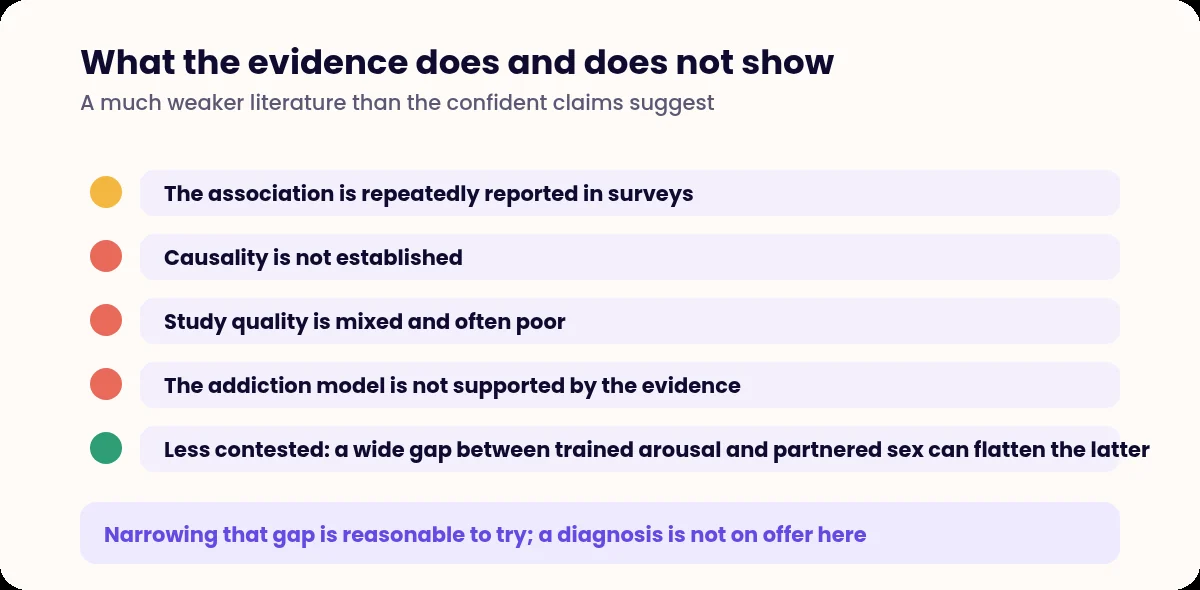
None of this proves pornography is harmless. It means the honest position is uncertainty, and uncertainty argues against both the alarmist claim and blanket reassurance.
The part that is less contested
Here is what clinicians see that does not require an addiction model.
Arousal is partly conditioned. If your reliable arousal conditions have become a particular kind of novelty, a particular intensity of stimulus, a particular grip, a particular pace, and above all zero interpersonal demand, then partnered sex — slower, less visually intense, involving another person’s needs and your own self-consciousness — can genuinely feel flat by comparison.
That is not brain damage. It is a mismatch between what you have practised and what you are attempting. The gap is narrowable, and narrowing it is a reasonable thing to try:
- Reduce or pause use for a defined period rather than indefinitely, so it is an experiment rather than a moral test.
- Change the conditions of masturbation before changing the frequency — grip, pace, and doing it without visual stimulus — since the conditioning is often more about method than volume.
- Deliberately reduce the performance demand in partnered sex. Removing intercourse as the goal for a period is the basis of sensate focus work and is more effective than trying harder. Our guide to performance anxiety and erections covers why effort makes this worse.
- Talk to your partner, because silence gets read as loss of interest.
Where the addiction framing goes wrong
ICD-11 recognises Compulsive Sexual Behaviour Disorder as an impulse control disorder [2]. It does not classify it as a substance-style addiction, and that omission was deliberate and contested.
The practical problem with the addiction framing is not that it is offensive but that it is unhelpful. It implies tolerance, withdrawal and permanent neural change, none of which has the evidential support the language implies. It also converts a behaviour into an identity, which reliably increases shame — and shame is the thing most likely to keep a man from raising any of this with a clinician.
If your use feels genuinely compulsive, that is a real clinical presentation and psychosexual therapy addresses it well. The framing you use to describe it does not need to include a disease model to get you help.
The mistake that actually causes harm
The single most consequential error in this area is a young man deciding pornography is the explanation and therefore not getting assessed.
Erectile dysfunction in a man under 40 still warrants blood pressure, HbA1c or fasting glucose, lipids and a morning testosterone, alongside a history covering sleep, mood, alcohol, recreational drugs, anabolic steroids and medication [3, 4]. Erectile dysfunction is an early marker of arterial disease, and the penile arteries show trouble before larger ones do. Our article on erectile dysfunction in younger men sets out what that assessment involves, and what causes erectile dysfunction covers the full list.
Self-diagnosis here is uniquely tempting because the explanation is available, free and requires no appointment. It is also unverifiable, which means a man can spend two years abstaining from pornography while an untreated metabolic problem progresses.
Getting help
If pornography use is distressing you, displacing partnered sex, or you feel unable to reduce it, psychosexual therapy is the appropriate route. COSRT-accredited therapists can be found directly [5]; NHS commissioning of psychosexual services in the UK is patchy, so most access is private. Where low mood or anxiety is driving the pattern, NHS Talking Therapies accepts self-referral in England [6].
If the primary complaint is erectile difficulty, start with a clinical assessment. Get the physical checks done, then address the behaviour — in that order, not the other way round.
Frequently asked questions
Is porn-induced erectile dysfunction real?
The term is widely used online but the evidence behind it is weak. Large studies find frequency of use explains very little of the variation in sexual function, only two longitudinal studies exist, and reverse causation is at least as plausible — men with existing sexual difficulties often use pornography more. Some men do find their use is displacing partnered sex, and that is worth addressing on its own terms.
Will giving up pornography fix my erections?
It may help if your use has become highly specific, frequent, or is replacing partnered sex, because narrowing the gap between your solo arousal conditions and real sex tends to help. It will not fix erectile difficulty caused by vascular disease, diabetes, medication, low testosterone or depression, which is why an assessment comes first.
Is pornography addiction a recognised diagnosis?
Not as such. ICD-11 recognises Compulsive Sexual Behaviour Disorder as an impulse control disorder, which can include pornography use. It deliberately does not classify it as a substance-style addiction, and the addiction framing remains contested among clinicians and researchers.
How much is too much?
There is no threshold in the evidence, and looking for one is probably the wrong question. The more useful test is functional: is it displacing things you want to do, is it being used to manage low mood, has it narrowed what you respond to, and is it causing you distress. Those are the things worth changing.
References
- Pornography and Sexual Dysfunction: Is There Any Relationship? Current Sexual Health Reports, 2023. link.springer.com/article/10.1007/s11930-023-00380-z
- World Health Organization. ICD-11 6C72 Compulsive sexual behaviour disorder. icd.who.int/browse11/l-m/en
- European Association of Urology. Guidelines on Sexual and Reproductive Health. uroweb.org/guidelines/sexual-and-reproductive-health
- NHS. Erection problems (erectile dysfunction). www.nhs.uk/conditions/erection-problems-erectile-dysfunction/
- College of Sexual and Relationship Therapists. Find a therapist. www.cosrt.org.uk/
- NHS Talking Therapies for anxiety and depression. www.nhs.uk/mental-health/talking-therapies-medicine-treatments/talking
Medical reviewer
Naeem Teni
Clinical Lead at Manova. Registered pharmacist and independent prescriber, GPhC 2215591. Reviews Manova’s clinical content for accuracy and safety.
Written by
Manova Editorial Team
Researched and written to our editorial policy, using NICE, NHS, MHRA and peer-reviewed sources.
This article is for general information and isn’t a substitute for advice from your own clinician. If you feel unwell, contact your GP or NHS 111. In an emergency, call 999.