

Key takeaways
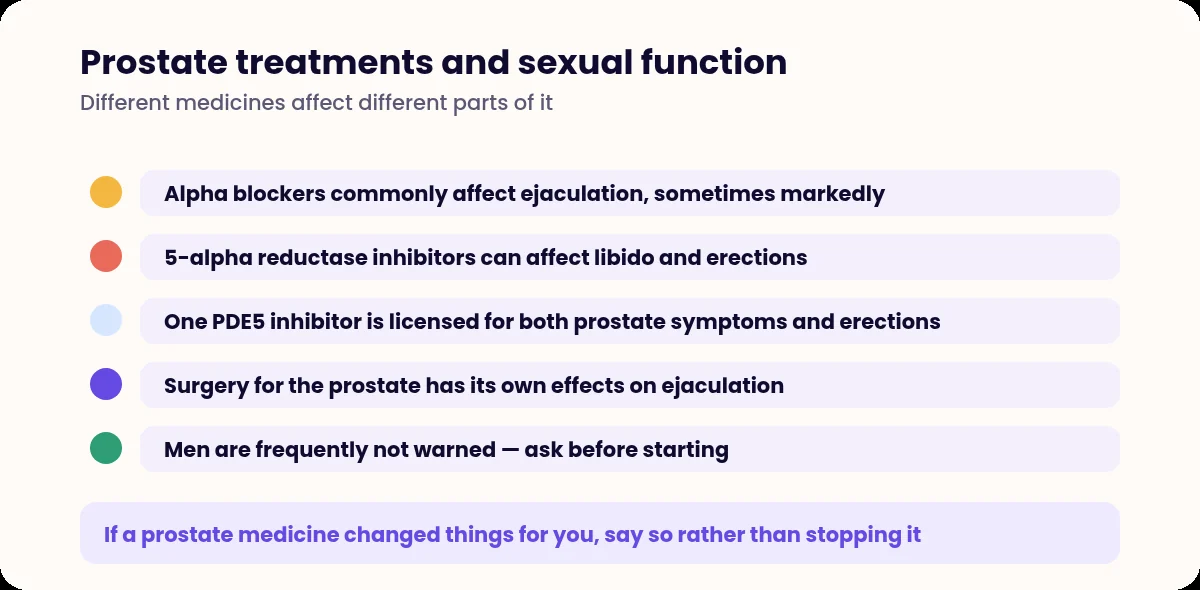
- Alpha blockers affect ejaculation, not erections — tamsulosin and silodosin far more often than alfuzosin, and the effect reverses on stopping.
- 5-alpha reductase inhibitors are the class associated with reduced libido and erectile difficulty, reported at roughly 3 to 8 per cent each in the first year.
- TURP causes retrograde ejaculation in around 65 to 75 per cent of men; UroLift and Rezum are offered partly on ejaculation preservation.
- Combining a daily PDE5 inhibitor with an alpha blocker risks severe low blood pressure, so UK guidance is to stop the alpha blocker first.
Urinary symptoms from an enlarging prostate are treated very effectively in the UK, and the treatments have specific sexual effects that men are frequently not warned about. Not vaguely — specifically. The two main classes of medicine affect completely different parts of sexual function, and knowing which does what changes how you interpret what is happening to you.
The two classes, and what each one does
Alpha blockers: an ejaculation effect, not an erection effect
Alpha blockers — tamsulosin is the usual UK first choice, with alfuzosin the common alternative — relax smooth muscle in the prostate and bladder neck. They work quickly, usually within days to a couple of weeks.
Their characteristic sexual effect is ejaculatory dysfunction: reduced volume of ejaculate, or none at all, with orgasm otherwise preserved. Mechanistically this is largely failure of seminal emission rather than true retrograde ejaculation, though UK guidelines and product information commonly use the “retrograde” label, which is why you will see it described both ways.
It is strongly dose- and drug-dependent. The more prostate-selective agents cause it far more often: reported rates for tamsulosin run roughly 4–18% across trials and for silodosin up to around 28%, against about 1% for alfuzosin [2, 3]. That difference is clinically useful, because switching within the class is a real option for a man to whom ejaculation matters.
Two things men are often not told:
- It reverses on stopping. This is not a permanent change.
- Alpha blockers do not cause erectile dysfunction, and may slightly improve it as urinary symptoms settle. If erections have deteriorated since starting one, look elsewhere for the cause rather than blaming the tablet.
5-alpha reductase inhibitors: a libido and erection effect
Finasteride and dutasteride shrink the prostate by blocking conversion of testosterone to dihydrotestosterone. They are used where the prostate is enlarged — UK guidance typically requires a prostate above 30 g or a PSA above 1.4 ng/ml with moderate to severe voiding symptoms — and they take three to six months to work [1, 3].
This is the class associated with reduced libido, erectile difficulty and ejaculatory problems. Product information puts each broadly in the 3–8% range in the first year, generally declining with continued use, and placebo rates in the same trials are high [6]. Gynaecomastia and breast tenderness also occur, and any breast lump should be reported.
Two further points belong here. These medicines reduce measured PSA by about 50%, so the value must be doubled when interpreting it — a man being monitored who does not know this can be falsely reassured [1]. And the MHRA has required warnings about depression and suicidal ideation with finasteride [5].
On persistent sexual symptoms after stopping — often called post-finasteride syndrome — the honest position is that it is contested. Prescribers should counsel on the possibility. But causal evidence for a lasting post-treatment syndrome is weak, and heavily confounded by nocebo effects and by the fact that most case series are assembled from online communities. Men report it, it is distressing, and the evidence does not currently establish it as a drug effect. Our guide to finasteride side effects covers the same debate in the hair loss context, where the dose is much lower.
The UK pathway
Typical practice, following NICE CG97 and local prescribing guidance [1, 3]:
- Assessment — IPSS symptom score, a frequency-volume chart, PSA with counselling, urinalysis, post-void residual and digital rectal examination.
- Conservative measures for symptoms that are not bothersome.
- An alpha blocker, reviewed at six weeks and then annually.
- A 5-alpha reductase inhibitor where the prostate is enlarged, as above.
- Both together for severe symptoms with significant enlargement.
- Antimuscarinic or beta-3 agonist medicines where storage and urgency symptoms predominate.
- A daily low-dose PDE5 inhibitor, one of which is licensed in the UK for benign prostatic enlargement as well as erectile dysfunction — useful where both problems coexist. Our guide to daily versus on-demand dosing explains that regimen.
- Surgery — TURP, HoLEP, Rezum, UroLift or prostate artery embolisation — where symptoms are refractory or complicated.
The interaction to know about
Combining a daily PDE5 inhibitor with an alpha blocker risks a severe fall in blood pressure. UK guidance is to stop the alpha blocker if starting a daily PDE5 inhibitor for prostate symptoms [3]. Combination with a 5-alpha reductase inhibitor is fine.
This is a prescriber decision, and it is one reason a man who has both urinary symptoms and erectile dysfunction is better served by one clinician seeing the whole picture than by two prescriptions arranged separately.
Surgery and ejaculation
TURP — the long-standing standard — causes retrograde ejaculation in around 65–75% of men, and erectile dysfunction in roughly 5–10% [2]. The ejaculatory effect is the expected outcome rather than a complication, and it is permanent.
UroLift and Rezum are offered partly on the basis of preserving ejaculation, and UroLift has the better ejaculatory data of the two. The trade-off is that both give less durable symptom relief than TURP, so a younger man weighing them is choosing between preserved ejaculation now and a higher chance of needing something further later.
If fertility matters, say so before any of these decisions. Retrograde ejaculation does not end fertility — sperm can be retrieved — but it changes the route entirely, and our guide to male fertility and sperm health covers the assessment.
What to do if this is happening to you
Do not stop a prescribed medicine on your own. Urinary retention is a genuinely unpleasant emergency, and stopping treatment for prostate symptoms is not a decision to make from a web page.
What to do instead is raise it specifically. Useful things to say: which function has changed — desire, erection, or ejaculation; when it started relative to starting the medicine; and whether it matters enough to you to trade some symptom control for it. Those three pieces of information let a clinician switch within a class, change class, or reconsider the dose.
If erections rather than ejaculation are the problem, that is worth assessing in its own right — erectile dysfunction is an independent cardiovascular risk marker, as our guide to ED and heart disease explains, and attributing it to a prostate tablet can mean missing that.
When to seek help urgently
Inability to pass urine at all is acute urinary retention and needs same-day assessment. Visible blood in the urine needs an urgent GP appointment on the suspected cancer pathway. A breast lump while taking a 5-alpha reductase inhibitor needs prompt review. Our guide to when to see someone about a sexual problem covers the rest.
Frequently asked questions
Why has my ejaculate disappeared since starting a prostate tablet?
This is the characteristic effect of alpha blockers, particularly the more prostate-selective ones such as tamsulosin and silodosin. Mechanistically it is mostly failure of seminal emission rather than true retrograde ejaculation, though guidelines and product information often use the retrograde label. It reverses if the medicine is stopped — a conversation to have with your prescriber, not a change to make alone.
Do alpha blockers cause erection problems?
No. Alpha blockers affect ejaculation, not erection, and if anything erectile function tends to improve slightly as urinary symptoms settle. If erections have deteriorated since starting one, the cause is more likely to be elsewhere and worth investigating rather than attributing to the tablet.
What is post-finasteride syndrome and is it real?
It refers to sexual symptoms said to persist after stopping a 5-alpha reductase inhibitor. The position is genuinely contested. The MHRA has required warnings about depression and suicidal ideation, and prescribers should counsel on persistent symptoms — but causal evidence for a lasting post-treatment sexual syndrome is weak and confounded by nocebo effects and by how cases are identified online.
Will prostate surgery stop me ejaculating?
TURP causes retrograde ejaculation in roughly 65 to 75 per cent of men, and erectile dysfunction in around 5 to 10 per cent. UroLift and Rezum are offered partly because they preserve ejaculation more often, with UroLift having the better ejaculatory data, but both give less durable symptom relief than TURP.
References
- NICE. Lower urinary tract symptoms in men: management. CG97. www.nice.org.uk/guidance/cg97
- European Association of Urology. Management of non-neurogenic male LUTS (2026 edition). uroweb.org/guidelines/management-of-non-neurogenic-male-luts
- Nottinghamshire Area Prescribing Committee. Male LUTS clinical guideline. www.nottsapc.nhs.uk/media/5bsm0hl2/male-luts-clinical-guideline.pdf
- NHS. Benign prostate enlargement. www.nhs.uk/conditions/prostate-enlargement/
- MHRA. Finasteride: reminder of the risk of psychiatric side effects. www.gov.uk/drug-safety-update
- British National Formulary. Treatment summary: benign prostatic hyperplasia. bnf.nice.org.uk/treatment-summaries/
Medical reviewer
Naeem Teni
Clinical Lead at Manova. Registered pharmacist and independent prescriber, GPhC 2215591. Reviews Manova’s clinical content for accuracy and safety.
Written by
Manova Editorial Team
Researched and written to our editorial policy, using NICE, NHS, MHRA and peer-reviewed sources.
This article is for general information and isn’t a substitute for advice from your own clinician. If you feel unwell, contact your GP or NHS 111. In an emergency, call 999.