

Key takeaways
- Current UK practice uses WHO 6th edition (2021) reference values: 16 million/ml concentration and 30 per cent progressive motility, not the older 15 million and 32 per cent.
- These are fifth-centile reference limits from men whose partners conceived, not a pass mark and not a diagnosis of infertility.
- Sperm production takes about 74 days plus transit, so no lifestyle change shows in a semen analysis for roughly three months.
- NICE NG257 (March 2026) names testosterone replacement, finasteride and GLP-1 agonists as medicines to ask about when fertility is a concern.
Roughly half of couples who struggle to conceive have a male factor involved, and the first test is a semen analysis. It is also the test most likely to be misread — by patients, and by websites quoting figures that changed five years ago.
Two things are worth establishing before anything else. The reference values in current UK use are not the ones most search results give. And whatever you change, the result will not move for about three months.
The reference values, correctly
UK practice follows NICE NG257, published on 31 March 2026 and replacing the 2013 guideline CG156 [1]. The reference values come from the WHO laboratory manual, 6th edition (2021) [2]:
| Parameter | Lower reference limit |
|---|---|
| Semen volume | ≥1.4 ml |
| pH | ≥7.2 |
| Sperm concentration | ≥16 million/ml |
| Total sperm number | ≥39 million per ejaculate |
| Total motility | ≥42% |
| Progressive motility | ≥30% |
| Vitality | ≥54% live |
| Normal morphology | ≥4% |
A great deal of UK patient material, and most of what circulates online, still quotes the WHO 5th edition (2010) figures — 15 million/ml, 32% progressive motility, 1.5 ml volume. Those numbers are not catastrophically different, but if you are comparing your result against a website you may be comparing it against the wrong line.
What the numbers are not
This matters more than the values themselves.
These are fifth-centile lower reference limits, derived from men whose partners conceived within twelve months. By construction, one in twenty men who successfully fathered a child falls below them. They are not a pass mark, they are not a threshold, and a result below a limit is not a diagnosis of infertility.
They also are not beyond criticism. The statistical basis of the 6th edition reference population has itself been challenged in the peer-reviewed literature [3]. A semen analysis is one piece of information about a couple, interpreted alongside the female partner’s assessment and how long they have been trying.
Repeat testing
One sample is not a result. Values fluctuate considerably between samples from the same man.
NG257 advises repeating the analysis ideally three months after the first, so the second sample reflects a complete cycle of sperm production, and sooner where there is gross deficiency [1]. Typical UK laboratory practice repeats within two to four weeks if total sperm number is below 7 million or the sample appears to contain no sperm at all, and at three months where progressive motility is under 10%, morphology is 0–1%, or very few sperm are present.
Why everything takes three months
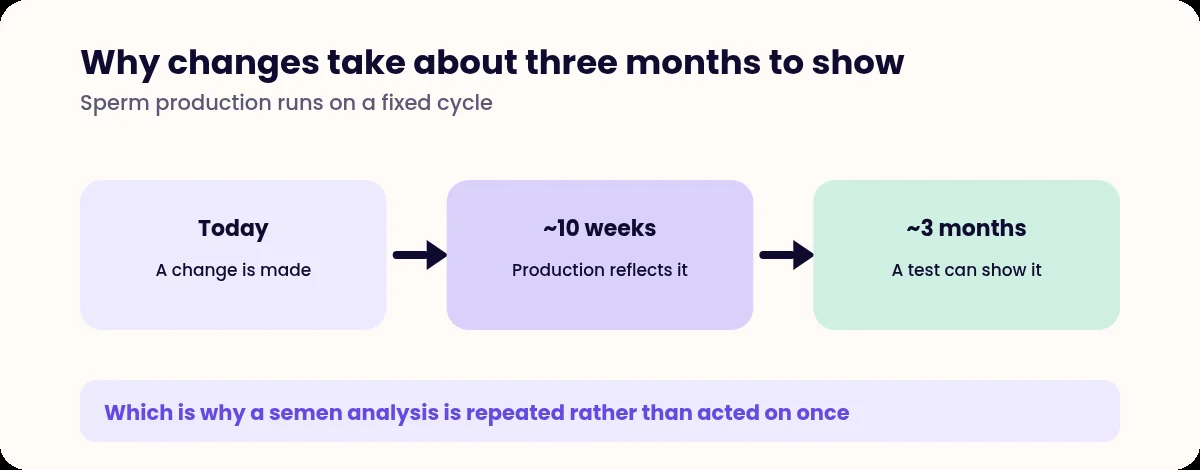
Spermatogenesis — the production of a sperm cell from its precursor — takes approximately 74 days. Add roughly two weeks of maturation and transit through the epididymis, and the sperm in today’s sample began forming around three months ago.
Every practical consequence follows from this. Stopping smoking, losing weight, stopping steroids, changing a medicine: none of it will show in a sample taken four weeks later, because those sperm were already made. Anyone offering a faster result is not describing human biology.
It also means the three months are not wasted. They are the window in which changes are actually taking effect.
What the guideline says about lifestyle
NG257 is careful about what is established and what is not, and it is worth reproducing that care rather than overclaiming [1].
Alcohol. Excessive alcohol damages semen quality. Drinking within the UK Chief Medical Officers’ guideline — no more than 14 units a week, spread over three or more days — is described as unlikely to affect semen quality [1, 6]. Note the UK framing in units; American advice in “standard drinks” is not the same measure.
Smoking. Associated with reduced semen quality, though the effect on actual fertility is uncertain. Support to stop is recommended regardless [1].
Weight. A BMI of 30 or above is associated with increased risk of reduced fertility [1]. Our guide to weight and fertility covers the mechanisms in both partners.
Scrotal temperature. Elevated scrotal temperature is associated with reduced semen quality — but the guideline explicitly states it is uncertain whether wearing loose-fitting underwear improves fertility [1]. This is worth saying plainly, because the internet is confident about laptops, hot baths and boxer shorts in a way the evidence is not.
Occupation. Worth asking about hazards — heat, solvents, pesticides, heavy metals.
Recreational drugs. NG257 advises asking specifically about anabolic steroids and cannabis [1].
The medicines to ask about
The 2026 update names three explicitly, and one of them is new [1].
Testosterone replacement. This suppresses the hormonal axis that drives sperm production, collapsing the testosterone concentration inside the testis and producing very low or absent sperm counts. It should not be given to a man seeking conception. Recovery after stopping, from pooled trial data, reaches 20 million/ml in around 67% by six months, 90% by twelve months and close to 100% by 24 months [4]. Our guide to testosterone replacement in the UK covers this in more detail.
Finasteride. Reduces ejaculate volume. Effects on sperm count at the lower dose used for hair loss are inconsistent and generally small, though case reports describe marked reductions that reversed on stopping. Being named in NG257 raises the bar for counselling men who are trying to conceive. Our guide to finasteride side effects covers the wider profile.
GLP-1 receptor agonists. Newly named in the 2026 guideline. The evidence here is preliminary, and weight loss itself generally improves semen parameters, so this should be read as an area of active uncertainty rather than established harm.
Others worth raising with a prescriber include sulfasalazine, chemotherapy agents, ketoconazole, spironolactone and long-term opioids. Do not stop a prescribed medicine on the strength of this list — raise it with your prescriber, who can weigh it against why you are taking it.
Anabolic steroids
The single most important reversible cause in young men who turn out to have no sperm in a sample, and the one most often not volunteered.
The mechanism is the same as with testosterone replacement: external androgens suppress the pituitary signals that drive the testes. Recovery is slower in this group — mean around 10.4 months, with FSH normalising at around 19 months and inhibin B at around 31 months [4]. Longer use, higher doses, older age and pre-existing testicular problems all slow it further.
Salvage treatments exist and are used in specialist andrology practice, but they are off-label in the UK and specialist-initiated. Our guide to hair loss and anabolic steroids covers the other visible consequences.
Telling a clinician honestly changes the tests and the advice. It is worth doing.
When to seek help
If you have been trying for 12 months without conception, both partners should be assessed. Sooner — around six months — if the female partner is over 36, or if there is a known reason for concern on either side.
Any testicular lump, hard or irregular testis, or testicular swelling needs an urgent GP appointment on the suspected cancer pathway, regardless of fertility. Our guide to when to see someone about a sexual problem sets out the other red flags.
Frequently asked questions
What is a normal sperm count?
Under the WHO 6th edition values used in current UK practice, the lower reference limit for concentration is 16 million per millilitre and for total sperm number 39 million per ejaculate. A result below that is not a diagnosis of infertility — the limits are the fifth centile of men whose partners conceived within a year, meaning one in twenty fertile men falls below them.
How long before lifestyle changes show up in a test?
About three months. Spermatogenesis takes roughly 74 days, plus around two weeks of transit through the epididymis. Nothing you change this week will appear in a sample taken next month. Anyone promising faster is not describing biology.
Does testosterone replacement affect fertility?
Yes, substantially. It suppresses the hormonal axis that drives sperm production and causes very low or absent sperm counts. It should not be given to a man seeking conception. After stopping, recovery data suggest around 67 per cent reach 20 million/ml by six months, 90 per cent by twelve and close to all by 24 months.
Will anabolic steroids permanently affect my fertility?
Usually not permanently, but recovery is slow — mean recovery time in former users is around 10.4 months, with some hormonal markers taking well over a year to normalise. Longer use, higher doses and older age all slow it. It is the single most important reversible cause in young men found to have no sperm in a sample.
References
- NICE. Fertility problems: assessment and treatment. NG257 (March 2026). www.nice.org.uk/guidance/ng257
- World Health Organization. WHO laboratory manual for the examination and processing of human semen, 6th edition (2021). www.who.int/publications/i/item/9789240030787
- Human Reproduction. Critique of the WHO 6th edition reference population (2022). academic.oup.com/humrep/article/37/10/2237/6645757
- Desai A et al. Recovery of spermatogenesis following exogenous testosterone. Therapeutic Advances in Urology (2022). journals.sagepub.com/doi/10.1177/17562872221105017
- NHS. Infertility. www.nhs.uk/conditions/infertility/
- UK Chief Medical Officers' low risk drinking guidelines. www.gov.uk/government/publications/alcohol-consumption-advice-on-low-r
Medical reviewer
Naeem Teni
Clinical Lead at Manova. Registered pharmacist and independent prescriber, GPhC 2215591. Reviews Manova’s clinical content for accuracy and safety.
Written by
Manova Editorial Team
Researched and written to our editorial policy, using NICE, NHS, MHRA and peer-reviewed sources.
This article is for general information and isn’t a substitute for advice from your own clinician. If you feel unwell, contact your GP or NHS 111. In an emergency, call 999.