

Key takeaways
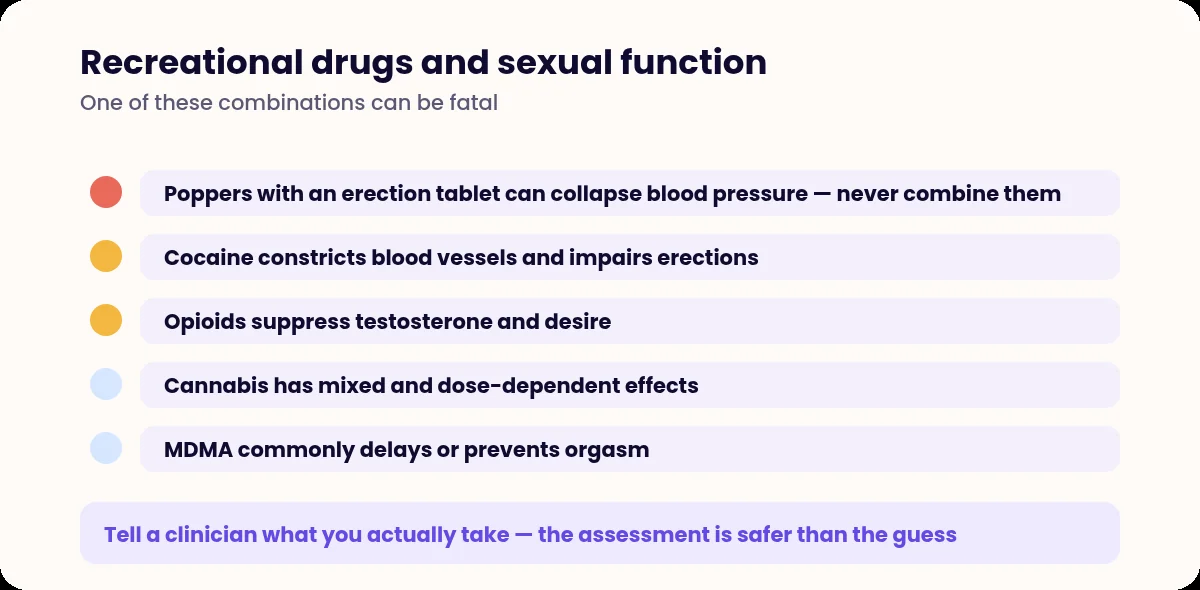
- Nitrites (poppers) taken with any PDE5 inhibitor can cause a sudden, severe and potentially fatal drop in blood pressure — this is an absolute contraindication, not a caution.
- Cocaine and MDMA typically raise desire while impairing erection and delaying or blocking ejaculation, which is a common reason men present convinced something is permanently wrong.
- Opioids have the strongest evidence of the illicit drugs, suppressing testosterone production and causing low libido, erectile difficulty and reduced fertility.
- Telling a clinician what you actually use changes the assessment and the safety advice, and UK sexual health services are used to hearing it.
Drugs and sex overlap far more often than clinical records suggest. Men do not mention it, clinicians do not always ask, and the result is that a genuinely dangerous interaction goes unspoken while a reversible problem gets treated as a permanent one.
This article is written on a harm reduction basis. Not using is the lowest-risk option and we are not pretending otherwise, but disapproval is a poor clinical tool: it reliably stops people disclosing, and what you do not disclose cannot be made safer.
The one that can kill you: nitrites and PDE5 inhibitors
Poppers are alkyl nitrites — amyl, isopropyl or isobutyl nitrite — inhaled for a short, intense flush and for smooth muscle relaxation. They work by releasing nitric oxide, which drops blood pressure quickly.
PDE5 inhibitors, the class of prescription erection medicines, work further along the same nitric oxide pathway and amplify its effect.
Taken together, the two can cause a profound, sudden and potentially fatal collapse in blood pressure. This is listed as an absolute contraindication in the product licence of every PDE5 inhibitor sold in the UK. It is not a theoretical concern and it is not dose-dependent in any reassuring way.
The practical points:
- Do not combine them. That is the only advice with no residual risk.
- If you use poppers, you need to know that PDE5 inhibitors stay active for very different lengths of time. The shorter-acting members of the class are largely cleared within about 24 hours. The long-acting one has a half-life of around 17.5 hours and can still be pharmacologically relevant close to 48 hours later. Our explainer on the PDE5 inhibitor class sets out how they differ.
- Being honest with a prescriber about poppers use is not going to get you refused treatment out of hand, but concealing it removes the one safety check that matters.
- If you have taken both and feel faint, grey out, or have chest pain, call 999. Lie flat and raise your legs while waiting. Say what you have taken — this changes the treatment.
Poppers carry other harms worth knowing. Methaemoglobinaemia can occur, particularly if the liquid is swallowed rather than inhaled, which is far more dangerous and has been fatal. Poppers maculopathy — loss of central vision from retinal damage — has been reported mainly since the shift to isopropyl nitrite; it often improves after stopping, but not always. Spilt liquid causes chemical burns. Twenty-five deaths involving alkyl nitrites were registered in England and Wales between 2001 and 2020 [1].
UK legal status is genuinely confusing. Possession is not an offence. Supply for human consumption is likely caught by the Psychoactive Substances Act 2016, which is why poppers are sold as room odourisers or leather cleaner. The Advisory Council on the Misuse of Drugs has recommended exempting them and regulating quality and age of sale instead [1].
Cocaine
Acutely, cocaine tends to increase desire and confidence while making erections harder to sustain and ejaculation delayed or impossible. Many men notice this the first time and assume it is a new sexual problem rather than a drug effect.
With regular use the picture shifts to reduced libido, persistent erectile difficulty and anorgasmia. Cocaine is also a recognised cause of priapism — an erection lasting more than three to four hours, which is a medical emergency and needs A&E, not waiting it out [2]. Over the longer term, repeated vasospasm and accelerated arterial disease are plausible contributors to vascular erectile dysfunction, which sits alongside the other causes of erectile dysfunction worth assessing.
The evidence here is moderate and mostly observational. What is fair to say is that the direction of effect is consistent and that function commonly improves when use falls.
Cannabis
Cannabis has the best evidence base of the illicit drugs. Heavy or chronic use is associated with erectile dysfunction, and with reduced sperm concentration and motility. The effect appears dose-related and at least partly reversible.
Current UK fertility guidance names cannabis specifically as a drug to ask about when a couple is being assessed [3], which is a meaningful change in emphasis — see our guide to sperm health and male fertility for what a semen analysis actually measures.
Occasional use in a man with no other risk factors is unlikely to be the whole explanation for erectile difficulty. Daily use is worth reducing as a diagnostic experiment before concluding the problem is structural.
MDMA
MDMA reliably increases feelings of desire, closeness and skin sensitivity while impairing erection and markedly delaying or blocking both ejaculation and orgasm. Survey data suggest around 46% of male users report reduced erectile ability.
That combination — wanting sex intensely while being unable to perform or finish — is why MDMA and PDE5 inhibitors are frequently taken together, often without any clinical oversight, and often alongside poppers. That stack is the dangerous one.
The evidence is survey-based and of moderate quality. The other MDMA risks, particularly hyponatraemia from drinking large volumes of water, are outside the scope of this article but not outside the scope of a long night.
Opioids
Heroin, methadone and long-term prescribed opioids all suppress the hypothalamic–pituitary–gonadal axis, producing what is called opioid-induced androgen deficiency. The result is low libido, erectile difficulty, reduced ejaculate volume and low sperm counts. The effect is dose-related and is particularly well documented with methadone [4].
This is the best-evidenced association in the whole category, and it is also the most treatable: the first step is opioid reduction or rotation, discussed with the prescriber, rather than adding testosterone on top. If you are on long-term opioids for pain and your libido has gone, that is a conversation to have — not something to accept. Our article on low libido in men covers the other causes worth excluding at the same time.
Chemsex
Chemsex usually means using methamphetamine, mephedrone or GHB/GBL specifically to have sex, most often but not exclusively among men who have sex with men. It is worth discussing factually, because the tabloid version of it helps nobody.
The clinically relevant issues are the risk of HIV, other STIs and hepatitis C — including through injecting, known as slamming; GHB overdose, which has a narrow margin between the dose that works and the dose that stops your breathing; and dependence. Methamphetamine-associated erectile difficulty, widely called crystal dick, drives heavy and usually unsupervised use of erection medicines bought outside any clinical route — which is how the poppers interaction above ends up happening at scale [5, 6].
Practical harm reduction: do not mix GHB with alcohol or ketamine; measure doses with a syringe and space them deliberately; never combine nitrites with a PDE5 inhibitor; use condoms, PrEP and doxyPEP as appropriate; use needle exchange rather than sharing.
UK support is real and non-judgemental. Sexual health clinics are self-referral, free and confidential. Change Grow Live runs chemsex-specific support, London Friend’s Antidote service works nationally by phone, and 56 Dean Street in London has long-standing expertise. FRANK covers general drug information.
Getting the sexual problem assessed anyway
A drug explanation does not remove the need for an assessment. Erectile dysfunction is an independent cardiovascular risk marker regardless of what else is going on [7], and men who use stimulants often have other risk factors stacked alongside. If you are not sure whether what you are experiencing needs a clinician, our guide on when to see someone about a sexual problem sets out the red flags.
Frequently asked questions
How long should I leave between poppers and an erection medicine?
The interaction is an absolute contraindication in every PDE5 inhibitor product licence, so the safest answer is not to combine them at all. Where a gap is discussed, the shorter-acting PDE5 inhibitors need at least 24 hours and the long-acting one needs at least 48 hours, because it stays in the body far longer. If you have taken both and feel faint, call 999.
Does cocaine cause permanent erection problems?
Not usually from occasional use, but regular use is associated with reduced libido, erectile difficulty and problems reaching orgasm, and cocaine is a recognised cause of priapism and of vascular damage through repeated vasospasm. The evidence is largely observational. Function often improves when use reduces.
Will my GP report me for using drugs?
No. UK clinicians ask about drug use to make treatment safe, not to involve the police. Sexual health clinics in particular are used to these conversations and can be accessed without going through your GP. What you disclose affects which medicines are safe to prescribe, so it genuinely matters.
Is cannabis bad for sperm?
Heavy or chronic cannabis use is associated with reduced sperm concentration and motility, and current UK fertility guidance explicitly names cannabis as something to ask about when a couple is trying to conceive. The effect appears dose-related and at least partly reversible after stopping.
References
- Advisory Council on the Misuse of Drugs. Report on alkyl nitrites (poppers). assets.publishing.service.gov.uk/media/66b5e7c40808eaf43b50df8a/
- NHS. Priapism (painful erections). www.nhs.uk/symptoms/priapism-painful-erections/
- NICE. NG257: Fertility problems — assessment and treatment. www.nice.org.uk/guidance/ng257
- Kafel et al. Opioid-induced androgen deficiency. Andrology, 2025. onlinelibrary.wiley.com/doi/10.1111/andr.70013
- Change Grow Live. Chemsex information and support. www.changegrowlive.org/advice-info/drugs/chemsex/professionals
- M3THOD study. Harm Reduction Journal, 2025. link.springer.com/article/10.1186/s12954-025-01329-2
- European Association of Urology. Guidelines on Sexual and Reproductive Health. uroweb.org/guidelines/sexual-and-reproductive-health
Medical reviewer
Naeem Teni
Clinical Lead at Manova. Registered pharmacist and independent prescriber, GPhC 2215591. Reviews Manova’s clinical content for accuracy and safety.
Written by
Manova Editorial Team
Researched and written to our editorial policy, using NICE, NHS, MHRA and peer-reviewed sources.
This article is for general information and isn’t a substitute for advice from your own clinician. If you feel unwell, contact your GP or NHS 111. In an emergency, call 999.