

Key takeaways
- Per kilogram lost through lifestyle change, triglycerides fall about 0.045 mmol/L and LDL about 0.033 mmol/L.
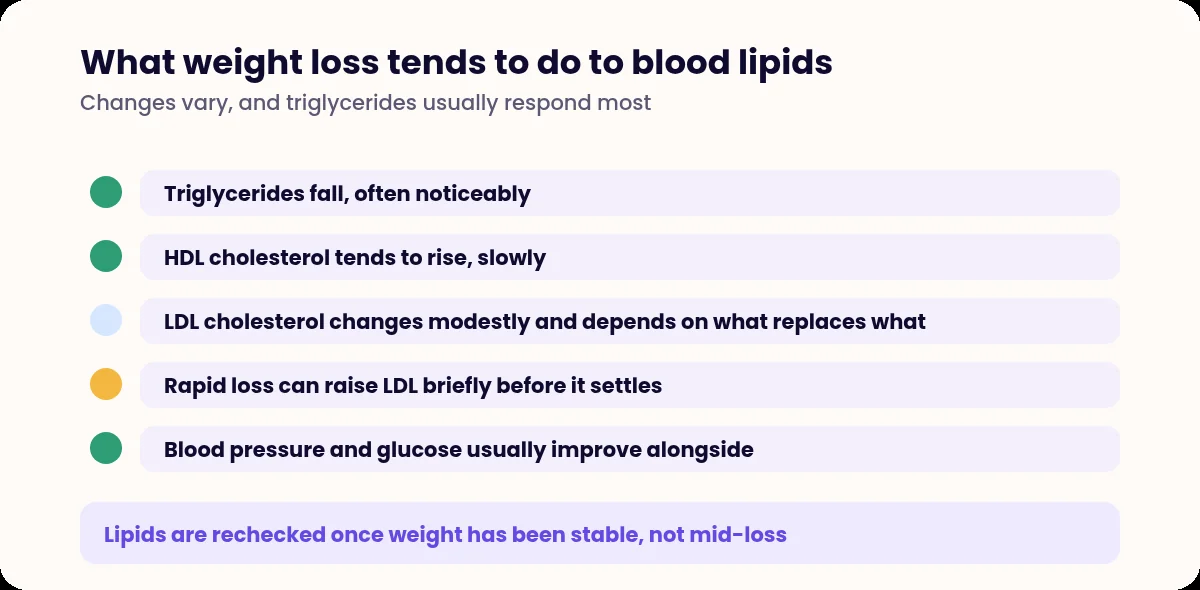
- Weight loss does much more for triglycerides and HDL than for LDL cholesterol.
- Statins lower LDL far more than weight loss does; the two do different jobs.
- Diet composition shapes the pattern: low carbohydrate favours triglycerides and HDL, low fat favours LDL.
“Lose weight and your cholesterol will come down” is true, and it hides a useful detail: the parts of the panel that respond are not the parts most people are told to worry about.
The numbers
A meta-analysis of 73 randomised trials covering more than 32,000 people measured lipid changes per kilogram of weight lost at 12 months [1]. Converted into the units UK labs use:
| Per 1 kg lost via lifestyle change | Change |
|---|---|
| Triglycerides | −0.045 mmol/L |
| LDL cholesterol | −0.033 mmol/L |
| HDL cholesterol | +0.012 mmol/L |
Scale that to a realistic 10 kg loss:
- Triglycerides −0.45 mmol/L
- LDL −0.33 mmol/L
- HDL +0.12 mmol/L
The triglyceride change is substantial. The LDL change is real but modest.
Why that asymmetry matters
Because the conversation people usually want to have is about statins.
A 10 kg weight loss lowering LDL by around 0.3 mmol/L is a genuine improvement. A moderate-intensity statin typically lowers LDL by 1.5 mmol/L or more — roughly five times as much, reliably, without requiring you to lose 10 kg.
That does not make weight loss pointless. It makes it a different tool. Weight loss improves triglycerides, HDL, blood pressure, blood glucose, liver fat and how you feel. A statin lowers LDL. If your risk assessment says you need LDL lowered substantially, weight loss alone is unlikely to get you there.
Anyone deciding whether to start, continue or stop a statin should do it with the clinician who calculated their cardiovascular risk. That risk score includes age, blood pressure, smoking, diabetes and family history, not just cholesterol.
Where weight loss wins outright
Triglycerides. These respond faster and further than any other lipid measure. High triglycerides are strongly linked to excess weight, alcohol, refined carbohydrate and insulin resistance, and all four respond to the same changes.
If your triglycerides are high, weight loss plus reduced alcohol is genuinely the main treatment.
HDL. Rises modestly with weight loss and more with activity.
Non-HDL cholesterol, which UK guidance increasingly uses instead of LDL, improves through the triglyceride effect as well.
Diet composition changes the pattern
From the same meta-analysis [1]:
- Low-carbohydrate diets reduced triglycerides and raised HDL most
- Low-fat diets reduced triglycerides and LDL, and raised HDL
So if LDL is the problem you are trying to solve, a lower-fat pattern — particularly replacing saturated fat with unsaturated fat — does more. If triglycerides are the problem, reducing refined carbohydrate and alcohol does more.
The Mediterranean pattern sits usefully in the middle and has the best hard-outcome evidence of any eating pattern, which is covered in the Mediterranean diet.
The things that move LDL that are not weight
- Replacing saturated fat with unsaturated fat
- Soluble fibre — oats, barley, beans, psyllium
- Plant stanols and sterols
- Reducing alcohol, mainly through triglycerides
- Statins and, where needed, ezetimibe or other agents
When to recheck
Lipids respond over weeks to months. Rechecking two weeks after starting a diet will mostly measure noise. Three months of a sustained change is a more informative interval, and your GP practice will usually have a view on timing.
One practical note: many UK labs no longer require fasting for a standard lipid profile. Check locally rather than assuming.
When to speak to a clinician
Speak to a clinician if you:
- have been advised to take a statin and want to discuss whether lifestyle change could substitute
- have triglycerides above about 10 mmol/L, which raises the risk of pancreatitis and needs prompt attention
- have a family history of early heart disease, or very high cholesterol from a young age, which may indicate familial hypercholesterolaemia
- have not had a cardiovascular risk assessment and are over 40
- are stopping or reducing a statin for any reason — this should be a shared decision, not a unilateral one
Frequently asked questions
Will losing weight lower my cholesterol?
It will improve your lipid profile, but unevenly. Triglycerides respond well and HDL rises modestly. LDL cholesterol falls only slightly — around 0.03 mmol/L per kilogram lost through lifestyle change.
Can I avoid statins by losing weight?
For most people who have been offered a statin, no. A 10 kg loss might lower LDL by around 0.3 mmol/L; a moderate-intensity statin typically lowers it by 1.5 mmol/L or more. That is a conversation with the clinician who assessed your risk, not a substitute decision.
Which diet is best for cholesterol?
It depends which number you are trying to move. Low-fat approaches lower LDL more; low-carbohydrate approaches lower triglycerides and raise HDL more. Both lower triglycerides.
How quickly does cholesterol improve?
Triglycerides respond within weeks of reduced intake and reduced alcohol. LDL changes are slower and smaller. Most guidance suggests rechecking after around three months of a sustained change.
References
- Effect of weight loss interventions on lipid profiles: systematic review and meta-analysis of 73 randomised trials. Journal of Clinical Endocrinology & Metabolism. 2020. pubmed.ncbi.nlm.nih.gov/32954416/
- NICE. Cardiovascular disease: risk assessment and reduction, including lipid modification. CG181. www.nice.org.uk/guidance/cg181
- NHS. High cholesterol. www.nhs.uk/conditions/high-cholesterol/
- HEART UK. Understanding your cholesterol test results. www.heartuk.org.uk/cholesterol/understanding-your-cholesterol-test-res
Medical reviewer
Naeem Teni
Clinical Lead at Manova. Registered pharmacist and independent prescriber, GPhC 2215591. Reviews Manova’s clinical content for accuracy and safety.
Written by
Manova Editorial Team
Researched and written to our editorial policy, using NICE, NHS, MHRA and peer-reviewed sources.
This article is for general information and isn’t a substitute for advice from your own clinician. If you feel unwell, contact your GP or NHS 111. In an emergency, call 999.