

Key takeaways
- These medicines are not for use in pregnancy, and the MHRA advises women of childbearing potential to use effective contraception while taking them.
- With tirzepatide specifically, women using oral contraception are advised to switch to a non-oral method or add a barrier method for 4 weeks after starting and after each dose increase.
- Semaglutide should be stopped at least 2 months before a planned pregnancy; tirzepatide at least 1 month.
- If you become pregnant while taking one, stop and contact your prescriber or GP promptly — do not simply continue.
This is the part of weight-management treatment that gets least attention and has the clearest official advice attached to it.
This page is information about prescription-only medicines. It is not a substitute for the advice of your own prescriber, and it does not replace the patient information leaflet that comes with your medicine.
The MHRA advice
In June 2025 the MHRA advised women of childbearing potential taking GLP-1 and dual GIP/GLP-1 medicines for weight management to use effective contraception while on treatment, because there is not enough evidence about safety in pregnancy [1].
That advice sits alongside the product information for each medicine, which states these medicines should not be used during pregnancy [2][3].
The tirzepatide and oral contraception issue
This is the specific point that catches people out.
Tirzepatide slows stomach emptying. Oral contraceptives are absorbed from the gut. The combination can reduce the amount of contraceptive hormone absorbed, particularly during the period when the body is adjusting to a new dose.
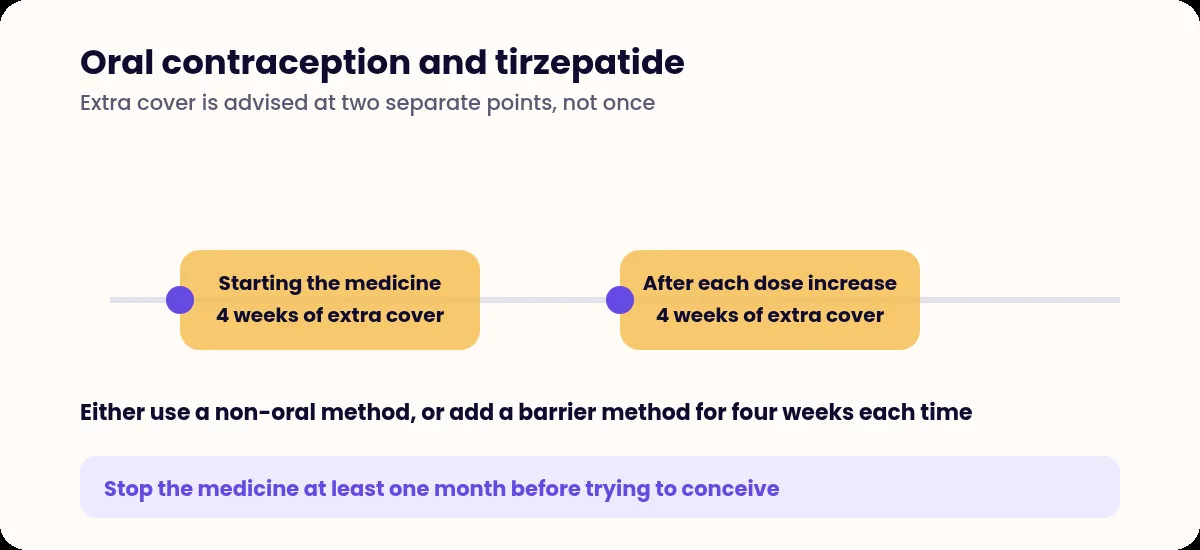
The advice for women using oral contraception is therefore to switch to a non-oral method, or add a barrier method, for four weeks after starting tirzepatide and for four weeks after each dose increase [1][2].
Read that again, because the second half is the part people miss. It is not a one-off four weeks at the start. Every time the dose steps up — and there are up to five increases on the way to the maximum — another four-week window opens.
Non-oral methods, which are not affected in this way, include the implant, the injection, the intrauterine device or system, and the patch or ring. A pharmacist or your GP practice can go through the options [4].
Before a planned pregnancy
Both medicines need to be stopped, and the timings differ because the medicines clear at different rates [2][3]:
| Medicine | Stop before a planned pregnancy |
|---|---|
| Semaglutide (Wegovy) | at least 2 months |
| Tirzepatide (Mounjaro) | at least 1 month |
Semaglutide’s longer washout reflects its long half-life — it is still present in the body for weeks after the last injection.
There is a second consideration that is easy to miss. Stopping a weight-management medicine tends to be followed by returning appetite and some weight regain, as covered in our guide to stopping weight loss medication. Planning a pregnancy means planning for that period too, ideally with support rather than alone.
If you become pregnant unexpectedly
Stop the medicine and contact your prescriber or GP promptly. Do not continue in the hope it is fine, and do not stop and say nothing.
There is not enough human safety data for anyone to give you a confident reassurance, which is precisely why the advice is to avoid pregnancy while taking these medicines. What happens next — monitoring, folic acid, other medicines you take — is a conversation to have quickly with a clinician.
Breastfeeding
This is an area where the two main medicines now say different things, and where a lot of published advice is out of date.
The semaglutide product information advises against use during breastfeeding [3].
The tirzepatide product information has changed. It now states that tirzepatide “could be considered for use during breast-feeding”. The reasoning given is that after a single dose, concentrations in breast milk were undetectable to very low, and that tirzepatide is an amino acid sequence, so any small amount an infant swallowed would be expected to be broken down rather than absorbed intact [2].
“Could be considered” is not the same as “is recommended”. It moves the decision to your prescriber rather than settling it. But it does mean that a blanket statement that these medicines are never compatible with breastfeeding is no longer accurate, and if you were told that, it is worth asking again.
The fertility point nobody mentions
Excess weight is a common cause of disrupted ovulation. Losing weight can restore regular cycles — which means some women become more fertile during treatment than they were before it, sometimes considerably more, and sometimes without realising.
If you have had irregular or absent periods and they return during treatment, treat that as a change in your fertility, not just a change in your cycle.
When to speak to a clinician
Speak to your prescriber before starting if you are planning a pregnancy, if you are unsure whether your contraception is affected, or if you are breastfeeding. Contact them promptly if you become pregnant while taking one of these medicines. Suspected side effects can be reported through the MHRA Yellow Card scheme [6].
Frequently asked questions
Can you take weight loss injections while trying to conceive?
No. The product information states these medicines should not be used in pregnancy, and they should be stopped before conception — at least two months for semaglutide because of its long half-life, and at least one month for tirzepatide.
Do weight loss injections affect the pill?
Tirzepatide can reduce the effectiveness of oral contraceptives, because delayed stomach emptying affects absorption. The advice is to switch to a non-oral method, or add a barrier method, for four weeks after starting and for four weeks after each dose increase.
What if I get pregnant while taking one?
Stop the medicine and contact your prescriber or GP promptly. There is not enough safety data in pregnancy to be reassuring, and the decision about what happens next should be made with a clinician rather than alone.
Can you breastfeed while taking them?
It depends on the medicine, and the answer recently changed. The semaglutide product information advises against it. The tirzepatide product information now says it could be considered during breastfeeding. Check the current leaflet for your specific medicine and raise it with your prescriber.
Do these medicines affect fertility?
Weight loss itself can restore ovulation in some women with obesity-related cycle problems, which means fertility can increase — sometimes unexpectedly. That is part of why the contraception advice matters.
References
- The Pharmaceutical Journal. MHRA urges women taking weight-loss drugs to use effective contraception. 5 June 2025. pharmaceutical-journal.com/article/news/mhra-urges-women-taking-weight
- Eli Lilly and Company Limited. Mounjaro KwikPen: Summary of Product Characteristics, section 4.6. Electronic Medicines Compendium. www.medicines.org.uk/emc/product/15484/smpc
- Novo Nordisk Limited. Wegovy: Summary of Product Characteristics, section 4.6. Electronic Medicines Compendium. www.medicines.org.uk/emc/product/13803/smpc
- NHS. Contraception. www.nhs.uk/conditions/contraception/
- NHS. Planning your pregnancy. www.nhs.uk/pregnancy/trying-for-a-baby/planning-your-pregnancy/
- MHRA. Yellow Card: report a suspected side effect. yellowcard.mhra.gov.uk/
Medical reviewer
Naeem Teni
Clinical Lead at Manova. Registered pharmacist and independent prescriber, GPhC 2215591. Reviews Manova’s clinical content for accuracy and safety.
Written by
Manova Editorial Team
Researched and written to our editorial policy, using NICE, NHS, MHRA and peer-reviewed sources.
This article is for general information and isn’t a substitute for advice from your own clinician. If you feel unwell, contact your GP or NHS 111. In an emergency, call 999.