

Key takeaways
- Finasteride lowers DHT, addressing the hormonal driver of miniaturisation; minoxidil prolongs the growth phase of the hair cycle. The mechanisms are unrelated.
- Finasteride is a prescription only tablet; topical minoxidil is available from UK pharmacies without a prescription.
- Studies of the two used together have generally shown better results than either alone, and combined use is common in practice.
- Both are maintenance treatments — benefit is lost within months of stopping either.
This page is medicine information rather than an advert. Finasteride is a prescription only medicine in the UK [5]; topical minoxidil is a pharmacy medicine. Whether either is suitable is a decision for a prescriber or pharmacist after an assessment.
The two are often presented as a choice. They are better understood as two levers on the same process, pulled in different places.
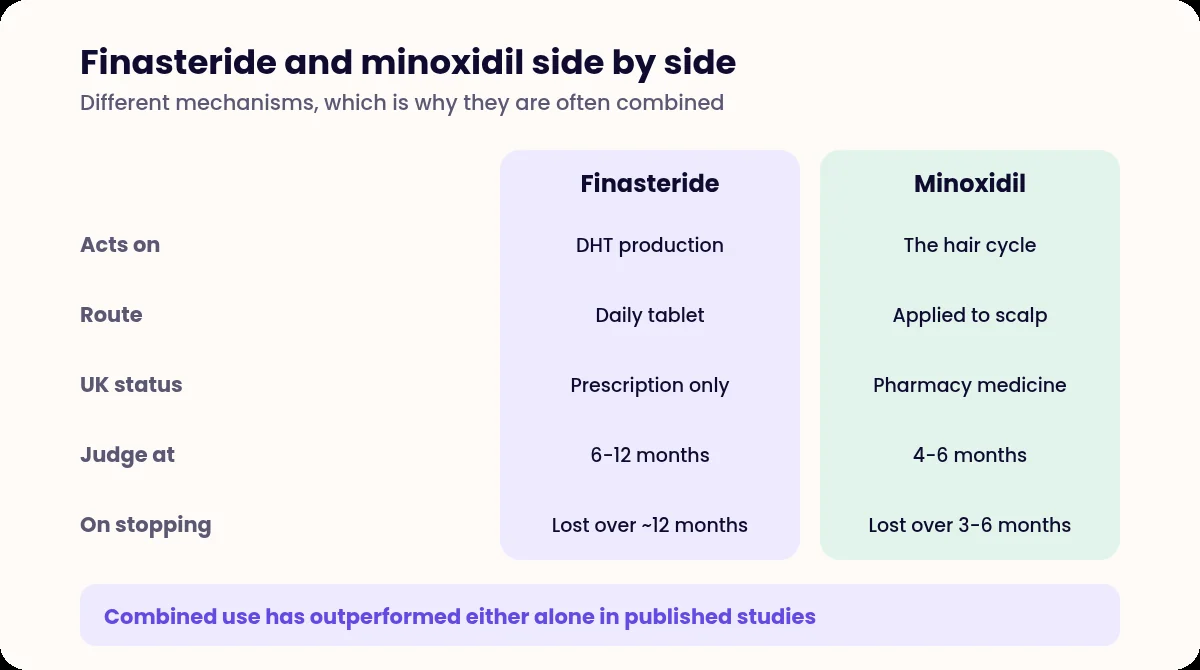
Side by side
| Finasteride | Topical minoxidil | |
|---|---|---|
| What it does | Inhibits type 2 5-alpha reductase, lowering DHT at the follicle | Prolongs the anagen (growth) phase and increases follicle size |
| Target | The hormonal cause of miniaturisation | The hair cycle itself |
| Route | Tablet, once daily | Solution or foam applied to the scalp |
| UK status | Prescription only medicine | Pharmacy medicine, no prescription needed |
| Licensed for women | No | Yes, at the strengths and regimens stated for the specific product |
| Time to judge | 6 to 12 months | 4 to 6 months |
| Early shedding | Possible, brief | Common in the first weeks |
| Main side effects | Sexual side effects in a small percentage; mood changes including depression carry a specific warning | Scalp irritation, itching, unwanted facial hair from transfer |
| On stopping | Benefit lost over about 12 months | Benefit lost over 3 to 6 months |
Where each is strongest
Finasteride acts on the driver. Because DHT is what shortens each successive growth cycle, lowering it slows the whole process rather than compensating for it. In the licensing trials most men maintained or increased hair count over a year while placebo groups continued to lose [2]. It tends to perform better at the crown and mid-scalp than at a receded frontal hairline.
Minoxidil does not touch DHT. It makes each follicle grow for longer and thicker while you use it, which produces visible improvement without altering the underlying process [3]. It is the option available without a prescription, which matters practically, and it can be used by people for whom finasteride is unsuitable.
Why combining them makes sense
Different mechanisms, no significant interaction, and published comparisons of combination therapy against either agent alone have generally favoured the combination for hair count and investigator assessment [1, 4]. In UK practice, men on finasteride are frequently using topical minoxidil as well.
The practical argument for starting one at a time is attribution: if a side effect appears, you know which treatment caused it. The argument for starting both is that both take months to show results and running them in series adds a year to the process. Neither is wrong; it depends on how cautious you want to be.
Choosing if you’re only going to use one
Some reasonable lines of reasoning:
Lean towards finasteride if the loss is progressing quickly, if you want to slow the underlying process rather than compensate for it, and if you are comfortable after discussing the side effect profile with a prescriber.
Lean towards minoxidil if you would rather not take a systemic medicine, if you are actively trying to conceive and would prefer to avoid any question (finasteride’s effect on semen parameters is not established as clinically significant, but some men prefer to sidestep the issue), if you have a history of depression that makes the psychiatric warning on finasteride something you want to avoid, or if you simply want to start today.
For women, finasteride is not licensed and the approach differs entirely — see female pattern hair loss.
What both have in common
They are maintenance treatments. Neither cures anything. Stop either and its contribution unwinds over months.
They preserve better than they restore. Miniaturised follicles still producing fine hair can improve; follicles dormant for years generally cannot. This is why starting earlier gives more to work with, and why expectations set against an old photograph tend to disappoint. See male pattern baldness for why.
They need months and photographs. Both are slow enough that memory is an unreliable judge. Take standardised photographs at the start and at six and twelve months.
Early shedding is not failure. Both can push follicles into a new cycle, releasing old hairs first.
What about adding a transplant?
Surgery and medical treatment address different things. A transplant moves androgen-insensitive follicles into a bald area; it does nothing to stop loss in the native hair around them, which is why men who have transplants without ongoing medical treatment often find the surrounding area thins and the result looks isolated within a few years. Surgeons commonly recommend continuing treatment afterwards — see hair transplants in the UK.
Getting started safely
Topical minoxidil can be bought from a pharmacy, where the pharmacist will check it is suitable. Finasteride requires a prescription and a proper assessment covering your health, your mood history, your fertility plans and your other medicines. A service that supplies it without asking those questions is not operating legally in the UK, and what arrives cannot be verified.
Frequently asked questions
Which works better, finasteride or minoxidil?
Head-to-head comparisons have generally favoured finasteride for overall hair count in men with male pattern hair loss, but the two act on different parts of the problem and combined use has outperformed either alone in published studies. Which suits you depends on your own risk profile and preferences.
Can I use both at the same time?
Yes, and it is common practice. They have different mechanisms and no significant interaction. Discuss it with a prescriber, since finasteride requires a prescription and an assessment.
Should I start with one and add the other?
Either approach is reasonable. Starting with one makes it easier to attribute any side effect to the right treatment; starting both together gets the full effect sooner. Talk it through with your prescriber.
If I stop one, do I lose everything?
You lose the contribution of the one you stop, over the following months. The other continues working. Both are maintenance treatments rather than cures.
References
- NICE Clinical Knowledge Summaries. Alopecia, androgenetic – male. cks.nice.org.uk/topics/alopecia-androgenetic-male/
- Summary of Product Characteristics: finasteride 1 mg film-coated tablets. Electronic Medicines Compendium. www.medicines.org.uk/emc/search?q=finasteride+1mg
- Summary of Product Characteristics: Regaine for Men Extra Strength 5% w/v cutaneous solution. Electronic Medicines Compendium. www.medicines.org.uk/emc/search?q=regaine
- DermNet. Androgenetic alopecia. dermnetnz.org/topics/androgenetic-alopecia
- The Human Medicines Regulations 2012, regulation 284. www.legislation.gov.uk/uksi/2012/1916/regulation/284
Medical reviewer
Naeem Teni
Clinical Lead at Manova. Registered pharmacist and independent prescriber, GPhC 2215591. Reviews Manova’s clinical content for accuracy and safety.
Written by
Manova Editorial Team
Researched and written to our editorial policy, using NICE, NHS, MHRA and peer-reviewed sources.
This article is for general information and isn’t a substitute for advice from your own clinician. If you feel unwell, contact your GP or NHS 111. In an emergency, call 999.