

Key takeaways
- Symptoms of low testosterone overlap heavily with poor sleep, depression, thyroid problems and simply being unwell — which is why diagnosis needs blood tests, not a symptom checklist.
- Testosterone should be measured on a fasting morning sample, and a low result must be repeated on a separate day before it means anything.
- Obesity, type 2 diabetes, opioid medicines and obstructive sleep apnoea are among the commonest reversible contributors.
- Low libido and reduced morning erections are more specific to testosterone deficiency than tiredness or low mood.
“Low testosterone” has become an explanation for almost anything a man in his forties is fed up about. Tiredness, thickening waistline, flat mood, no interest in sex. The awkward truth is that all of those things have several common causes, and testosterone is rarely the first one.
That doesn’t mean testosterone deficiency isn’t real. It is, it is treatable, and it is under-diagnosed in some groups — men with type 2 diabetes especially. But it is diagnosed on blood tests interpreted alongside symptoms, not on symptoms alone, and the testing has to be done properly [2, 3].
What the symptoms actually are
Clinicians divide them by how specific they are.
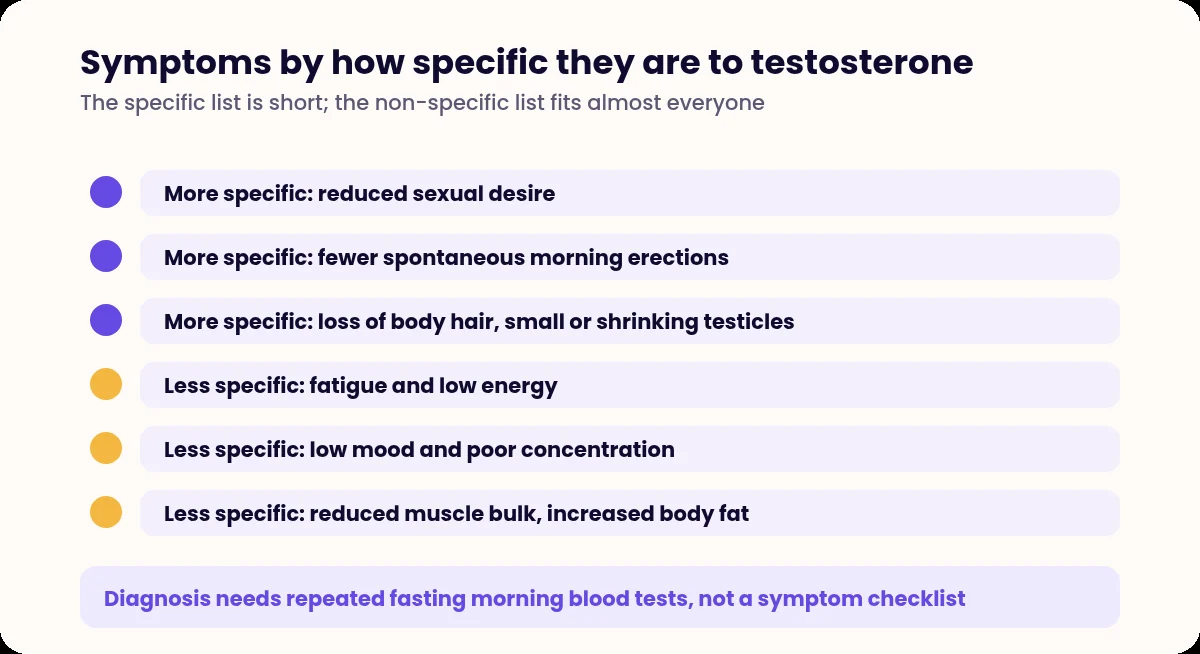
More specific to testosterone deficiency:
- reduced sexual desire
- fewer spontaneous erections, particularly on waking
- loss of body and facial hair
- small or shrinking testicles
- breast tenderness or enlargement
- hot flushes or sweats
- infertility with a low sperm count
Less specific — common, but caused by many other things:
- fatigue and low energy
- low mood or irritability
- poor concentration
- reduced muscle bulk and strength
- increased body fat
- poor sleep
If everything on your list comes from the second group and nothing from the first, testosterone deficiency is possible but statistically unlikely to be the explanation [2].
Why the test has to be done in the morning, fasting, twice
Three things trip people up.
Timing. Testosterone follows a circadian rhythm with a morning peak. A sample taken at 4pm can sit well below the reference range in a man whose 8am level is comfortably normal [2, 3].
Food. Eating lowers total testosterone measurably. Guidance is to sample fasting [2].
One result means nothing. Levels vary day to day, and any acute illness suppresses them. A low result is repeated on a separate morning before it is acted on [2, 3]. If you have been unwell, had surgery, or are in an unusually stressful stretch, that is a reason to delay testing rather than to test now.
A properly done work-up usually includes more than testosterone: LH and FSH (which distinguish a testicular problem from a pituitary one), SHBG (so free testosterone can be calculated, which matters because obesity lowers SHBG and can make total testosterone look falsely low), prolactin, full blood count, HbA1c, thyroid function, and often ferritin [2, 3].
The causes worth finding
A large proportion of men referred with low testosterone have a reversible or contributory cause, and finding it changes the plan.
Obesity. Adipose tissue converts testosterone to oestradiol and lowers SHBG. Weight loss is consistently associated with a rise in testosterone in men with obesity.
Type 2 diabetes. Testosterone deficiency is substantially more common in men with type 2 diabetes than in the general population, which is why some diabetes services screen for it.
Obstructive sleep apnoea. Untreated sleep apnoea suppresses testosterone and produces most of the non-specific symptom list on its own — the tiredness, the low mood, the poor concentration [5]. Loud snoring, witnessed pauses in breathing, and waking unrefreshed are worth mentioning to your GP.
Medicines. Opioid painkillers are the big one; long-term use suppresses testosterone markedly. Long-term corticosteroids, some antipsychotics and anabolic steroid use (including past use) all do too.
Alcohol. Heavy regular drinking lowers testosterone directly and via liver effects.
Anabolic steroids. Past or present use shuts down the body’s own production, sometimes for a long time after stopping. It is important to mention honestly; it changes both the interpretation of results and the treatment.
Pituitary problems. Less common, but a raised prolactin or a low LH alongside low testosterone prompts further investigation, sometimes including imaging.
What happens next
If repeated morning tests confirm deficiency and a cause has been looked for, the conversation moves to whether testosterone replacement is appropriate, what it involves, and what it does not do. That is covered in our guide to testosterone replacement in the UK.
If tests are normal, that is genuinely useful information rather than a dead end. It redirects attention to the things that are actually producing the symptoms — sleep, mood, alcohol, thyroid, iron, or the stage of life you’re in — and those are all treatable too.
Where low libido sits alongside erectile difficulty, our guides to what causes erectile dysfunction and lifestyle changes that help erections cover the wider picture.
A note on private testosterone testing
Direct-to-consumer finger-prick testosterone tests are widely sold. They can be a reasonable prompt to see someone, but a single result — particularly one taken at an unspecified time of day, unfasted, from capillary blood — is not a diagnosis. Take the result to a clinician rather than to a treatment provider, and expect it to be repeated properly.
Frequently asked questions
What is a normal testosterone level?
Reference ranges differ between laboratories, so results should be read against the range printed on your own report. UK and European guidance generally treats a repeated fasting morning total testosterone below roughly 12 nmol/L as warranting further assessment, and below 8 nmol/L as more clearly deficient, with the grey zone between the two interpreted alongside symptoms and a calculated free testosterone.
Why does the test have to be in the morning?
Testosterone follows a daily rhythm and is highest in the early morning, particularly in younger men. An afternoon sample can read low in a man whose morning level is normal. Guidance is to sample fasting, before 11am.
Does low testosterone cause erectile dysfunction?
It can contribute, but it is an uncommon sole cause. Most erectile dysfunction is vascular, psychological or medicine-related. Testosterone is usually checked as part of the work-up rather than assumed to be the answer.
Can losing weight raise testosterone?
Weight loss is associated with a rise in testosterone in men with obesity, and studies of both lifestyle programmes and bariatric surgery have shown this. It is one reason clinicians look at reversible contributors before considering replacement.
References
- NHS. Male menopause. www.nhs.uk/conditions/male-menopause/
- British Society for Sexual Medicine. Guidelines on adult testosterone deficiency. www.bssm.org.uk/guidelines/
- European Association of Urology. Guidelines on Sexual and Reproductive Health. uroweb.org/guidelines/sexual-and-reproductive-health
- NICE Clinical Knowledge Summaries. Erectile dysfunction. cks.nice.org.uk/topics/erectile-dysfunction/
- NHS. Obstructive sleep apnoea. www.nhs.uk/conditions/obstructive-sleep-apnoea/
Medical reviewer
Naeem Teni
Clinical Lead at Manova. Registered pharmacist and independent prescriber, GPhC 2215591. Reviews Manova’s clinical content for accuracy and safety.
Written by
Manova Editorial Team
Researched and written to our editorial policy, using NICE, NHS, MHRA and peer-reviewed sources.
This article is for general information and isn’t a substitute for advice from your own clinician. If you feel unwell, contact your GP or NHS 111. In an emergency, call 999.