

Key takeaways
- Acquired premature ejaculation is associated with erectile dysfunction in about a third of cases, and treating the erectile problem first often resolves the ejaculation problem.
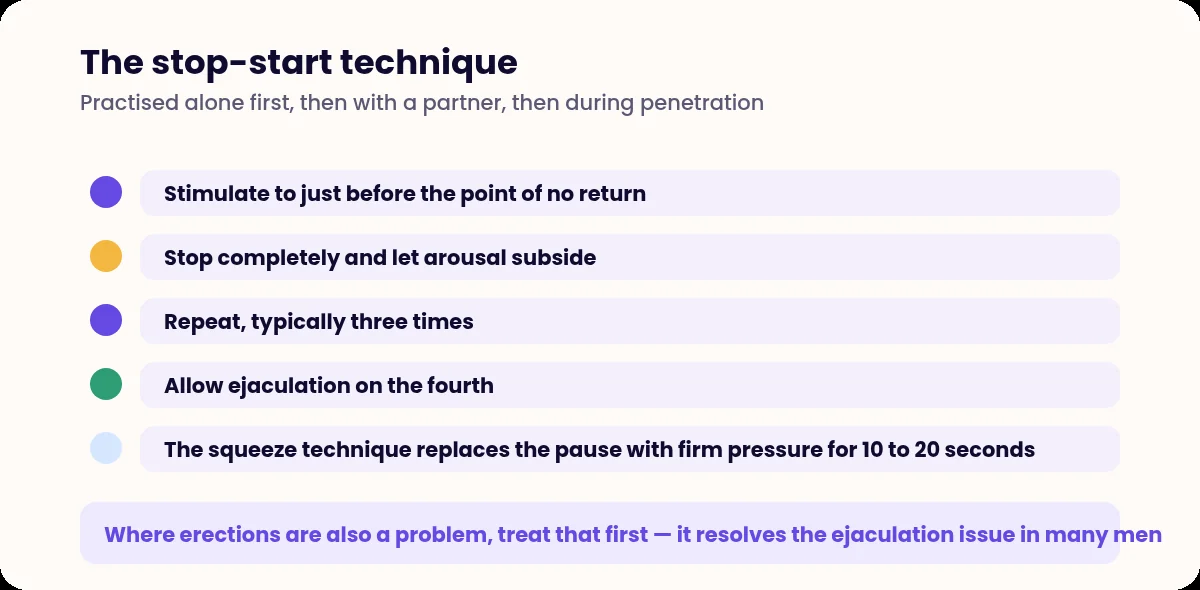
- Stop-start involves stimulating to just before the point of inevitability, stopping completely until arousal subsides, and repeating around three times before allowing ejaculation on the fourth.
- The squeeze technique adds firm pressure to the glans or base for roughly 10 to 20 seconds at the point of inevitability.
- The evidence for behavioural techniques is weak: few randomised trials, small samples, short follow-up, common relapse after practice stops, and the original 1970s success claims have never been replicated.
The stop-start and squeeze techniques are the most widely recommended self-help approaches for premature ejaculation, and they are taught almost identically everywhere. What is usually missing is two things: enough detail to actually do them, and an honest account of how thin the evidence behind them is.
This article gives both. It also starts somewhere most articles do not, because there is one clinical point that matters more than either technique.
Check the erection first
Acquired premature ejaculation — where latency has clearly reduced from a previous baseline — is associated with erectile dysfunction in around a third of cases [1].
The link is mechanical as much as psychological. A man who is not confident an erection will last tends to rush, consciously or otherwise, and higher arousal and higher anxiety both shorten latency. Treat the erectile problem and the ejaculation problem frequently resolves on its own, without any behavioural work at all.
This is why UK guidance is to screen for and address erectile dysfunction first in anyone with acquired premature ejaculation [1]. It is also why spending eight weeks on stop-start exercises, when the real issue is an erection you are not sure of, tends to go nowhere.
Acquired premature ejaculation is also associated with thyroid and other hormonal disturbance, chronic prostatitis, metabolic syndrome and poor sleep [1]. All of those are worth ruling out. Our guide to premature ejaculation causes goes through the list properly.
Lifelong premature ejaculation — present from the first sexual experiences, with ejaculation always or nearly always within about a minute of penetration — is a different picture, associated with serotonergic genetic factors, and it behaves differently in treatment.
The stop-start technique
First described by Semans in 1956, and the simpler of the two.
The core cycle:
- Stimulate to the point just before ejaculatory inevitability — the moment past which ejaculation will happen regardless of what you do. Learning to recognise that point is the actual skill being trained.
- Stop completely. Not slow down. Remove all stimulation.
- Wait until arousal has clearly subsided. Usually 30 seconds or so, sometimes longer.
- Resume.
Repeat the cycle around three times, then allow ejaculation on the fourth.
The progression matters. Most protocols work through three stages, and skipping ahead is the commonest reason people conclude it does not work:
- Solo. Practise alone until you can reliably identify the point of inevitability and can complete three cycles without going over it.
- With a partner, without penetration. Manual stimulation by a partner is harder, because you control the input less. Expect to go backwards initially.
- During penetration. Stopping means stopping — pausing all movement, or withdrawing.
A partner needs to know this is happening and why. Without that, stopping mid-act reads as loss of interest, which imports a new problem. Our guide to talking to your partner about ED covers that conversation; the principles transfer directly.
The squeeze technique
Described by Masters and Johnson in 1970, and essentially stop-start with an added manoeuvre.
The cycle is the same, but at the point of inevitability, firm pressure is applied for roughly 10 to 20 seconds to either:
- the glans, with the thumb on the frenulum and first two fingers on the coronal ridge on the other side, or
- the base of the penis.
Pressure should be firm enough to reduce the urge to ejaculate, not painful. Arousal typically drops somewhat; some loss of erection is normal and expected. Then resume, and cycle as above.
In practice many men find the squeeze more disruptive than stop-start, particularly with a partner, and it is not clear it works better. Trying stop-start first is reasonable.
Two related habits worth knowing
Pelvic floor training. There is a plausible mechanism and some supporting data. A UK position statement cites one study in which 61% of men achieved ejaculatory control after 15 to 20 sessions, though the wider literature on pelvic floor work for sexual dysfunction consists of few, small, heterogeneous studies. It is free, low risk, and it may help — but a large proportion of men contract the wrong muscles when self-taught. Our guide to pelvic floor exercises for men explains how to locate and train them correctly.
Reduced sensation. Thicker condoms are an easy, no-downside experiment. Topical anaesthetic products reduce sensitivity more aggressively and need more care, including the risk of transferring numbness to a partner.
Being honest about the evidence
This is the part usually left out.
The UK position statement published in February 2025 states that “the evidence for effectiveness and long-term benefit for psychological interventions is limited” [1]. A systematic review published in Sexual Medicine in 2015 reached the same conclusion from the other direction: few randomised controlled trials, small samples, short follow-up periods and a high risk of bias across the literature [2].
What the data do support is that short-term gains in ejaculatory latency are demonstrable, and modest. What they also show is that relapse after stopping practice is common — this is a skill that decays, not a cure that holds.
And the original figures deserve a specific mention. Masters and Johnson reported success rates of around 95% for their programme. Those numbers have never been replicated under controlled conditions [2]. They are still quoted in popular articles half a century later, and they should not be taken at face value.
None of that means do not try. These techniques are free, carry no risk and require nothing but time, which makes them a sensible first step. It means going in with realistic expectations, and treating six to eight weeks of consistent practice without change as a signal to look elsewhere rather than a personal failure.
What the evidence supports more strongly
One thing is reasonably consistent: combined behavioural and pharmacological treatment outperforms either alone [1]. UK guidance notes combination approaches producing better latency improvement than single treatments, in one study by a substantial margin.
There are medicines licensed and used in the UK for premature ejaculation, and the UK position differs from the US here — one of the main options licensed in the UK and Europe has never been approved in the United States. Our guide to dapoxetine and Fortacin sets out what is available and how it is used. Those are prescription decisions for a clinician after an assessment, not something to self-select.
When to get assessed
Worth speaking to a clinician if this is causing distress to you or a partner, if latency has clearly shortened from a previous baseline, if there is any erectile difficulty alongside it, or if there is pain on ejaculation or blood in the semen — the last of those warrants a same-week GP appointment.
An assessment is straightforward: a history, a look at medicines and alcohol, and blood tests where the picture suggests a hormonal or metabolic contributor. If you would like that looked at, our clinicians can carry out an online assessment and advise whether treatment is appropriate.
Frequently asked questions
What counts as premature ejaculation?
Definitions used in UK practice distinguish lifelong premature ejaculation — ejaculation always or nearly always within about a minute of penetration, from the first sexual experiences — from acquired premature ejaculation, a clinically significant reduction in latency, often to around three minutes or less. Both require an inability to delay on all or nearly all occasions plus negative personal consequences.
Does the stop-start technique actually work?
Short-term improvements in ejaculatory latency are demonstrable but modest, and the research base is thin: few randomised trials, small samples, short follow-up and a high risk of bias. Relapse after stopping practice is common. It is a reasonable first thing to try because it is free and carries no risk, not because the evidence is strong.
How long does it take to see a difference?
Most protocols involve several weeks of regular practice, working solo first and then with a partner. If nothing has changed after six to eight weeks of consistent practice, that is useful information rather than failure, and it is worth reviewing whether something else — an erectile problem, anxiety, a medicine or a thyroid issue — is driving it.
Do thicker condoms or delay sprays help?
Reducing sensation does raise latency for some men. Thicker condoms are widely available and carry no particular downside. Topical anaesthetic products need care, because they can transfer to a partner and cause numbness, and because losing too much sensation can create its own problems. Discuss options with a pharmacist or clinician.
References
- British Society for Sexual Medicine. Position Statement on Premature Ejaculation, 26 February 2025. www.bssm.org.uk/guidelines/
- Cooper et al. Systematic review of behavioural therapies for premature ejaculation. Sexual Medicine, 2015. pubmed.ncbi.nlm.nih.gov/
- NHS. Ejaculation problems. www.nhs.uk/conditions/ejaculation-problems/
- International Society for Sexual Medicine. Definition of premature ejaculation. www.issm.info/
- European Association of Urology. Guidelines on Sexual and Reproductive Health. uroweb.org/guidelines/sexual-and-reproductive-health
- NICE Clinical Knowledge Summaries. Ejaculatory problems. cks.nice.org.uk/
Medical reviewer
Naeem Teni
Clinical Lead at Manova. Registered pharmacist and independent prescriber, GPhC 2215591. Reviews Manova’s clinical content for accuracy and safety.
Written by
Manova Editorial Team
Researched and written to our editorial policy, using NICE, NHS, MHRA and peer-reviewed sources.
This article is for general information and isn’t a substitute for advice from your own clinician. If you feel unwell, contact your GP or NHS 111. In an emergency, call 999.