

Key takeaways
- In the trials the excess of sexual side effects over placebo was about 1.7 percentage points at twelve months, with high placebo rates on both sides.
- UK product information now states that depression, suicidal ideation and sexual dysfunction are associated with finasteride and may persist after treatment is stopped.
- Every UK finasteride pack contains a patient card covering sexual and psychiatric side effects, and prescribers are expected to ask about depression before prescribing.
- Finasteride roughly halves PSA readings, so anyone interpreting a PSA test must be told you take it.
This page is medicine information rather than an advert. Finasteride is a prescription only medicine in the UK [7], and whether it is suitable is a decision for a prescriber after an assessment.
The safety position on finasteride has changed three times since 2024, and most of what is written about it online predates those changes. This page sets out what the trials measured, what the reporting systems have recorded, why those two things disagree, and what the UK product information now says.
The trial numbers
The randomised data are the starting point, and they are reassuring in a specific, limited way.
In the twelve-month trials recorded in the UK product information, comparing finasteride 1mg with placebo [4]:
- decreased libido: 1.8% versus 1.3%
- erectile dysfunction: 1.3% versus 0.7%
- decreased ejaculate volume: 0.8% versus 0.4%
- any drug-related sexual adverse experience: 3.8% versus 2.1%
Two things stand out. The placebo rate is high — a substantial share of men told they might get sexual side effects reported them on a dummy tablet. And the absolute excess over placebo was around 1.7 percentage points, which is roughly one man in sixty.
The product information classes decreased libido, erectile dysfunction, ejaculation disorders and depression as uncommon, meaning between one in a thousand and one in a hundred [4].
What the reporting systems show
Pharmacovigilance data tell a different-shaped story, and the difference is the crux of this whole subject.
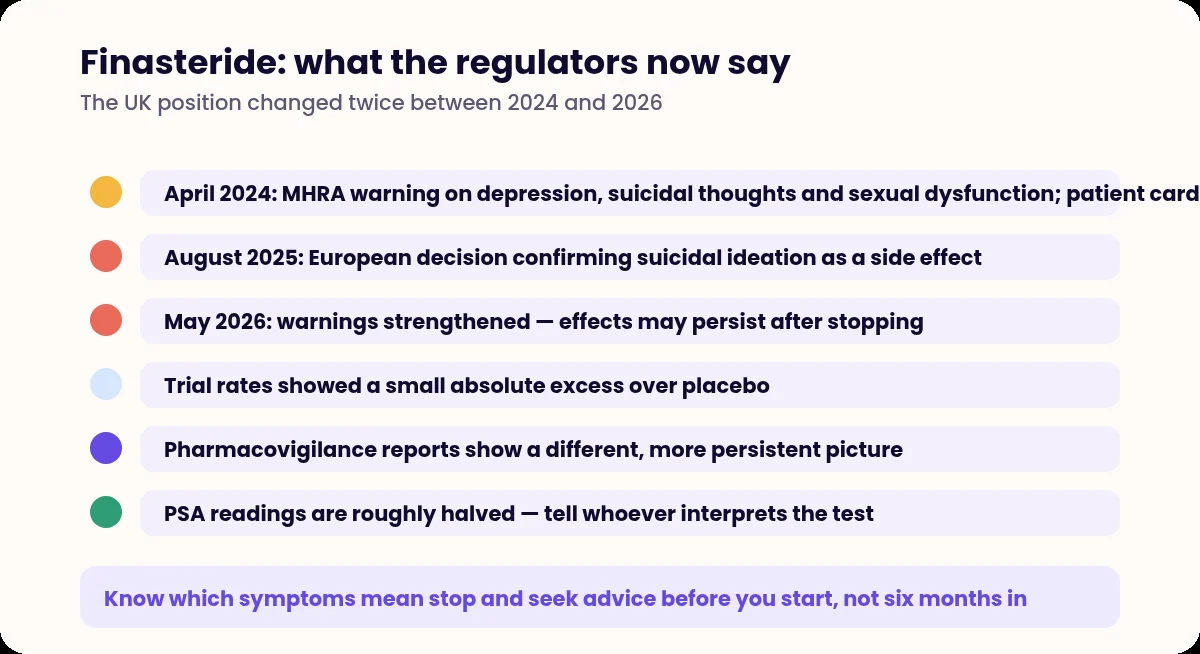
The MHRA’s April 2024 Drug Safety Update reported 426 Yellow Card reports of sexual dysfunction between November 1992 and April 2024, with nearly half recorded as not recovered or not resolved, and 281 reports of psychiatric dysfunction between February 1993 and April 2024 [2]. It stated that patients have reported sexual dysfunction persisting even after treatment was stopped.
Why the two pictures differ
They are not measuring the same thing.
Trials measure incidence in a defined population over a defined period. They were twelve months long, enrolled selected participants, and used adverse event questioning rather than detailed sexual function instruments. They were never designed to detect symptoms that begin or persist after the study ends.
Spontaneous reporting measures what people choose to report, with no denominator. You cannot calculate a rate from Yellow Card or FAERS data, because nobody knows how many people took the medicine without reporting anything. What these systems are good at is detecting the shape of a problem — in this case, persistence — that a short trial cannot see.
So a small excess in trials and a substantial body of persistence reports are compatible. The common outcome is no side effects; side effects when they occur usually resolve; and a minority report symptoms that do not, which the trials were structurally incapable of counting.
What the regulators have done
April 2024 — MHRA Drug Safety Update. The MHRA stated that finasteride has been associated with depression, suicidal thoughts and sexual dysfunction, and announced a patient card to be included in every finasteride pack during 2024 covering sexual and psychiatric side effects [2]. It advised prescribers to ask about a history of depression or suicidal ideation before prescribing, to monitor, and to stop finasteride 1mg immediately if depression develops.
22 August 2025 — European Commission binding decision. Following an EMA Article 31 referral endorsed on 19 June 2025, the Commission confirmed suicidal ideation as a side effect of finasteride at both 1mg and 5mg, with most cases reported in patients taking the 1mg hair loss dose [3]. For dutasteride the conclusion was that there was insufficient evidence to establish a causal association, though a precautionary class warning was added.
11 May 2026 — MHRA Drug Safety Update. The current UK position. The wording is now that finasteride is associated with depression, suicidal ideation and sexual dysfunction which may persist after treatment is stopped [1, 6]. Two things are new:
- the finasteride 1mg product information now states that sexual dysfunction may itself contribute to mood disorders, recognising a possible pathway from one to the other as well as each occurring independently
- a precautionary psychiatric warning was added to dutasteride on class grounds, despite the 2025 finding on causation
UK patient cards are retained for both the 1mg and 5mg strengths. The MHRA’s Chief Safety Officer, Dr Alison Cave, said the agency expects prescribers to discuss the relevant safety information with patients so they can make informed decisions about their treatment [6].
In practice that means a consultation that asks directly about mood history, a documented discussion of persistence, a card in the box and a follow-up plan. Our guide to hair loss in your 20s covers why this matters particularly in younger men, where distress about hair loss and risk from treatment overlap.
Post-finasteride syndrome
The term describes persistent sexual, physical and cognitive symptoms reported by some men after stopping.
A 2025 review in IJIR concluded that post-finasteride syndrome remains controversial and is not formally recognised by medical societies, and that no medical society has proposed a definition for it [5]. There is no biomarker and no diagnostic test. The same review cited a meta-analysis reporting that 5-alpha reductase inhibitor use was associated with a 1.87-fold increase in the risk of these adverse effects compared with placebo, and noted that the very high symptom rates quoted from self-selected patient cohorts — for example 94% reporting low libido — reflect selection bias rather than prevalence.
The named limitations of the literature are worth stating plainly: no standardised definition, selection and reporting bias, nocebo effect, recall bias, and the absence of any biomarker [5].
None of that makes the symptoms unreal. Men reporting persistent problems after stopping should not be dismissed, and UK regulators have now acted specifically on persistence. What remains unproven is the mechanism and whether these symptoms constitute a distinct syndrome. Both halves of that sentence matter.
Other effects listed in the product information
The UK SmPC also records, with frequency not known from post-marketing reports [4]: hypersensitivity reactions including rash, itching, urticaria and swelling of the lips and face; anxiety; breast tenderness and enlargement; testicular pain; blood in the semen; male infertility or poor semen quality; and male breast cancer, where causality is not established.
Any breast lump, breast pain, gynaecomastia or nipple discharge should be reported to a clinician promptly rather than at the next routine appointment.
PSA testing
Finasteride lowers prostate specific antigen. In the trials mean serum PSA fell from 0.7 ng/ml at baseline to 0.5 ng/ml at twelve months [4].
Standard clinical practice, and the safest approach, is to double the measured PSA before comparing it with normal ranges for untreated men. Anyone interpreting your PSA needs to know you take finasteride. A result that looks reassuring can conceal a significant one. This becomes relevant from around age 40, and the sensible time to get it into your records is when you start, not when a test is ordered years later.
Pregnancy and handling
Finasteride is contraindicated in pregnancy and in women of childbearing potential [4]. Inhibiting the conversion of testosterone to DHT carries a risk of abnormalities of the external genitalia, specifically hypospadias, in a male foetus.
Crushed or broken tablets must not be handled by women who are or may be pregnant. The film coating prevents contact with the active ingredient during normal handling of intact tablets, so a whole tablet in a blister is not the concern; a split or crumbling one is. The same principle, with an added transfer route, applies to topical finasteride.
Where this leaves a decision
The realistic summary is that most men take finasteride without side effects, that a small excess of sexual side effects over placebo was measured in trials, that a minority report symptoms persisting after stopping, and that UK product information now says so explicitly.
What makes that manageable is knowing in advance which symptoms mean stop and seek advice: any change in mood, any thoughts of self-harm, new sexual dysfunction, any breast change. If you are already taking finasteride and something here concerns you, raise it with your prescriber rather than stopping on your own, with the exception of new depression, where the MHRA advice is to stop and seek advice. If you have thoughts of harming yourself, contact your GP the same day, call 111, or go to A&E.
Our guide to finasteride explained covers how the medicine works and what to expect from it, and dutasteride for hair loss covers the related medicine that acquired its own warning in 2026.
Frequently asked questions
What are the most common finasteride side effects?
In the UK product information, reduced libido, erectile dysfunction, ejaculation disorders including reduced ejaculate volume, and depression are all listed as uncommon, meaning between one in a thousand and one in a hundred people. In the twelve-month trials the individual rates were between roughly 0.8% and 1.8%, with placebo rates close behind.
Did the MHRA change its finasteride advice in 2026?
Yes. A Drug Safety Update on 11 May 2026 strengthened the finasteride 1mg product information to state that depression, suicidal ideation and sexual dysfunction may persist after treatment is stopped, and that sexual dysfunction may itself contribute to mood disorders. A precautionary psychiatric warning was also added to dutasteride.
Is post-finasteride syndrome recognised?
Not formally. A 2025 review concluded that it remains contested and that no medical society has proposed a definition for it, and there is no biomarker or diagnostic test. That does not mean the symptoms people report are imagined, and UK product information now explicitly acknowledges persistence after stopping.
Should I stop finasteride if my mood changes?
MHRA advice for finasteride 1mg is to stop immediately and seek medical advice if depression develops. Do not stop any prescribed medicine without raising it with your prescriber, but mood change is the one symptom where the advice is to act first and discuss promptly rather than wait for a routine appointment.
References
- MHRA. Finasteride and dutasteride: updated safety warnings for psychiatric side effects and sexual dysfunction. Drug Safety Update, 11 May 2026. www.gov.uk/drug-safety-update/finasteride-and-dutasteride-updated-safe
- MHRA. Finasteride: reminder of the risk of psychiatric side effects and reports of sexual dysfunction. Drug Safety Update, April 2024. assets.publishing.service.gov.uk/media/6630a6d03579e7a8f398a9a6/April_
- European Medicines Agency. Finasteride and dutasteride containing medicinal products: Article 31 referral, measures to minimise the risk of suicidal thoughts. www.ema.europa.eu/en/documents/referral/finasteride-dutasteride-contai
- Summary of Product Characteristics: Propecia 1 mg film-coated tablets. Electronic Medicines Compendium. www.medicines.org.uk/emc/product/2194/smpc
- Cilio S et al. Post-finasteride syndrome: a true clinical entity? IJIR: Your Sexual Medicine Journal, 2025. www.pfsfoundation.org/wp-content/uploads/2025/02/Post-finasteride-synd
- MHRA. MHRA strengthens safety warnings for finasteride and dutasteride. News, 11 May 2026. www.gov.uk/government/news/mhra-strengthens-safety-warnings-for-finast
- The Human Medicines Regulations 2012, regulation 284. www.legislation.gov.uk/uksi/2012/1916/regulation/284
Medical reviewer
Naeem Teni
Clinical Lead at Manova. Registered pharmacist and independent prescriber, GPhC 2215591. Reviews Manova’s clinical content for accuracy and safety.
Written by
Manova Editorial Team
Researched and written to our editorial policy, using NICE, NHS, MHRA and peer-reviewed sources.
This article is for general information and isn’t a substitute for advice from your own clinician. If you feel unwell, contact your GP or NHS 111. In an emergency, call 999.