

Key takeaways
- Measured by health professionals, mean erect length is 13.12 cm and mean erect circumference is 11.66 cm — figures well below what most men assume.
- Almost every large number circulating online comes from self-report, which runs substantially higher than professionally measured data.
- Micropenis is a specific diagnosis — stretched length below roughly 9.3 cm — and almost no man presenting with size worry meets it.
- Surgery and injectables carry real risks including loss of erect length, altered sensation and, with oil-based fillers, tissue death, and the evidence for benefit is poor.
The most useful thing this article can do is show you where you actually sit. So here is the measured data first, before any discussion of what it means.
A systematic review by Veale and colleagues, published in BJU International in 2015, pooled studies covering up to 15,521 men, all measured by health professionals following a standard protocol, and built nomograms from them [1].
| Measurement | Mean |
|---|---|
| Flaccid length | 9.16 cm (3.61 in) |
| Flaccid stretched length | 13.24 cm (5.21 in) |
| Erect length | 13.12 cm (5.17 in) |
| Flaccid circumference | 9.31 cm (3.66 in) |
| Erect circumference | 11.66 cm (4.59 in) |
If those figures are lower than you expected, that reaction is the point of the article.
Why the numbers you have seen are bigger
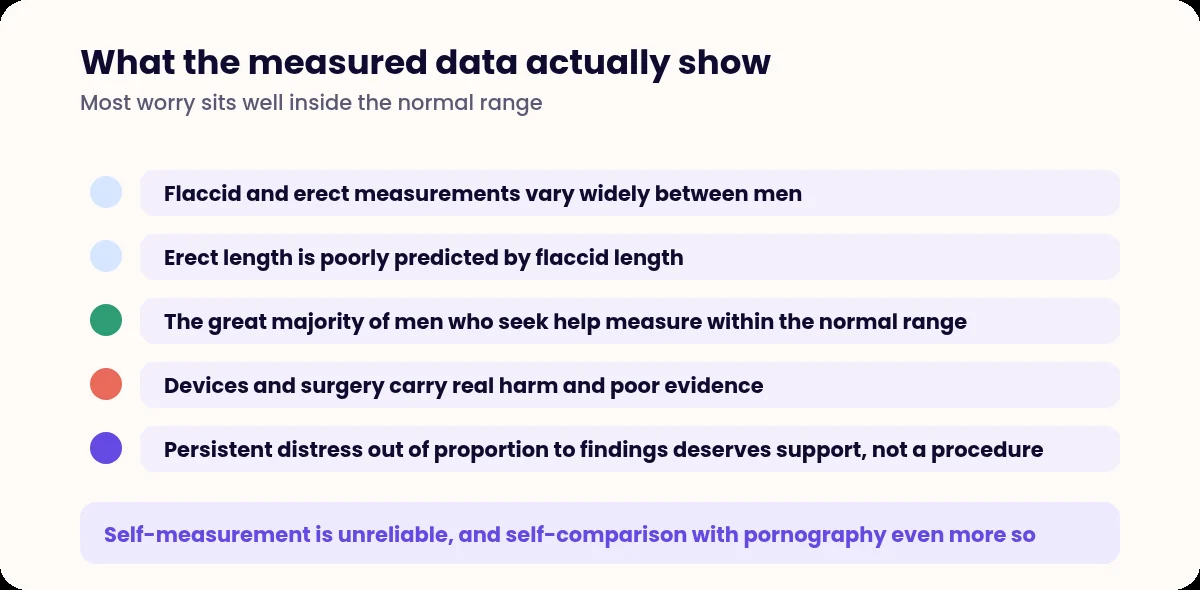
Studies fall into two groups. In one, a health professional measures the participant — from the pubic bone along the dorsal surface, with the fat pad compressed, to a standard endpoint. In the other, men measure themselves and report the result, usually on the internet.
The second kind produces substantially higher figures. Almost every large number circulating online, in forums and in marketing copy comes from that second kind of study. When someone tells you the average is six inches, they are quoting men grading their own homework.
A few other findings from the properly measured data are worth having:
- Correlation with height is real but weak (r roughly 0.2 to 0.6). Correlations with foot size, hand size, BMI and ethnicity are weak or absent once measurement is standardised.
- Flaccid stretched length is very close to erect length. This is why clinicians use stretched length — it is reproducible and does not require an erection in a clinic room.
- Distributions are narrow. Being “average” covers a great many men, and the difference between the 25th and 75th centile is smaller than most men imagine.
Micropenis is a real diagnosis, and it is rare
Micropenis is defined as a stretched length more than 2.5 standard deviations below the mean, which in adults is roughly below 9.3 cm stretched. It is a specific finding, usually with an endocrine cause identified in childhood.
Almost no man who presents to a clinic worried about size meets this definition. That is not a dismissal — it is the single most relevant clinical fact for the person asking.
When the worry is the problem
There is a well-recognised presentation: a man of entirely normal measurement with persistent, intrusive, distressing preoccupation with size. It goes by several names — small penis anxiety, penile dysmorphophobia — and where it meets criteria it is body dysmorphic disorder, a condition with effective treatment [4].
Two things follow from that, and both matter.
First, reassurance alone usually does not work. Being told you are normal, even with a measurement to prove it, tends to relieve the distress for hours rather than months. That is characteristic of the condition and is not a personal failing.
Second, body dysmorphic disorder is a contraindication to cosmetic surgery, because satisfaction after surgery in this group is poor. The 2024 International Consultation on Sexual Medicine recommendations, published in early 2026, state that where BDD is suspected, psychiatric assessment and psychosexual counselling should precede any surgery, and that psychotherapy is the appropriate initial management — noting that motivations for augmentation are “often strongly connected to psychological rather than physical needs” [2].
The UK route is your GP, then NHS Talking Therapies (self-referral in England) or psychosexual therapy through a COSRT-accredited therapist [3, 5]. Specialist NHS services for obsessive–compulsive and body dysmorphic disorders exist for severe cases.
What the enlargement options actually do
The ICSM 2024 review is the clearest recent assessment of this evidence [2].
Penile traction therapy. An average gain of around 2 cm in length after a minimum of three months of daily traction. This carries a moderate recommendation on low-to-moderate evidence, and comes with two caveats: it requires genuinely sustained daily use over months, and gains partly regress when you stop.
Suspensory ligament release. Improves flaccid appearance only. No gain in erect length and none in girth. Revision rates run up to 50% because of scar contracture, and the operation can destabilise the erection by removing part of what anchors it. The supporting evidence is expert opinion.
Girth fillers — hyaluronic acid or your own fat. Relatively safe, but temporary and needing repeat procedures. Weak recommendation, low-quality evidence.
Silicone, paraffin and oil-based fillers. There is a strong recommendation against these, and it is the most important harm message on this page. They cause granuloma formation, tissue necrosis, permanent disfigurement and in some cases loss of the penis. They are sold cheaply, often abroad or informally, and the damage is frequently not reconstructable.
Grafts and implants for girth remain experimental.
Pills, creams and supplements have no evidence of efficacy. Jelqing has no evidence of benefit and case reports describe injury and Peyronie’s-like fibrosis — worth reading alongside our guide to Peyronie’s disease.
The real risks of augmentation surgery, stated plainly, are poor aesthetic result, altered sensation, penile deformity, loss of erect length, sexual dysfunction, and loss of the penis.
Things that genuinely change appearance
Two honest non-surgical options affect apparent length rather than actual length, and both are low risk:
- Losing weight. The suprapubic fat pad conceals part of the shaft. Reducing it exposes length that is already there, which is often a more noticeable change than anything a device achieves.
- Trimming pubic hair. Unglamorous, free, and visually effective.
The part about partners
Partner-reported data consistently rank size below other factors in sexual satisfaction, and girth is reported as more relevant than length where either is mentioned at all. More usefully: the sexual difficulties that partners do report — feeling rushed, lack of communication, a partner who is anxious and distracted — are the ones that respond to being addressed. Size anxiety produces exactly that distracted, self-monitoring state, which is also how performance anxiety undermines erections.
If a sexual problem has appeared alongside the worry, get it assessed rather than assuming the two are the same thing. Our guide to when to see someone about a sexual problem sets out the routes.
Frequently asked questions
What is the average penis size in the UK?
The largest systematic review of professionally measured men, covering up to 15,521 participants, found a mean erect length of 13.12 cm (5.17 inches) and a mean erect circumference of 11.66 cm (4.59 inches). Mean flaccid stretched length was 13.24 cm, which is close to erect length and is the measurement clinicians usually use.
Why are the numbers I see online bigger?
Because they are self-reported. Studies using self-measurement or internet surveys produce substantially higher figures than studies where a health professional measures to a standard protocol. Almost every large number in circulation comes from the first kind of study.
Do pumps, pills or stretching devices make a permanent difference?
Pills and creams have no evidence of efficacy. Penile traction therapy, used daily for at least three months, has evidence of an average gain of around 2 cm, but it requires sustained daily use and gains partly regress. Jelqing has no evidence and case reports describe injury and scarring.
I know I am average but I still cannot stop thinking about it. What now?
That pattern — normal size with persistent, intrusive distress — is recognised and treatable, and reassurance alone rarely resolves it. Psychological treatment is the appropriate first step, not surgery. Speak to your GP, self-refer to NHS Talking Therapies in England, or find a COSRT-accredited therapist.
References
- Veale D et al. Am I normal? A systematic review and construction of nomograms for flaccid and erect penis length and circumference. BJU International, 2015. pubmed.ncbi.nlm.nih.gov/25487360/
- ICSM 2024 recommendations on penile augmentation. Sexual Medicine Reviews, 2026. academic.oup.com/smr/article/14/1/qeaf067/8365266
- College of Sexual and Relationship Therapists. Find a therapist. www.cosrt.org.uk/
- NHS. Body dysmorphic disorder (BDD). www.nhs.uk/mental-health/conditions/body-dysmorphia/
- NHS Talking Therapies for anxiety and depression. www.nhs.uk/mental-health/talking-therapies-medicine-treatments/talking
- European Association of Urology. Guidelines on Sexual and Reproductive Health. uroweb.org/guidelines/sexual-and-reproductive-health
Medical reviewer
Naeem Teni
Clinical Lead at Manova. Registered pharmacist and independent prescriber, GPhC 2215591. Reviews Manova’s clinical content for accuracy and safety.
Written by
Manova Editorial Team
Researched and written to our editorial policy, using NICE, NHS, MHRA and peer-reviewed sources.
This article is for general information and isn’t a substitute for advice from your own clinician. If you feel unwell, contact your GP or NHS 111. In an emergency, call 999.