

Key takeaways
- Recomposition is real, and a 2020 review concluded trained individuals can achieve it too, contrary to the claim that it only works for beginners.
- Realistic lean gain is about 0.25-0.5 kg a month in beginners and often under 0.1-0.2 kg a month in trained individuals.
- DXA and BIA error bands of roughly 1-2 kg are comparable to the effect being measured over short periods, so many recomp claims are noise plus glycogen and water shifts.
- The enabling conditions are adequate protein, progressive resistance training and a modest deficit; deficits above 500 kcal a day work against simultaneous muscle gain.
Body recomposition means losing fat and gaining muscle at the same time, rather than doing them in separate phases. It is real. It is also slower than the internet implies, more dependent on who you are than on what programme you follow, and much harder to measure than to achieve.
Getting all three of those straight at the start saves a lot of disappointment three months in.
Who it works for
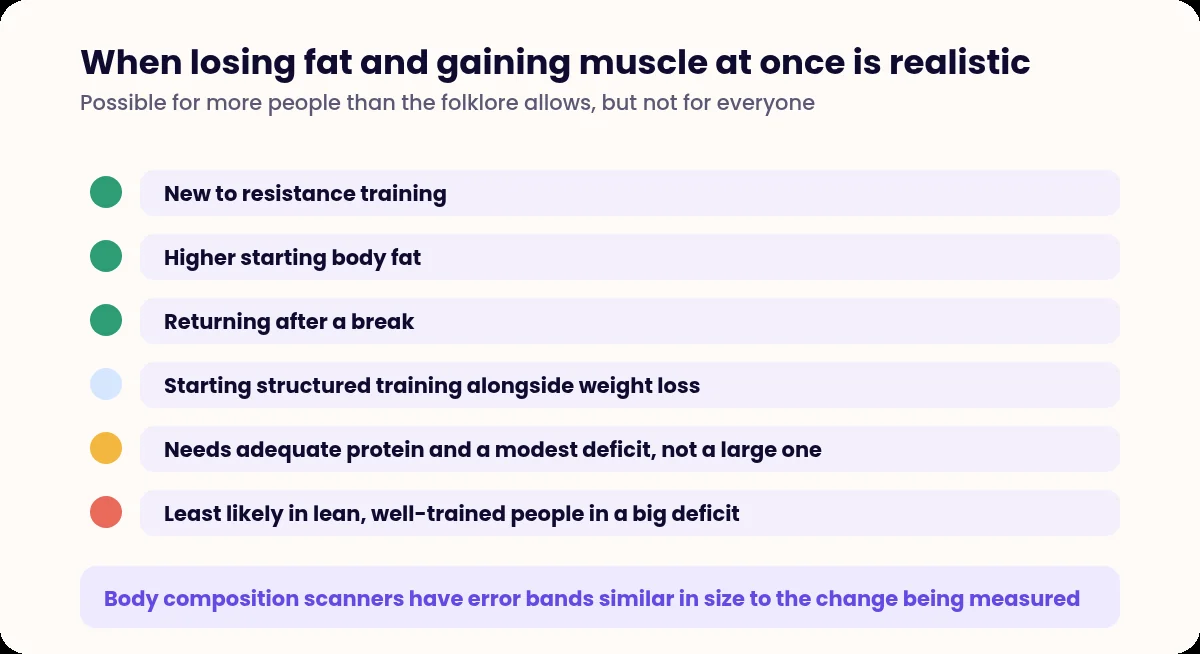
The old rule was that recomposition only works for beginners. That is too strong. A 2020 review in the Strength and Conditioning Journal concluded that trained individuals can also achieve recomposition, though at markedly lower rates [1].
Most likely to see meaningful recomposition:
- Untrained beginners starting resistance training for the first time
- People with higher starting body fat, who have more stored energy available to fuel tissue building
- People returning after a layoff, where previously built muscle comes back faster than it was originally built
- Adolescents, for obvious developmental reasons
- People beginning structured training alongside pharmacological weight loss
Least likely: lean, well-trained individuals in a large deficit. If you are already close to your genetic ceiling and eating well below maintenance, you are asking the body to do two contradictory things with no spare capacity for either.
The conditions that enable it
Three things, and they are not negotiable if simultaneous muscle gain is the goal.
Adequate protein. Figures of 1.6 to 2.4 g per kg of body weight per day are used in recomposition contexts, higher than typical weight loss recommendations. The best single demonstration is a 2016 trial in young men undergoing a 40% energy deficit with intense training: the higher-protein group gained 1.2 kg of lean mass against 0.1 kg in the lower-protein group [2]. Same deficit, same training, different outcome.
Progressive resistance training. Not activity in general, and not cardiovascular exercise. Muscle grows in response to a progressively increasing mechanical demand, and nothing else on this list substitutes for that.
A modest deficit. This is the one people get wrong. Deficits above roughly 500 kcal a day should be avoided by anyone wanting simultaneous muscle growth. Lean gain is often possible when losing at around 0.45 kg a week or less. A large deficit will still lose fat faster, but it does so at the cost of the muscle side of the equation.
The tension is unavoidable: the faster you want the fat gone, the less likely you are to gain muscle while it happens.
Realistic rates
Numbers, so you can judge your own results honestly:
- Lean mass gain: roughly 0.25 to 0.5 kg a month in beginners
- Lean mass gain in trained individuals: often under 0.1 to 0.2 kg a month
- Simultaneous fat loss: around 0.5% of body weight a week
For an 85 kg beginner, that is perhaps 1.5 kg of lean mass over six months alongside steady fat loss. That is a genuinely different-looking body. It is not the transformation implied by a photo pair taken eight weeks apart in different lighting.
The measurement problem
This section is the one most likely to save you money.
DXA and bioelectrical impedance carry error bands of roughly plus or minus 1 to 2 kg. Compare that with the effect being measured: perhaps 0.5 to 1.5 kg of lean mass change over several months. The error band is comparable to the entire signal.
On top of that, both methods are sensitive to hydration status. Starting resistance training increases muscle glycogen storage, and each gram of glycogen is stored with several grams of water. A new trainee can appear to gain 1.5 kg of lean mass in three weeks, and almost all of it is glycogen and water rather than contractile tissue. That is not a worthless change, but it is not muscle.
A large share of dramatic recomposition claims are measurement noise plus glycogen and water shifts.
What to do about it:
- Compare scans months apart, not weeks
- Use the same method, same machine, same conditions — fasted, similar hydration, similar time of day
- Weight the practical markers more heavily: strength progression, how clothes fit, waist circumference
- Do not pay for monthly scans expecting them to show anything reliable
BMI versus body fat covers what the various measures do and do not tell you.
Why the scales are almost useless here
Recomposition is the one goal where body weight is actively misleading. If you lose 1 kg of fat and gain 1 kg of muscle, the scales report that nothing happened, while your body has changed meaningfully. Conversely, weight can fall steadily while the lean mass side of the ledger quietly goes backwards.
This is why recomposition attempts need a second measure from the start. Waist circumference and a small number of tracked lifts will tell you more over three months than daily weighing will, and neither costs anything.
Recomposition alongside weight loss medicines
People starting a weight loss medicine are, in one sense, ideally placed: they are often untrained, have higher starting body fat, and are about to start moving more. In another sense they are badly placed, because appetite suppression makes hitting 1.6 to 2.4 g/kg of protein genuinely difficult, and the rate of weight loss is often well above the modest deficit recomposition requires.
The realistic goal in that situation is usually preserving lean mass rather than gaining it, which is a lower bar and a more achievable one. Losing weight without losing muscle covers the practical side, and the evidence on lean mass and these medicines specifically is in muscle loss on weight loss medicines.
A workable setup
- Resistance train two to four times a week, with a plan that gets progressively harder
- Protein at 1.6 g/kg/day minimum, higher if you are lean or training hard
- Deficit of no more than 500 kcal a day, targeting 0.45 kg a week or less
- Sleep, because it is where the adaptation happens. The NHS recommends muscle-strengthening activity on at least two days a week as a baseline for all adults [3]
- Judge it over six months, using strength and waist rather than a scan
If you are over 40, the case for the resistance training component gets stronger rather than weaker, for reasons set out in strength training over 40.
When to check with a clinician
- Before starting resistance training with a heart condition, uncontrolled hypertension or recent surgery
- Chronic kidney disease, before increasing protein intake substantially
- If training becomes compulsive, or body composition tracking becomes distressing
- Unexplained weight or muscle loss, or a marked drop in strength — arrange a GP appointment
Frequently asked questions
Can you build muscle and lose fat at the same time?
Yes, but the rate is slow and it depends heavily on who you are. It is most achievable in untrained beginners, people with higher starting body fat, those returning after a break, and people newly starting resistance training. It is least achievable in lean, well-trained people in a large deficit.
How fast can you recomp?
Lean mass gain of roughly 0.25-0.5 kg a month is realistic in beginners, often under 0.1-0.2 kg a month in trained individuals, with simultaneous fat loss of around 0.5% of body weight a week. Over three months that is a real change, but it is not a dramatic one.
Are body composition scales accurate enough to track recomp?
Generally not over short periods. Bioelectrical impedance and even DXA carry error bands of roughly 1-2 kg, which is comparable to the whole effect being measured over a few months. Add glycogen and water shifts and a single scan comparison can easily show a change that did not happen.
How much protein do I need for body recomposition?
Figures of 1.6-2.4 g per kg of body weight per day are commonly used in recomposition contexts, which is higher than general weight loss recommendations. A trial in young men in a 40% deficit with training found 1.2 kg of lean gain on high protein versus 0.1 kg on low protein.
References
- Barakat C, Pearson J, Escalante G, et al. Body recomposition: can trained individuals build muscle and lose fat at the same time? Strength and Conditioning Journal. 2020;42(5):7-21. doi.org/10.1519/SSC.0000000000000584
- Longland TM, Oikawa SY, Mitchell CJ, et al. Higher compared with lower dietary protein during an energy deficit combined with intense exercise promotes greater lean mass gain and fat mass loss. American Journal of Clinical Nutrition. 2016;103(3):738-746. doi.org/10.3945/ajcn.115.119339
- NHS. Strength and flexibility exercises. www.nhs.uk/live-well/exercise/strength-and-flex-exercise-plan/
- NICE. Overweight and obesity management. NG246. January 2025. www.nice.org.uk/guidance/ng246
Medical reviewer
Naeem Teni
Clinical Lead at Manova. Registered pharmacist and independent prescriber, GPhC 2215591. Reviews Manova’s clinical content for accuracy and safety.
Written by
Manova Editorial Team
Researched and written to our editorial policy, using NICE, NHS, MHRA and peer-reviewed sources.
This article is for general information and isn’t a substitute for advice from your own clinician. If you feel unwell, contact your GP or NHS 111. In an emergency, call 999.