

Key takeaways
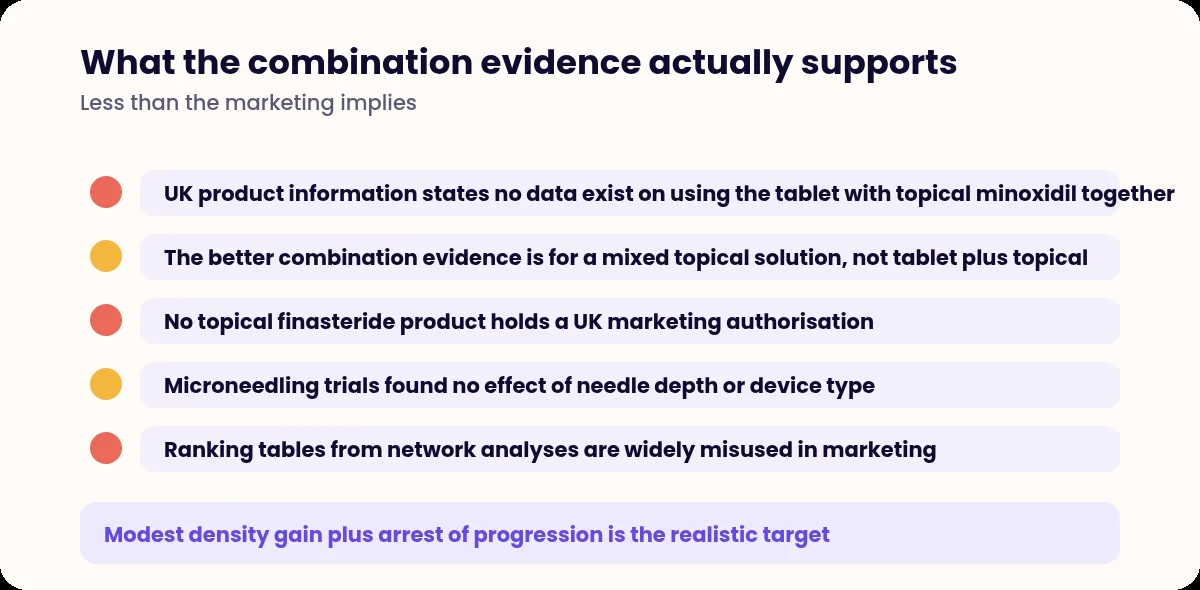
- Every UK finasteride 1mg SmPC states that no data are available on the concomitant use of finasteride and topical minoxidil in male pattern hair loss, so the most commonly promoted combination sits outside the licensed evidence base.
- The best combination trial evidence is for a mixed topical minoxidil-finasteride solution, not for oral finasteride plus topical minoxidil, and no topical finasteride product holds a UK marketing authorisation.
- In the microneedling meta-analysis, subgroup analyses found no significant effect of needle depth, treatment duration or device type — which contradicts clinics that market a specific depth or device as necessary.
- Network meta-analysis rankings of combination regimens should not be read as a league table; the authors found no significant differences between interventions for hair density and warned that the estimates carry substantial uncertainty.
This page is medicine information rather than an advert. Finasteride is a prescription only medicine in the UK [7], and whether it is suitable is a decision for a prescriber after an assessment.
Combination treatment for pattern hair loss is discussed as though it were settled. It is not, and the gap between how it is described and what has been assessed is unusually wide in this particular corner of medicine. This page sets out the licensing position, what the combination trials measured, and which claims the data do not support.
The licensing baseline
Before any combination question, it is worth being clear about what holds a UK licence for pattern hair loss and what does not.
Topical minoxidil is the only treatment licensed over the counter for androgenetic alopecia in the UK — Regaine for Men Extra Strength 5% solution and foam in men, and Regaine for Women 2% solution and 5% foam in women aged 18 to 65 [5].
Finasteride 1mg is a prescription only medicine, licensed for male pattern hair loss in men only, and contraindicated in women. Its UK product information was revised on 16 June 2026 and 31 July 2026 [1].
Dutasteride, oral minoxidil, topical finasteride, spironolactone and microneedling for pattern hair loss are all off-label or unlicensed in the UK. Each of those words means something slightly different — off-label means a licensed product used outside its licensed indication, unlicensed means a product with no UK marketing authorisation at all — and the distinction affects who carries responsibility for the supply.
The sentence in the product information
Here is the point that reframes the whole subject.
Every UK finasteride 1mg SmPC states that “no data are available on the concomitant use of finasteride and topical minoxidil in male pattern hair loss” [1].
Both components are individually licensed. Both have registration trial data behind those licences. The combination of the two, which is routinely described as the standard approach to treating pattern hair loss, is outside the licensed evidence base.
It is worth being precise about what that does and does not mean. It does not mean the combination has been assessed and found ineffective, and it does not mean it is unsafe. It means the regulator has no data on it, because the studies that would generate those data were not submitted. A prescriber may still have good reasons to use both. But a claim that the pairing is established rests on inference and clinical experience, not on assessed evidence, and the product information says so in plain terms.
What the best combination evidence actually studied
There is reasonable combination evidence, and it is not for the pairing above. It is for a mixed topical solution containing both minoxidil and finasteride in one preparation — a different route, a different pharmacokinetic profile, and a different product.
A systematic review and meta-analysis in Frontiers in Medicine, published 7 October 2025, pooled seven randomised controlled trials, 396 men, across five countries [2]. Its findings:
- Hair density: mean difference +9.22 hairs/cm² (95% CI 0.29 to 18.16, p=0.04), but I² = 90%. The confidence interval very nearly crosses zero and the heterogeneity is extreme. GRADE certainty was rated moderate.
- Hair diameter: mean difference 2.26 (0.68 to 3.83), I² = 0%, low certainty.
- Global photographic assessment: mean difference 0.79 (0.50 to 1.08), I² = 0%, low certainty.
- Marked improvement: odds ratio 3.29 (1.28 to 8.47), I² = 0%, low certainty.
- Contact dermatitis occurred in 12 to 24%.
- No treatment-emergent sexual adverse events were recorded with the topical combination, against 2 to 5% typically quoted for oral finasteride.
- All studies ran for six months or less, and no external funding was declared.
That is a more interesting result than it first appears, particularly the adverse event contrast. It is also a thin evidence base: seven small trials, short follow-up, and a primary outcome whose heterogeneity undermines confidence in the pooled figure.
The caveat for UK readers is decisive: no topical finasteride product holds a UK marketing authorisation [1]. Anything supplied here is a special, an import, or a compounded unlicensed product. The trials above tested defined preparations; a compounded product is not necessarily the same thing. Our page on topical finasteride covers that supply question in more detail.
Microneedling, and the claim the data contradict
A meta-analysis in Archives of Dermatological Research, published 8 March 2025, pooled 12 randomised trials and 631 patients, with 11 trials in the quantitative synthesis [3].
Comparing microneedling plus minoxidil against minoxidil alone:
- Hair count: SMD 1.32 (0.73 to 1.92), but I² = 88%
- Hair diameter: SMD 0.34 (0.11 to 0.58), I² = 0%
- Adverse events were more frequent with microneedling (74 versus 59) but were mild and self-limiting
The finding worth singling out is in the subgroup analyses. No significant effect was found for needle depth (≤1mm versus >1mm), for treatment duration (≤12 weeks versus >12 weeks), or for device type [3].
That directly contradicts a common marketing position. Clinics and device sellers routinely present a specific depth or a specific device as the thing that makes microneedling work. In this synthesis, none of those variables separated responders from non-responders. Our guide to microneedling for hair loss covers the practical side.
Why the ranking tables are misleading
A network meta-analysis published in Aesthetic Plastic Surgery in 2026, online 21 May 2026, pooled 27 randomised trials and 3,012 participants [4]. It produced SUCRA rankings, and those rankings circulate widely as an ordered list of which combination is best.
They should not be read that way, for a reason the authors state themselves. No significant differences were found between the interventions for hair density, and the authors warn that the estimates “should be interpreted cautiously due to limited study numbers and inherent uncertainty in the network” [4].
A SUCRA value is a probability of ranking highly given the network, not a measured difference between treatments. When the underlying comparisons are not statistically distinguishable, a ranking still produces an order — because ranking always produces an order — and that order carries far less information than its appearance suggests. It is the single most commonly misused statistic in hair loss marketing.
What a realistic combined regimen looks like
Setting aside the marketing, the shape of what is actually done in UK practice is:
- licensed topical minoxidil as the base, since it is the component with a UK licence for the indication [5]
- oral finasteride 1mg considered in men, as a prescriber decision following a documented consultation covering the May 2026 MHRA warnings on depression, suicidal ideation and sexual dysfunction which may persist after treatment is stopped [6] — see finasteride side effects for what that consultation should cover
- microneedling as an optional adjunct of uncertain magnitude
- everything else experimental
The realistic expectation from that is modest density gain plus arrest of progression, not restoration of a lost hairline. Follicles that have already been replaced by fibrous tissue are not recoverable by any of these routes.
Our pages on finasteride explained and minoxidil explained cover each component individually, including how long each takes to assess.
Frequently asked questions
Is it established that finasteride and minoxidil work better together?
Not from the licensed evidence. UK finasteride 1mg product information states that no data are available on concomitant use with topical minoxidil in male pattern hair loss. Both medicines have individual evidence behind their own licences, but the combination as usually prescribed has not been assessed by the regulator, which is a different thing from having been assessed and rejected.
What does the trial evidence on combination treatment actually show?
The strongest synthesis is a 2025 review of seven randomised trials in 396 men of a mixed topical minoxidil-finasteride solution. It reported a hair density difference of 9.22 hairs per square centimetre with a confidence interval of 0.29 to 18.16, but heterogeneity was extreme at 90% and all studies ran for six months or less. Hair diameter and photographic assessment favoured the combination with low certainty.
Does microneedling need a particular needle depth?
The 2025 meta-analysis found no significant effect of needle depth, treatment duration or device type in its subgroup analyses. Adding microneedling to minoxidil increased hair count compared with minoxidil alone, but heterogeneity was high at 88%. Adverse events were more frequent with microneedling but were mild and self-limiting.
Is topical finasteride licensed in the UK?
No topical finasteride product holds a UK marketing authorisation. Anything supplied is a special, an import or a compounded unlicensed product. That has practical consequences for consistency of concentration, for what recourse exists if something goes wrong, and for who takes responsibility for the supply.
References
- Summary of Product Characteristics: finasteride 1 mg film-coated tablets. Electronic Medicines Compendium, revised 16 June 2026 and 31 July 2026. www.medicines.org.uk/emc/
- Li et al. Efficacy and safety of minoxidil-finasteride topical solution in androgenetic alopecia: a systematic review and meta-analysis. Frontiers in Medicine, 2025;12:1632139, published 7 October 2025. www.frontiersin.org/journals/medicine
- Chen et al. Microneedling combined with minoxidil for androgenetic alopecia: a systematic review and meta-analysis. Archives of Dermatological Research, published 8 March 2025. link.springer.com/guides/403
- Network meta-analysis of combination therapies for androgenetic alopecia. Aesthetic Plastic Surgery, 2026;50(13), online 21 May 2026. link.springer.com/guides/266
- Summary of Product Characteristics: Regaine for Men Extra Strength 5% w/v cutaneous solution. Electronic Medicines Compendium. www.medicines.org.uk/emc/
- MHRA. Finasteride and dutasteride: updated safety warnings for psychiatric side effects and sexual dysfunction. Drug Safety Update, 11 May 2026. www.gov.uk/drug-safety-update
- The Human Medicines Regulations 2012, regulation 284. www.legislation.gov.uk/uksi/2012/1916/regulation/284
Medical reviewer
Naeem Teni
Clinical Lead at Manova. Registered pharmacist and independent prescriber, GPhC 2215591. Reviews Manova’s clinical content for accuracy and safety.
Written by
Manova Editorial Team
Researched and written to our editorial policy, using NICE, NHS, MHRA and peer-reviewed sources.
This article is for general information and isn’t a substitute for advice from your own clinician. If you feel unwell, contact your GP or NHS 111. In an emergency, call 999.