

Key takeaways
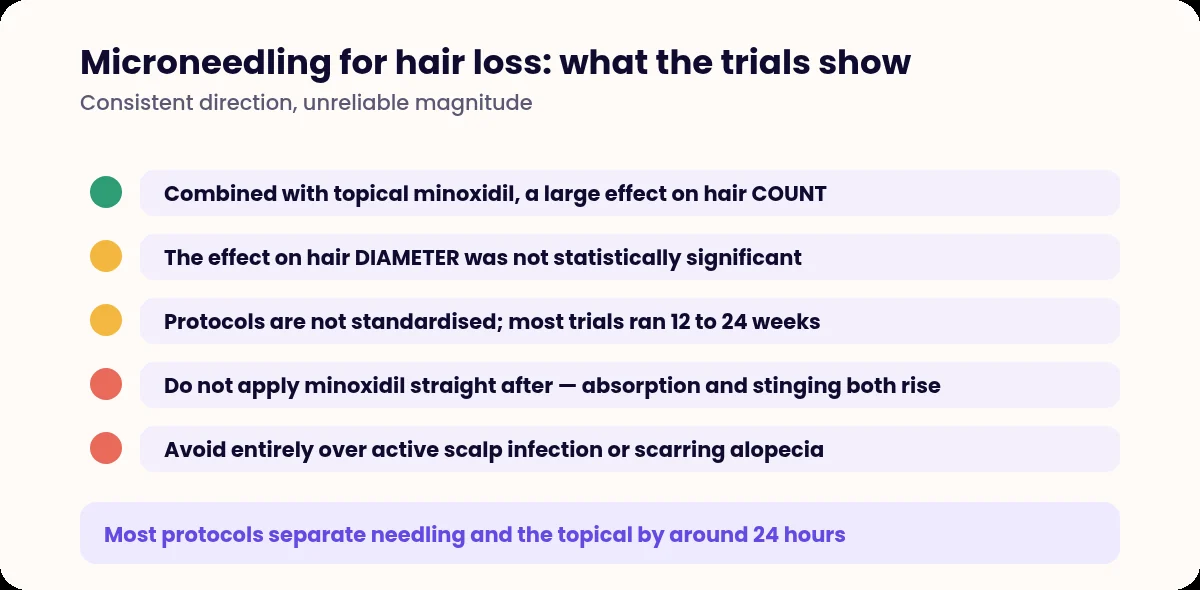
- A meta-analysis of ten randomised trials found a large effect on hair count when microneedling was added to topical minoxidil, with a standardised mean difference of 1.76.
- The effect on hair diameter was not statistically significant, so the evidence supports more hairs rather than demonstrably thicker ones.
- Protocols are not standardised across the trials, which the meta-analyses themselves identify as the main weakness of the literature.
- Do not apply minoxidil immediately after needling: absorption is markedly increased through breached skin and the solution stings badly. Most protocols separate them by around 24 hours.
Microneedling has gone from a cosmetic clinic add-on to a standard question in hair loss consultations, largely on the strength of one striking meta-analysis result. The result is real. What it measured, and what it did not, is worth understanding before buying a roller.
What the evidence shows
The best synthesis is a systematic review and meta-analysis published in Archives of Dermatological Research in 2023, covering ten randomised trials in 466 patients, with eight contributing to the pooled analysis [1]. The comparison throughout was microneedling plus topical minoxidil against minoxidil alone.
Hair count favoured the combination with a standardised mean difference of 1.76 (95% CI 1.26 to 2.26, p<0.00001). In effect-size terms that is large, and considerably larger than most additions to an existing treatment achieve.
Hair diameter gave a standardised mean difference of 0.82 (95% CI −0.01 to 1.65, p=0.05), which was not statistically significant [1].
That distinction deserves emphasis, because it is routinely dropped. The evidence supports microneedling increasing the number of hairs. It does not demonstrate that it makes hairs thicker. Since perceived density depends on both, the honest expectation is a partial one.
On safety, the review recorded that “no scarring nor serious adverse events were reported in any of the studies” [1]. A further meta-analysis in the Journal of Cosmetic Dermatology in 2024 reached similar conclusions [2]. That is a reassuring finding about supervised, protocol-driven use in trials, which is not quite the same population as people using a device bought online at home.
Why the numbers should be held loosely
The review’s own authors note that “variations in factors such as rating scale measurements, microneedling methods, and areas of treatment may have resulted in confounding” [1]. That is a polite way of saying the trials were not doing the same thing.
The wider picture: the studies are mostly small, single-centre, short (twelve to twenty-four weeks), heterogeneous and at risk of bias, and many come from a small number of centres. Blinding a procedure someone can feel is close to impossible, which matters when one outcome is patient self-assessment.
The consistent finding is the direction of effect. The magnitude is not reliable — a pooled effect size drawn from trials using different needle lengths, different frequencies, different treatment areas and different measurement methods is an average of procedures that are not really the same procedure.
Microneedling alone, without a topical treatment, has much weaker evidence. Almost the entire literature is about combination, and the plausible mechanisms — controlled wound healing responses, growth factor release, and improved delivery of topical drug through the skin — mostly describe something that needs a drug present to amplify.
What the trials actually did
Across the studies showing benefit [1, 2]:
- needle lengths of 0.5 to 1.5mm, most commonly 1.5mm
- sessions weekly to fortnightly
- a minimum of twelve weeks before assessment
Protocols are not standardised. This is stated explicitly in the meta-analyses and is the main weakness of the field. There is no evidence-based answer to “how long should the needles be” or “how often should I do it”, only a range of things that have been tried and reported.
That has a practical consequence for anyone being sold a package of sessions. A clinic quoting a precise protocol is quoting a preference, not a standard, and the honest version of that conversation says so. More frequent or deeper is not established as better, and deeper needling is where the risks concentrate.
The safety points that matter
Do not apply minoxidil straight afterwards
This is the single most useful practical instruction here, and the one most often ignored.
Topical minoxidil solution contains ethanol and propylene glycol [3]. Applied to skin that has just been punctured hundreds of times, it stings considerably. More importantly, transdermal absorption is markedly increased when the skin barrier is broken, which raises systemic exposure well above the roughly 1-2% absorbed through intact scalp [3].
This is not a theoretical concern. It is the reason the minoxidil product information lists a shaved scalp and any scalp abnormality as contraindications. Most protocols separate microneedling and minoxidil application by around 24 hours. Needle one day, resume the topical the next.
Our guide to minoxidil side effects covers the systemic symptoms that would warrant stopping.
Home rollers carry real risks
The trials were conducted in clinical settings with clean technique. A roller used in a bathroom is a different proposition. Reported problems include folliculitis and bacterial infection, blunted or bent needles tearing rather than puncturing the skin, and, at longer needle lengths or with excessive pressure, scarring.
Needles blunt quickly. Devices should be single-person and replaced regularly, not shared and not kept for years. Cleanliness of the scalp and the device before use is not optional.
When not to do it at all
Microneedling is contraindicated over scarring alopecia that is active, over any scalp infection or inflammatory scalp disease, in anyone with a tendency to keloid scarring, and in anyone taking anticoagulants without first getting advice.
Active inflammation of any kind is a reason to stop and get assessed rather than to keep going. The scarring alopecia point is the serious one. Those conditions destroy follicles permanently and the priority is stopping the inflammation, not stimulating it. If your scalp is itchy, burning or painful, if there are smooth shiny areas where the follicle openings have disappeared, or if the hairline is receding as a smooth band, arrange a GP appointment within the week rather than starting a device.
No microneedling device is licensed in the UK as a treatment for hair loss. These are CE or UKCA marked devices, which is a route to market for medical devices rather than an efficacy judgment — the same distinction that applies to laser caps.
Where it reasonably fits
Microneedling is a plausible adjunct with a consistent direction of evidence, an unusually large pooled effect on hair count, no demonstrated effect on hair thickness, no standardised protocol, and a good safety record in clinical hands.
It is an addition to treatment, not a replacement for it. Anyone considering it should already have something with randomised evidence in place — minoxidil explained covers the topical option — and should be photographing the same areas at the same angle at baseline, three months and six months, because a procedure this variable needs personal evidence rather than pooled evidence to justify continuing.
Frequently asked questions
Does microneedling actually work for hair loss?
The best evidence, a 2023 systematic review of ten randomised trials in 466 patients, found a large effect on hair count when microneedling was combined with topical minoxidil compared with minoxidil alone. The effect on hair diameter was not statistically significant. Microneedling on its own, without a topical treatment, has much weaker support.
What needle length should be used?
Trials used 0.5 to 1.5mm, most commonly 1.5mm in the studies showing benefit, with sessions weekly to fortnightly over at least twelve weeks. Protocols are not standardised, and the meta-analyses explicitly say so, so no length can be described as the correct one on current evidence.
Can I use minoxidil straight after microneedling?
No. Applying it immediately after needling causes significant stinging, because the solution contains ethanol and propylene glycol and the skin barrier has just been breached, and transdermal absorption is markedly increased, which raises systemic exposure. Most protocols separate microneedling and minoxidil application by around 24 hours.
Are home derma rollers safe?
They carry real risks: folliculitis and bacterial infection, blunted or bent needles tearing the skin, and at longer needle lengths or with heavy pressure, scarring. Needles blunt quickly, devices should be used by one person only and replaced regularly, and microneedling should not be done over an active scalp infection, inflammatory scalp disease or scarring alopecia.
References
- Microneedling combined with topical minoxidil in androgenetic alopecia: a systematic review and meta-analysis. Archives of Dermatological Research, 2023. link.springer.com/article/10.1007/s00403-023-02688-1
- Efficacy of microneedling in androgenetic alopecia: a meta-analysis. Journal of Cosmetic Dermatology, 2024. onlinelibrary.wiley.com/doi/10.1111/jocd.16186
- Summary of Product Characteristics: Regaine for Men Extra Strength 5% w/v cutaneous solution. Electronic Medicines Compendium. www.medicines.org.uk/emc/product/5765/smpc
- DermNet. Male pattern hair loss. dermnetnz.org/topics/male-pattern-hair-loss
- NHS. Hair loss. www.nhs.uk/conditions/hair-loss/
Medical reviewer
Naeem Teni
Clinical Lead at Manova. Registered pharmacist and independent prescriber, GPhC 2215591. Reviews Manova’s clinical content for accuracy and safety.
Written by
Manova Editorial Team
Researched and written to our editorial policy, using NICE, NHS, MHRA and peer-reviewed sources.
This article is for general information and isn’t a substitute for advice from your own clinician. If you feel unwell, contact your GP or NHS 111. In an emergency, call 999.