

Key takeaways
- Most scalp reactions to minoxidil are irritant rather than allergic, and are usually driven by the propylene glycol and ethanol in the solution rather than the minoxidil.
- Foam formulations are propylene-glycol-free, so people who react to the solution can often tolerate the foam.
- A temporary increase in shedding generally begins two to six weeks after starting and subsides within a couple of weeks.
- Around 1-2% of a dose is absorbed through intact scalp, but absorption rises markedly where the skin barrier is broken, which is why scalp disease and a shaved scalp are contraindications.
This page is medicine information rather than an advert. Topical minoxidil is available from UK pharmacies without a prescription, but oral minoxidil is a prescription only medicine, and whether any form is suitable is a decision for a prescriber or pharmacist after an assessment.
Most people who stop topical minoxidil do so for one of two reasons: their scalp became itchy and flaky, or their hair started falling out more in the first month. Both have straightforward explanations, and in both cases the usual response — abandoning treatment — is often the wrong one.
The irritation is usually to the vehicle
This is the single most useful thing to understand about minoxidil.
The 5% solution is not just minoxidil. It contains propylene glycol and ethanol at 280.53 mg per 1 ml dose [1], and those two ingredients are what keep the drug dissolved and help it penetrate. They are also what makes a lot of scalps unhappy.
The distinction that matters is between two different reactions:
Irritant contact dermatitis is by far the commoner. It presents as itch, scaling, dryness and a burning or stinging sensation, often worst in the first minutes after applying. It is a direct chemical effect on the skin, not an immune response, and it is largely driven by the propylene glycol and ethanol.
Allergic contact dermatitis is less common and is a genuine immune reaction. When people with suspected minoxidil allergy are patch tested, the culprit more often turns out to be propylene glycol than minoxidil itself.
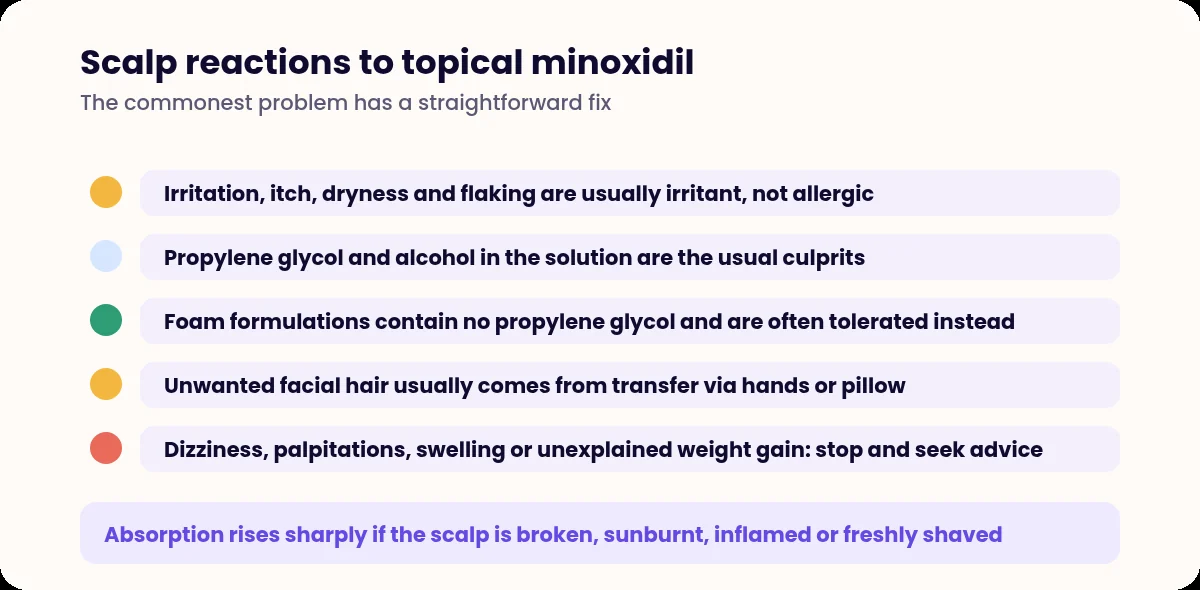
The practical consequence is worth spelling out: foam formulations are propylene-glycol-free. Someone who cannot tolerate the solution can very often tolerate the foam, at the same minoxidil strength. Anyone who has abandoned minoxidil because of an itchy, flaking scalp has usually not actually failed the drug — they have failed the vehicle, and never tried the alternative.
The product information lists hypersensitivity to minoxidil, ethanol or propylene glycol as contraindications, which tells you how routinely the excipients are the problem [1].
Ethanol also stings on broken skin and irritates the eyes badly. Keep it away from the face, and if it runs into an eye, rinse with cool water.
A few practical measures reduce irritation without changing product. Apply to a dry scalp rather than a damp one, use the stated dose rather than more, part the hair and place the liquid on skin instead of flooding it across the hair, and leave a gap between minoxidil and any medicated shampoo. If irritation is mild and settling over the first fortnight, it is often tolerance developing. If it is worsening at four weeks, it is not going to settle, and switching vehicle is the sensible next step rather than gritting it out.
Shedding in the first weeks
The UK product information describes a temporary increase in hair shedding that generally occurs two to six weeks after beginning treatment and subsides within a couple of weeks [1].
The mechanism is reassuring once you know it. Minoxidil pushes follicles out of the resting phase and into a new growth phase. The old club hair sitting in the follicle has to be extruded before the new hair can come through, so a batch of hairs that were going to be shed over the coming months all leave at once. It is a marker that the drug is acting.
What to do: expect it, and carry on. If the shedding persists beyond about two weeks, the product information advises stopping and consulting a clinician, because at that point something else may be going on — telogen effluvium from an unrelated trigger is a common coexisting explanation.
How much gets into the body
Roughly 1-2% of an applied dose is absorbed through normal intact scalp [1]. That is low, and it is why systemic effects from the topical product are uncommon.
The important qualifier is that absorption rises markedly when the skin barrier is broken. That is the reason behind a set of contraindications that otherwise look arbitrary [1]:
- any scalp abnormality, including sunburn, psoriasis, infection or inflammation
- a shaved scalp — shaving breaches the barrier, and a freshly shaved head absorbs far more
- occlusive dressings or other topical scalp medicines used at the same time
- treated or untreated hypertension
The same logic applies to combining minoxidil with microneedling, where deliberately breaching the skin immediately before applying the solution both increases absorption and causes considerable stinging.
Stop and see a clinician promptly if you develop low blood pressure symptoms, chest pain, a rapid heartbeat, faintness or dizziness, unexplained weight gain, or swelling of the hands or feet [1]. Chest pain with breathlessness is an emergency: call 999 or go to A&E.
Unwanted hair elsewhere
Hypertrichosis — hair growth where you did not want it, typically on the face — is reported, and it is nearly always a transfer problem rather than a systemic one. Solution runs down the temples; hands carry it to the face; a pillow carries it overnight.
The product information specifically records hypertrichosis in infants following skin contact with the application sites of carers, reversing when the exposure stops [1]. That is a strong argument for washing your hands immediately after applying, letting the scalp dry fully before bed or before picking up a small child, and keeping the product out of reach.
Women and the 5% solution
In the UK, the 5% solution marketed for men is contraindicated in women [1]. Women’s licensed options are the 2% solution or the 5% once-daily foam. This is a genuine UK licensing distinction rather than a marketing convention, and it is one of the more common mistakes made when partners share a bottle.
Minoxidil is not for use in pregnancy or breastfeeding — it is secreted in human milk [1]. Our guide to female pattern hair loss covers the wider approach in women.
Timeframes, and what stopping does
Judging minoxidil early is the other common way people talk themselves out of a treatment that was working. The product information advises at least four months of twice-daily use before assessing effect [1], and a fair assessment usually means photographs at the start and at four to six months rather than mirror impressions.
Effects reverse within months of stopping. Minoxidil maintains a state rather than changing it permanently, so the decision to start is a decision about a long-term routine. Minoxidil explained covers what it does and how it compares with the alternatives.
When a reaction means stop rather than persist
Most irritation settles or responds to switching formulation. A few things warrant stopping and getting advice rather than pushing through: spreading rash beyond the scalp, swelling of the face or lips, blistering, an infected-looking scalp, or any of the cardiovascular symptoms above. Swelling of the lips, tongue or throat, or difficulty breathing, means calling 999.
Frequently asked questions
Why does minoxidil make my scalp itch and flake?
Usually irritation rather than allergy. The 5% solution contains propylene glycol and a substantial amount of ethanol, both of which cause dryness, scaling, stinging and itch in a proportion of users. True allergic contact dermatitis is less common and, when patch tested, is more often to propylene glycol than to minoxidil itself.
Is minoxidil shedding normal?
A temporary increase in hair fall is described in the UK product information as generally occurring two to six weeks after starting and subsiding within a couple of weeks. It happens because minoxidil pushes resting follicles into a new growth phase and the old club hairs are pushed out. If shedding continues beyond about two weeks, stop and speak to a clinician.
Can minoxidil cause hair growth on the face?
Unwanted hair growth has been reported, usually from run-off down the face or transfer from the hands. Washing your hands straight after application and letting the scalp dry before contact with anyone else reduces it. The product information specifically records hypertrichosis in infants after skin contact with a carer's application site, reversing when exposure stops.
Can women use the 5% solution for men?
No. In the UK the 5% solution marketed for men is contraindicated in women. Women's products are the 2% solution or the 5% once-daily foam. Minoxidil is not for use in pregnancy or while breastfeeding, as it is secreted in human milk.
References
- Summary of Product Characteristics: Regaine for Men Extra Strength 5% w/v cutaneous solution. Electronic Medicines Compendium. www.medicines.org.uk/emc/product/5765/smpc
- NHS. Hair loss. www.nhs.uk/conditions/hair-loss/
- NICE Clinical Knowledge Summaries. Alopecia, androgenetic – male. cks.nice.org.uk/topics/alopecia-androgenetic-male/
- DermNet. Male pattern hair loss. dermnetnz.org/topics/male-pattern-hair-loss
- British National Formulary. Minoxidil. bnf.nice.org.uk/drugs/minoxidil/
Medical reviewer
Naeem Teni
Clinical Lead at Manova. Registered pharmacist and independent prescriber, GPhC 2215591. Reviews Manova’s clinical content for accuracy and safety.
Written by
Manova Editorial Team
Researched and written to our editorial policy, using NICE, NHS, MHRA and peer-reviewed sources.
This article is for general information and isn’t a substitute for advice from your own clinician. If you feel unwell, contact your GP or NHS 111. In an emergency, call 999.