

Key takeaways
- A meta-analysis of seven randomised trials in 607 people found a statistically significant improvement in hair density with low-level laser therapy compared with sham devices.
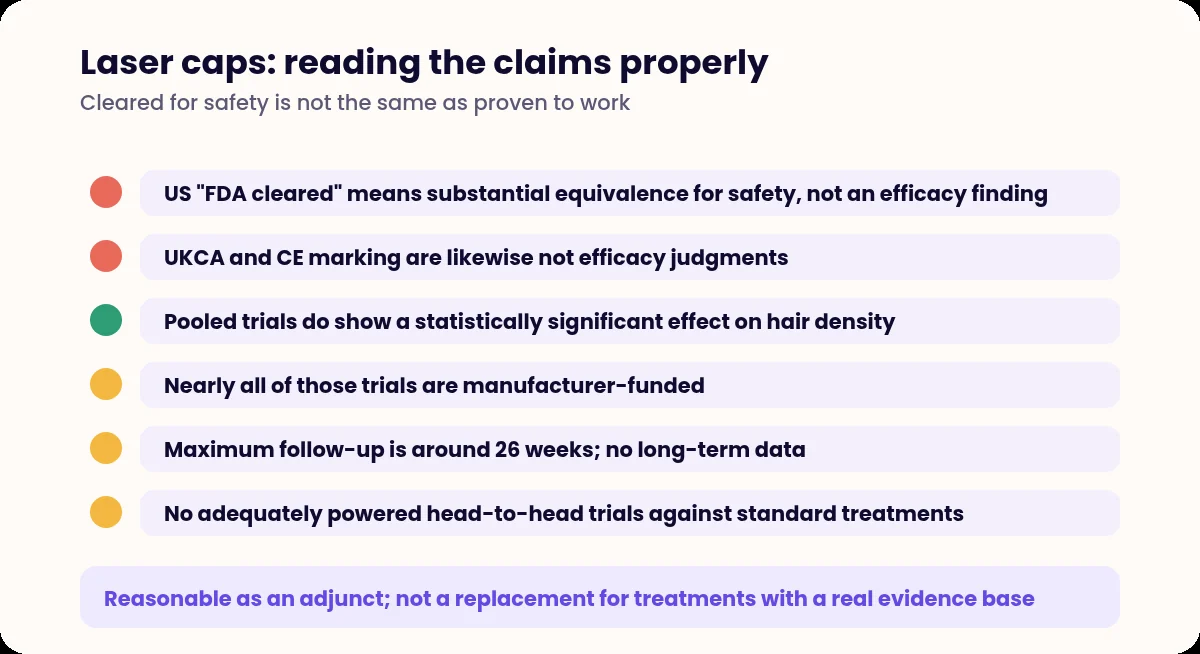
- US 'FDA cleared' status means a device was judged substantially equivalent to an existing one for safety — it is not a finding that the device grows hair, and UKCA or CE marking is not an efficacy judgment either.
- The longest follow-up in that evidence base is 26 weeks, nearly all the trials were funded by device manufacturers, and none compared the devices head to head against standard treatments.
- Laser caps are best understood as a possible add-on in mild to moderate pattern hair loss, not a replacement for treatments with stronger evidence. They are not available on the NHS.
Laser caps are the most heavily marketed hair loss product that nobody talks about honestly. The advertising leans on a single phrase — “FDA cleared” — that does not mean what almost every buyer assumes it means. The underlying evidence is not nothing, but it is a lot thinner than the price tag suggests.
Here is what is actually known.
What the devices are
Low-level laser therapy, sometimes called photobiomodulation or red light therapy, uses low-energy light in the red part of the spectrum. In the trials that have been run, wavelengths sit between 620 and 678 nanometres, and devices carry a median of around 148 laser diodes [1]. The light is non-thermal: it does not heat, cut or ablate tissue.
They come as caps, helmets, headbands and hand-held combs. Typical protocols are three to four sessions a week, with each session lasting several minutes to half an hour depending on the device. The proposed mechanism is that red light is absorbed by mitochondria in the follicle, increasing cellular energy production and pushing resting follicles back into a growth phase. That is a plausible story rather than a demonstrated pathway.
“FDA cleared” is not “proven to work”
This is the single most misrepresented fact in the category, and it is worth being blunt about.
In the United States, home-use laser devices for hair loss reach the market through the 510(k) clearance route. A 510(k) clearance means the manufacturer demonstrated that the device is substantially equivalent to a device already on the market, giving reasonable assurance of safety. It is not the same process as drug approval, and it is not a regulatory finding that the device grows hair. Marketing copy routinely blurs the two.
In the UK, these devices are UKCA or CE-marked medical devices. That marking confirms the product meets the applicable safety and conformity requirements. It is likewise not an efficacy judgment, and it is not comparable to an MHRA marketing authorisation for a medicine.
So when a laser cap is described as “cleared” or “approved”, the accurate reading is: a regulator is satisfied it is unlikely to hurt you. Whether it works is a separate question answered — partly — by the trial literature.
What the trials found
The best available synthesis is a systematic review and meta-analysis of randomised trials of home-use devices, published in 2021. It pooled seven randomised controlled trials including 607 participants [1].
- Hair density improved with laser therapy compared with sham devices, with a standardised mean difference of 1.27 (95% CI 0.993 to 1.639) — a statistically significant result.
- Mean study duration was 21.3 weeks, with a range of 16 to 26 weeks.
- Devices using laser diodes alone outperformed those using LEDs only or a combination of light sources (p=0.043).
- There was no significant difference between comb-type and helmet-type devices, and no significant difference in response between men and women.
- No serious adverse events were reported.
As of January 2020 the review counted 32 cleared home-use devices, retailing between $279 and $2,999 [1]. UK prices vary similarly.
Taken at face value, that is a positive result. The problem is what sits underneath it.
Why the evidence is weaker than the headline
Several things should temper how much weight you put on that effect size [1, 2]:
- Nearly all the trials were funded by device manufacturers. That does not make them wrong, but industry-funded device trials as a body tend to report larger effects than independent ones, and publication bias is likely.
- Sham-controlling a device the patient can see and feel is genuinely difficult. A cap that lights up is hard to blind convincingly, and expectation effects on a subjective outcome like hair appearance are substantial.
- Maximum follow-up was 26 weeks. The review’s authors name short-term follow-up as their principal limitation. Pattern hair loss is a condition measured in decades. There is no long-term data at all.
- Outcomes were usually hair count in a small marked target area rather than global photographic assessment, which is what a person actually notices in the mirror.
- There are no adequately powered head-to-head trials against standard treatments. Nobody has run the study that would tell you whether a laser cap adds anything on top of what someone is already doing, or how it compares on its own.
A 2025 systematic review of lasers and energy-based devices in hair loss reaches broadly the same conclusions [2].
Where that leaves them
A fair summary: a modest and probably real short-term benefit in mild to moderate pattern hair loss, with a good safety record, at a high price, and unproven beyond six months.
That positions a laser cap as adjunctive at best — something that might add a little on top of treatment with stronger evidence, never a substitute for it. If you are choosing between a laser cap and starting a treatment with randomised evidence spanning years rather than months, the cap is the weaker choice.
There is no NICE guidance on low-level laser therapy for hair loss and it is not available on the NHS [3]. Everything in this category is a private purchase.
How long before you would know
The trials ran for between 16 and 26 weeks, and that is a reasonable benchmark for a personal trial too. Hair cycles slowly; nothing visible happens in a fortnight, and a device judged after a month has not been given a fair test.
The flip side is that an open-ended commitment with no review date is how people end up three years and several hundred pounds in with no idea whether anything changed. Set a date before you start, take the baseline photographs on the day the device arrives, and hold yourself to reviewing them honestly.
One more thing worth saying plainly: consistency is the variable most likely to determine whether you see anything. A device used three or four times a week as studied is a different intervention from one used when you remember. If the format you have chosen is one you will not keep up with, that matters more than the diode count.
Practical points if you buy one
- Get the diagnosis first. These devices are studied in androgenetic alopecia. If your loss is patchy, inflammatory, painful or scarring, a laser cap is the wrong answer and delay matters — see our guides on male pattern baldness and scarring alopecia.
- Check the specification, not the marketing. The meta-analysis found laser diodes outperformed LED-only devices. Many cheaper products are LED arrays described loosely as “laser”.
- Expect to use it indefinitely. Nothing in the evidence suggests a course of treatment with a durable result after stopping.
- Judge it on photographs, not impressions. Standardised photos at baseline and six months in the same light and position are worth more than a recollection of how your hair looked in March.
- Be sceptical of bundles. Devices sold alongside shampoos and supplements borrow credibility across products. Our guides to hair loss myths and microneedling for hair loss cover where the other add-ons sit.
Frequently asked questions
Do laser caps actually regrow hair?
The pooled randomised evidence shows a real, modest increase in hair density over sham devices in mild to moderate pattern hair loss. What it does not show is how much of that is cosmetically noticeable, whether it lasts beyond six months, or how it compares with established treatments, because nobody has run those trials.
Is a laser helmet better than a laser comb?
The meta-analysis found no significant difference between helmet-type and comb-type devices. It did find that devices using laser diodes alone performed better than those using LEDs only or a mix of both. Compliance probably matters more than form factor, since a hands-free cap is easier to use three or four times a week.
Can I get a laser cap on the NHS?
No. There is no NICE guidance on low-level laser therapy for hair loss and it is not an NHS-funded treatment. These are consumer devices bought privately, and prices vary enormously between models.
Are laser caps safe?
The trials reported no serious adverse events. The light is non-thermal and does not cut or burn. The realistic risks are financial rather than physical: spending several hundred pounds on a device while an underlying condition goes undiagnosed, or using one instead of treatment with better evidence.
References
- Systematic review and meta-analysis of home-use low-level laser therapy devices for androgenetic alopecia. Journal of Clinical and Aesthetic Dermatology, 2021. jcadonline.com/laser-therapy-hair-loss/
- Systematic review of lasers and energy-based devices in hair loss, 2025. pubmed.ncbi.nlm.nih.gov/42339398/
- NHS. Hair loss. www.nhs.uk/conditions/hair-loss/
- DermNet. Male pattern hair loss. dermnetnz.org/topics/male-pattern-hair-loss
- NICE Clinical Knowledge Summaries. Alopecia, androgenetic – male. cks.nice.org.uk/topics/alopecia-androgenetic-male/
Medical reviewer
Naeem Teni
Clinical Lead at Manova. Registered pharmacist and independent prescriber, GPhC 2215591. Reviews Manova’s clinical content for accuracy and safety.
Written by
Manova Editorial Team
Researched and written to our editorial policy, using NICE, NHS, MHRA and peer-reviewed sources.
This article is for general information and isn’t a substitute for advice from your own clinician. If you feel unwell, contact your GP or NHS 111. In an emergency, call 999.