

Key takeaways
- A difference in desire between partners is normal variation, not a disorder, and framing it as a couple-level issue is less stigmatising and more useful than diagnosing one person.
- Desire is not always spontaneous — for many people it follows arousal and intimacy rather than preceding it, and men experience this too.
- It becomes a clinical question when one partner has changed from their own baseline, with distress lasting six months or more, or when a medical or medication cause is identifiable.
- Erectile dysfunction frequently masquerades as low desire, because avoiding anticipated failure looks exactly like not wanting sex.
In nearly every long relationship, one person would like sex more often than the other. That is not a sign that something has gone wrong. European urology guidance puts it directly: sexual desire discrepancy is often found in couples and represents normal variation across the lifespan [1].
What causes the damage is usually not the gap itself but the interpretation attached to it. The higher-desire partner concludes they are unwanted. The lower-desire partner concludes they are broken, or under pressure, or both. Each response makes the other worse.
A note on the evidence before we go further: this is one of the least well-researched areas in sexual medicine. Most of what follows is cross-sectional survey work and clinical theory rather than trial data, and it is presented that way deliberately.
Two patterns of desire
The most useful idea available here is the distinction between spontaneous and responsive desire.
Spontaneous desire appears unprompted. You want sex, then you seek it out. This is the version that features in nearly all cultural depictions and is widely assumed to be how desire works, particularly for men.
Responsive desire works the other way round. Nothing much is felt at the start. Arousal begins for a reason — touch, closeness, a deliberate decision — and desire follows it rather than preceding it.
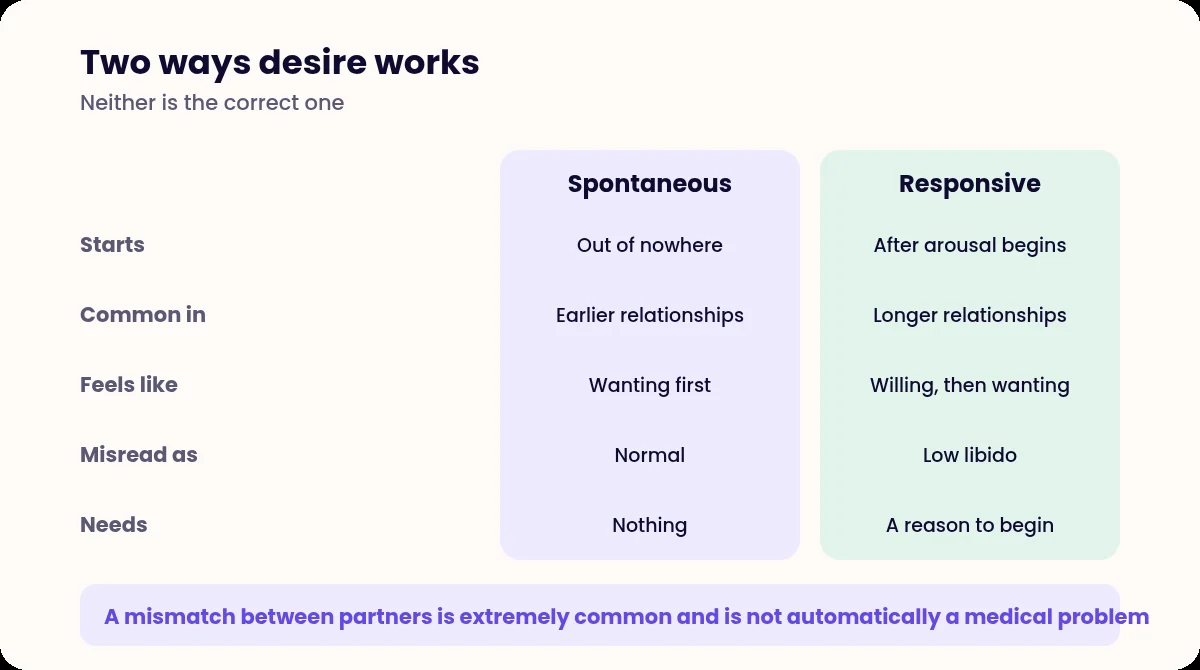
This comes from Basson’s non-linear model of sexual response [2], and it is worth being careful about what that model is. It was developed primarily in work with women, it is a clinically useful heuristic rather than a validated mechanism, and empirical validation is limited. It has been popularised far beyond its evidence base.
Used as a framework rather than a fact, though, it does two things well.
It removes the assumption that a lack of initial interest means a lack of interest full stop — which is the assumption under most desire mismatch arguments. And it corrects a specifically male problem: the belief that men are supposed to want sex spontaneously, always, and that not doing so is a defect. Men show responsive desire too. Many men in their forties and beyond describe exactly this pattern and quietly assume something has failed.
The practical consequence is that “I don’t feel like it right now” and “I would not enjoy this if we started” are different statements, and couples who learn to distinguish them tend to do much better.
When it is a relationship question
It is reasonable to treat this as a relationship matter, not a medical one, when both partners’ desire is within their own normal range and the distress is coming from the gap and how it is being handled.
What helps, based on clinical practice rather than trial data:
Take it out of the scoreboard. Counting frequency and comparing it to an imagined average turns sex into a performance measure. Nobody’s desire survives being audited.
Separate initiation from obligation. A great deal of the avoidance in these couples comes from the lower-desire partner feeling that any affection will be read as a sexual opening, so they stop offering affection at all. Agreeing explicitly that touch is not a contract usually increases both touch and sex.
Make space for responsive desire. If desire follows arousal for one of you, waiting to feel spontaneous want before agreeing to anything guarantees it never happens. Deciding to start, with permission to stop, is not the same as duty.
Say the specific thing. “I miss you” lands very differently from “we never have sex any more”. Our guide to talking to your partner covers this ground, and most of it transfers.
Get help earlier than feels necessary. Psychosexual and couple therapy is the appropriate route, and it works better before several years of resentment have accumulated.
When it is worth assessing medically
The clinical question is not “is your desire lower than your partner’s”. It is “has your desire changed from your own baseline, and is that change distressing you”.
The formal diagnosis, male hypoactive sexual desire disorder, requires persistently or recurrently deficient sexual thoughts, fantasies and desire, for at least six months, causing clinically significant distress, and not better explained by another disorder, by relationship distress, or by a substance or medicine. The duration and distress criteria are what convert normal variation into a diagnosis. Prevalence in a population-based survey of 12,646 middle-aged German men was 4.7%, with risk rising with age, poor general health, vascular disease, smoking, depression and relationship problems [1].
Worth excluding before concluding it is relational:
- Testosterone deficiency. Measured properly: fasting total testosterone, before 11am, repeated, with LH and prolactin if low. Desire does not track circulating testosterone in a neat linear way, particularly in older men, so a number at the low end of normal is not automatically the answer. Our guide to low testosterone symptoms covers how it is tested.
- Raised prolactin, thyroid disease, and depression.
- Medication — SSRIs, antipsychotics, opioids, 5-alpha reductase inhibitors, some antihypertensives.
- Alcohol, recreational drugs and sleep deprivation, all of which are commoner explanations than hormones.
- Erectile dysfunction itself. This is the one clinicians most often see missed.
Erectile difficulty masquerading as low desire
When sex has repeatedly gone wrong, anticipating it stops being pleasant. Avoidance follows, and avoidance is indistinguishable from disinterest from the outside — and often from the inside too. A man in this position will frequently and sincerely report that he has gone off sex.
Get the order right. If erections have become unreliable and desire dropped afterwards, the erectile problem is the thing to assess. Our guide to low libido in men sets out how to separate the two, and performance anxiety and erections covers the cycle that maintains it.
Where to get help in the UK
Your GP for the medical exclusions — bloods, medication review, mood.
Psychosexual or couple therapy for the relationship side. COSRT-accredited therapists can be found directly [4], and Relate offers sex therapy as well as relationship counselling [5]. NHS psychosexual services exist but are patchily commissioned, so most UK access is private. Guidance supports CBT and mindfulness-based approaches as showing potential benefit, with the honest caveat that the trial evidence is thin.
NHS Talking Therapies accepts self-referral in England where anxiety or depression is driving or maintaining the problem [6].
Frequently asked questions
Is it normal for one partner to want sex more than the other?
Yes, and it is close to universal over the length of a long relationship. European urology guidance describes desire discrepancy as commonly found in couples and as normal variation across the lifespan. What varies is not whether the gap exists but how a couple negotiates it, which is where the distress usually comes from.
What is responsive desire?
It describes a pattern where desire arrives after arousal and intimacy have begun, rather than appearing spontaneously beforehand. It is a useful framework rather than established science — the model was developed primarily for women and empirical validation is limited — but many men recognise it, and the assumption that male desire is always spontaneous causes real distress.
When is low desire a medical problem?
When it represents a persistent change from your own baseline, has lasted at least six months, causes you genuine distress, and is not better explained by relationship difficulty or circumstance. At that point it is worth excluding testosterone deficiency, raised prolactin, thyroid disease, depression, medication effects, alcohol and sleep deprivation.
Could my medication be causing it?
Several common medicines affect desire: SSRIs and other antidepressants, antipsychotics, opioids, 5-alpha reductase inhibitors used for hair loss or prostate symptoms, and some antihypertensives. Do not stop anything yourself — raise it with your prescriber, as a dose change or a switch is often possible.
References
- European Association of Urology. Low sexual desire and male hypoactive sexual desire disorder. uroweb.org/guidelines/sexual-and-reproductive-health/chapter/low-sexua
- Basson R. Human sex-response cycles. Journal of Sex and Marital Therapy, 2001. pubmed.ncbi.nlm.nih.gov/11898699/
- British Society for Sexual Medicine. Guidelines on the management of erectile dysfunction in men. www.bssm.org.uk/guidelines/
- College of Sexual and Relationship Therapists. Find a therapist. www.cosrt.org.uk/
- Relate. Relationship counselling and sex therapy. www.relate.org.uk/
- NHS Talking Therapies for anxiety and depression. www.nhs.uk/mental-health/talking-therapies-medicine-treatments/talking
Medical reviewer
Naeem Teni
Clinical Lead at Manova. Registered pharmacist and independent prescriber, GPhC 2215591. Reviews Manova’s clinical content for accuracy and safety.
Written by
Manova Editorial Team
Researched and written to our editorial policy, using NICE, NHS, MHRA and peer-reviewed sources.
This article is for general information and isn’t a substitute for advice from your own clinician. If you feel unwell, contact your GP or NHS 111. In an emergency, call 999.