

Key takeaways
- Glycaemic index ranks a 50 g available-carbohydrate portion of a food by its two-hour blood glucose response against glucose scored at 100.
- GI is measured on single foods eaten alone by fasted volunteers, so it predicts the response to a mixed meal poorly.
- A 2023 Cochrane review found little to no difference in body weight or BMI between low-GI diets and comparator diets, on low to very low certainty evidence.
- There is modest genuine utility for glycaemic control in type 2 diabetes, and UK bodies are noticeably less enthusiastic about GI than US and commercial sources.
The glycaemic index is one of the few nutrition concepts that is both scientifically real and, for most people trying to lose weight, close to useless. Both halves of that sentence matter.
It was designed as a research tool for understanding blood glucose responses. It got repackaged as a healthy-eating heuristic, and it does not survive the journey well.
What the number actually measures
To generate a GI value, a laboratory feeds volunteers a portion of a food containing 50 g of available carbohydrate, on an empty stomach, with nothing else. Blood glucose is then measured over two hours and the incremental area under the curve is compared against a reference food — glucose, scored at 100.
The bands are:
- Low GI: 55 or under
- Medium GI: 56 to 69
- High GI: 70 or above
Glycaemic load corrects for the most obvious problem, which is that 50 g of available carbohydrate is a very different amount of food depending on the food. GL multiplies the GI by the available carbohydrate in a realistic serving and divides by 100. Low is 10 or under, medium 11 to 19, high 20 or above.
So watermelon has a high GI and a low glycaemic load, because a slice of watermelon is mostly water. GL is the more sensible of the two numbers, and it is the one almost nobody uses.
Why the method limits what the number can tell you
Four problems, and they compound.
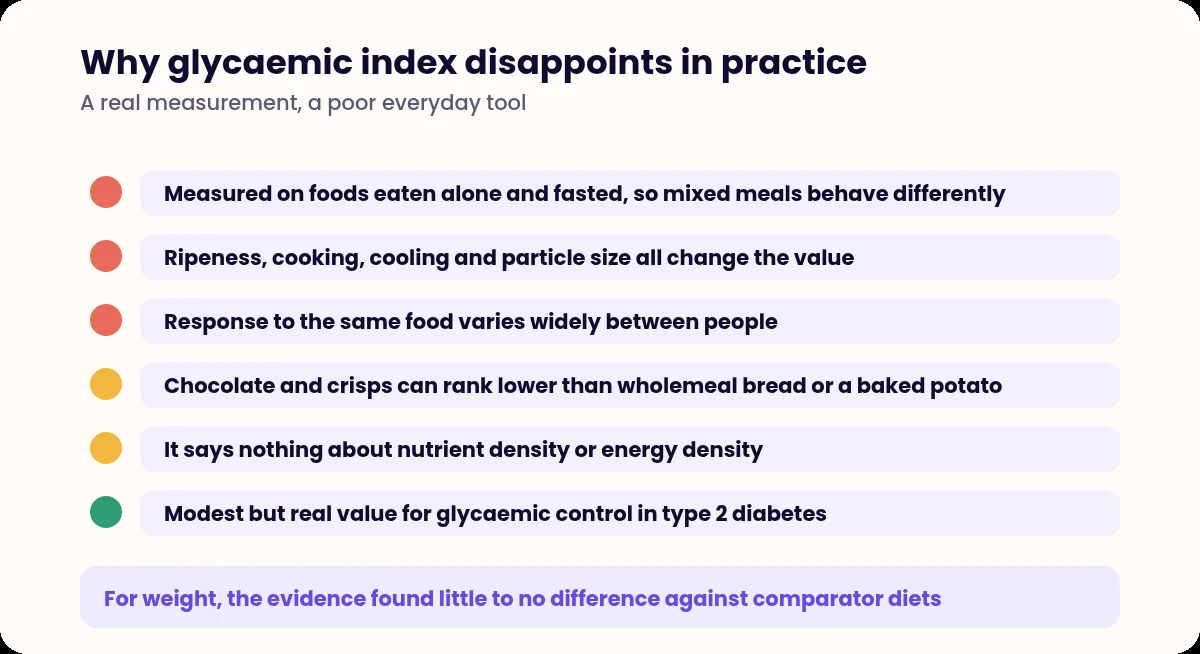
It is measured on food eaten alone, fasted. Almost nobody eats that way. Add fat, protein, acid or fibre to a carbohydrate and the glucose response changes, usually flattening. Eat the same food after a previous meal and it changes again. Mixed-meal prediction from published GI values is poor, and that is the context in which people actually eat.
The same food gives different numbers in different people. Within-person and between-person variability in the glucose response to an identical food is large. A published GI value is a group average that may not describe you.
Processing and preparation move the number a long way. Ripeness of fruit, particle size of flour, cooking time of pasta and whether a potato or a portion of rice has been cooled — which increases resistant starch — all change the glycaemic response of what is nominally the same food.
The rankings are frequently counterintuitive. Chocolate and crisps can score lower than wholemeal bread, watermelon or a baked potato, because fat slows gastric emptying and blunts the glucose curve. That is not a quirk at the margins. It is the central reason GI fails as a shorthand for healthy eating: it says nothing about nutrient density, energy density, fibre, salt, or the overall quality of the diet. A number that ranks crisps above wholemeal bread is not measuring what a person following a “low GI diet” thinks it is measuring.
What the evidence says about weight
This is the part most commercial material skips.
A 2023 Cochrane review of low-GI diets as an intervention for obesity found little to no difference in body weight, BMI or other anthropometric outcomes compared with the diets they were tested against, and rated the certainty of that evidence as low to very low [1].
That is about as clear as nutrition evidence gets. Where low-GI diets do produce weight loss in trials, the reasonable interpretation is that the eating pattern they encourage — more legumes, more intact grains, more vegetables, fewer refined snacks — reduces energy intake. The mechanism is the food, not the index. If you want the same result more directly, fibre and total energy intake are the levers worth pulling, and the arithmetic behind that is covered in what a calorie deficit really is.
This also puts the low-GI approach in the same category as most named diets. The comparison between low carb and low fat landed in the same place: the label matters much less than whether the pattern is one you will keep to.
Where GI genuinely earns its place
Glycaemic control in type 2 diabetes, modestly.
An older Cochrane review of 11 randomised trials in 402 participants, running from one to twelve months, found low-GI diets reduced HbA1c by 0.5 percentage points (95% CI −0.9 to −0.1) with fewer hypoglycaemic episodes [2]. Those trials were small, short and are now dated, so the effect should be held loosely. But it is a real signal, and it is about blood glucose rather than body weight.
Even there, the UK position is measured. Diabetes UK and the NHS both mention GI as one option among several, while putting considerably more emphasis on carbohydrate quantity, fibre intake and the overall dietary pattern [3, 4]. NICE guidance on obesity management does not recommend GI-based diets as a weight loss intervention [5]. That is a noticeably cooler position than you will find in US patient material and in commercial low-GI programmes, and the difference is not accidental — it tracks the strength of the evidence for each use.
If you are working toward type 2 diabetes remission, total carbohydrate and total energy do far more work than the index.
How to use any of this practically
If you want the benefit without the bookkeeping:
- Choose the intact version of a carbohydrate where you can. Whole oats over instant, pulses over refined starch, whole fruit over juice.
- Put protein, fat or vegetables alongside carbohydrate rather than eating it alone. This does more to flatten a glucose response than swapping to a lower-GI food.
- Treat portion size as the primary variable. Glycaemic load beats glycaemic index precisely because it accounts for how much you eat.
- Ignore GI when it conflicts with the obvious. Crisps having a lower GI than a baked potato is a fact about the measurement, not dietary advice.
One more thing worth saying plainly: continuous glucose monitors marketed to people without diabetes have made glucose “spikes” feel like a health outcome in their own right. In people with normal glucose regulation, post-meal rises are normal physiology. The relationship between those readings and long-term weight or health outcomes in that group has not been established, and a lot of confident content is being built on top of a gap. Reading food labels for energy, fibre and added sugar will tell you more useful things.
When to speak to a clinician
Get advice rather than self-managing if you:
- have type 2 diabetes and are considering a low-GI or low-carbohydrate approach while taking insulin or a sulfonylurea, as medication doses may need adjusting to avoid hypoglycaemia
- have type 1 diabetes, where carbohydrate counting and insulin matching are the priority
- are pregnant, including with gestational diabetes, where dietary changes should be supervised
- find that tracking glucose responses or food rankings is becoming rigid or distressing
Frequently asked questions
What is a low GI food?
Foods are banded as low if the glycaemic index is 55 or under, medium at 56 to 69, and high at 70 or above. Glucose itself is the reference and scores 100. The bands describe the shape of a blood glucose response to a standardised portion, not how healthy a food is overall.
Does a low GI diet help you lose weight?
The evidence does not support it as a weight loss strategy in itself. A 2023 Cochrane review found little to no difference in body weight, BMI or other body measurements between low-GI diets and comparison diets, and rated the certainty of that evidence as low to very low.
What is the difference between glycaemic index and glycaemic load?
Glycaemic index describes a fixed 50 g carbohydrate portion, which can be an unrealistic amount of food. Glycaemic load multiplies the GI by the available carbohydrate in a realistic serving and divides by 100, so it accounts for portion size. Low glycaemic load is 10 or under, high is 20 or above.
Is GI useful if I have type 2 diabetes?
It has modest value. An older Cochrane review of 11 trials in 402 people found low-GI diets reduced HbA1c by about 0.5 percentage points with fewer hypoglycaemic episodes. Those trials were small and short. Diabetes UK mentions GI as one option but puts more weight on carbohydrate quantity, fibre and overall dietary pattern.
References
- Zafar MI, Mills KE, Zheng J, et al. Low glycaemic index diets as an intervention for obesity. Cochrane Database of Systematic Reviews. 2023;CD005105.pub3. www.cochranelibrary.com/cdsr/doi/10.1002/14651858.CD005105.pub3/full
- Thomas D, Elliott EJ. Low glycaemic index, or low glycaemic load, diets for diabetes mellitus. Cochrane Database of Systematic Reviews. 2009;CD006296. www.cochranelibrary.com/cdsr/doi/10.1002/14651858.CD006296.pub2/full
- Diabetes UK. Glycaemic index and diabetes. www.diabetes.org.uk/guide-to-diabetes/enjoy-food/carbohydrates-and-dia
- NHS. Starchy foods and carbohydrates. www.nhs.uk/live-well/eat-well/food-types/starchy-foods-and-carbohydrat
- NICE. Overweight and obesity management. NG246. January 2025. www.nice.org.uk/guidance/ng246
Medical reviewer
Naeem Teni
Clinical Lead at Manova. Registered pharmacist and independent prescriber, GPhC 2215591. Reviews Manova’s clinical content for accuracy and safety.
Written by
Manova Editorial Team
Researched and written to our editorial policy, using NICE, NHS, MHRA and peer-reviewed sources.
This article is for general information and isn’t a substitute for advice from your own clinician. If you feel unwell, contact your GP or NHS 111. In an emergency, call 999.