

Key takeaways
- Permitted sites differ by product: Wegovy and Saxenda list abdomen, thigh or upper arm, while the Mounjaro KwikPen lists abdomen or thigh for self-injection, with the upper arm only if someone else administers it.
- FIT UK recommends a 4mm pen needle for all adults regardless of age, sex or BMI, inserted at 90 degrees with no skin fold needed.
- Pen needles are single use, and the needle should not be left attached to the pen between doses.
- Sharps disposal routes are set by local authorities and are not standardised across the UK, so check your own council rather than assuming a national rule.
This page is medicine information rather than an advert. Semaglutide, tirzepatide and liraglutide are prescription only medicines in the UK [7], and whether any of them is suitable is a decision for a prescriber after an assessment.
Injection technique is one of the few parts of this treatment entirely in the patient’s hands, and it is the part most often taught once and never revisited. The UK has a detailed reference document for it, and each product has its own licensed instructions that differ in ways worth knowing.
What the SmPC says for each product
The Summary of Product Characteristics is the licensed, legally binding document. Everything else is guidance or local practice.
Wegovy (semaglutide) 2.4mg. Subcutaneous injection in the abdomen, thigh or upper arm. The SmPC states the injection site can be changed, that it must not be given intravenously or intramuscularly, and that dosing is once weekly, with or without meals, at any time of day [2].
Wegovy 7.2mg. Escalation runs 0.25, 0.5, 1, 1.7 then 2.4mg over 16 weeks, with 7.2mg available after a minimum of four weeks at 2.4mg. There is a 2025-26 addition worth reading carefully: where the 7.2mg dose is delivered as three separate 2.4mg injections, they “can be given in the same body area but should be at least 5cm apart“, with a needle change between each [3]. Three injections, three needles, spaced.
Mounjaro KwikPen (tirzepatide). Inject in the abdomen or thigh. The SmPC states that “another person should inject in the back of the upper arm”, which makes the upper arm a carer-administered site rather than a self-injection site for this product. Injection sites should be rotated with each dose, and anyone who also injects insulin should use a different injection site for each [4].
Saxenda (liraglutide 3mg). Daily injection in the abdomen, thigh or upper arm. This SmPC specifically links site rotation to reducing the risk of amyloid deposits at injection sites [5].
The FIT UK recommendations
The Forum for Injection Technique UK produced the reference UK document, now in its 5th edition [1]. It states explicitly that patients on non-insulin injectables should follow the same recommendations as for insulin.
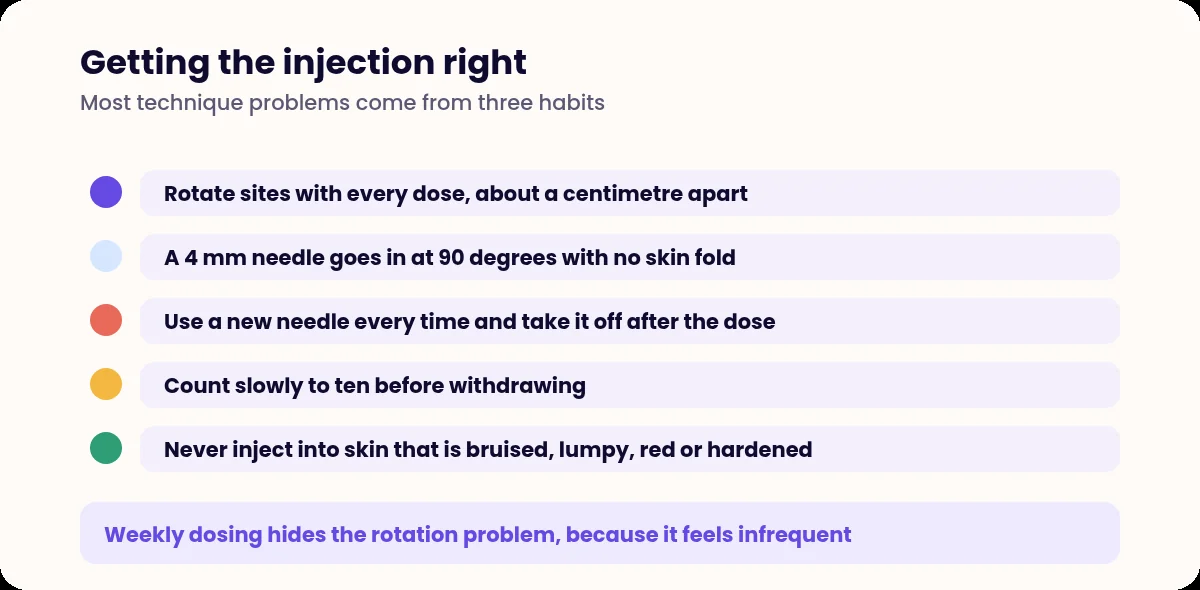
- A 4mm pen needle is recommended for all adults, regardless of age, sex or BMI. 6mm and 8mm needles are no longer recommended for adults
- With a 4mm needle, insert perpendicular at 90 degrees with no skin fold. A skin fold is required for needles of 5mm or longer, or in very thin adults with a BMI below 19
- Space injections about 1cm apart. Divide each area into quadrants and rotate systematically, returning to the same specific spot no more often than every four weeks where that is feasible
- Pen needles are single use
- After fully depressing the button, count slowly to ten before withdrawing
- Prime or air-shot before injecting, following the manufacturer’s instructions for your specific device
One caveat about this document
The 5th edition is dated 2019. It predates the widespread use of GLP-1 receptor agonists for weight management, and its lipohypertrophy figures — that the condition affects almost two thirds of insulin users, and that 39% of those with it report unexplained hypoglycaemia — are insulin-derived data. They should not be presented as GLP-1 figures. The technique recommendations transfer straightforwardly; the epidemiology does not.
The errors that actually happen
Reusing needles. Common, and against the manufacturer’s instructions for every one of these devices. A used needle is blunter and the tip can deform.
Leaving the needle attached between doses. This allows leakage, lets air into the cartridge, and creates a contamination route. It is specifically against manufacturer instructions.
Withdrawing too early. The most frequent cause of under-dosing. The visible drop of liquid at the site afterwards is the giveaway.
Injecting into the same favourite spot. Weekly dosing disguises this. Fifty-two injections a year into one small area is a real exposure, but because it only happens once a week it does not feel like repetition. This is the single biggest difference from insulin practice, where multiple daily injections make the need for rotation obvious.
Injecting through clothing. Not a recommended practice, and it prevents you seeing the site.
Not inspecting the sites. Run your fingers over the areas you use periodically, looking for thickened, rubbery or lumpy tissue. Raise anything you find with your prescriber rather than continuing to inject into it.
Skipping the prime or air-shot on multi-dose pens. Note that single-dose pen presentations differ, so check which device you have rather than applying advice written for a different one.
Injecting intramuscularly. This happens by pinching too hard, or by using an over-long needle in a lean thigh. It is one of the reasons FIT UK moved to recommending 4mm for everyone.
Storage errors. Covered separately in storing and travelling with weight loss medicines.
Sharps disposal in the UK
Used pens and needles must never go into household or public rubbish. They are healthcare waste, and there is a legal duty of care under the Environmental Protection Act 1990, with handling covered by HTM 07-01 [6].
A UK-approved sharps container should be supplied by the prescriber or pharmacy. In England, a sharps container is prescribable on an FP10.
What happens to the full bin is where it gets complicated, and this is the point at which most articles state something that is not true nationally. The disposal route varies by local authority and is not standardised. Some councils operate a free household clinical waste collection. Some charge. Some require the full container to be taken to a named household waste recycling centre. Some community pharmacies and GP practices accept returns, but they are not obliged to.
The only correct instruction is therefore: check your own council’s website before your first bin is full, not after.
Private patients are a known gap. People who obtain these medicines through an online clinic frequently receive pens without a sharps bin and without disposal instructions. If that describes you, ask your provider for a container, ask your GP practice or pharmacy whether they will supply one, and check your council’s route. It is also worth telling your GP about private treatment for reasons beyond waste disposal.
Practical sequence
- Check the pen is the right product and the right dose, and inspect the solution
- Attach a new needle and prime or air-shot per the device instructions
- Choose a site at least 1cm from your last injection, working systematically around a quadrant
- Insert at 90 degrees, no skin fold with a 4mm needle
- Depress the button fully, then count slowly to ten
- Withdraw, remove the needle from the pen, and place the needle in the sharps bin
- Record the site used, so next week’s rotation is not guesswork
Anyone who is unsure should ask for their technique to be watched rather than described. Dose schedules for individual products are covered in mounjaro dosage and wegovy 7.2 mg, and what to do when a dose is missed is covered in missed dose weight loss medicine.
When to speak to a clinician
- A lump, thickened area or dent at an injection site — raise it before your next dose rather than injecting into it
- Redness, heat, swelling or pain at a site that is spreading, which needs a same-day assessment
- A visible leak at the site after every injection, which suggests technique rather than the device
- Any accidental needlestick injury involving someone else’s pen — contact 111 or your GP the same day
Frequently asked questions
Where can I inject a weekly weight management medicine?
It depends on the product. The Wegovy SmPC permits the abdomen, thigh or upper arm. The Mounjaro KwikPen SmPC specifies the abdomen or thigh, and states that another person should inject in the back of the upper arm, so it is not listed as a self-injection site. Saxenda permits abdomen, thigh or upper arm. None of these may be given intravenously or intramuscularly.
Do I need to pinch a skin fold?
Not with a 4mm needle. FIT UK recommends inserting a 4mm pen needle perpendicular at 90 degrees with no skin fold. A skin fold is required for needles of 5mm or longer, and in very thin adults with a BMI below 19. FIT UK no longer recommends 6mm or 8mm needles for adults.
How long should I hold the pen against the skin?
Count slowly to ten after fully depressing the button, before withdrawing the needle. Withdrawing early is a common cause of under-dosing, and often shows as a visible drop of liquid at the site afterwards.
How do I dispose of used pens and needles in the UK?
Never in household or public rubbish. A UK-approved sharps container should be supplied by your prescriber or pharmacy, and in England it is prescribable on an FP10. The route for the full bin varies by local authority: some councils collect free, some charge, and some require you to take it to a named waste recycling centre. Check your own council's website.
References
- Forum for Injection Technique UK. Optimising Diabetes Care: The UK Injection and Infusion Technique Recommendations, 5th edition. October 2019. www.fit4diabetes.com/united-kingdom/
- Summary of Product Characteristics: Wegovy 2.4 mg solution for injection in pre-filled pen. Electronic Medicines Compendium. www.medicines.org.uk/emc/
- Summary of Product Characteristics: Wegovy 7.2 mg solution for injection in pre-filled pen. Electronic Medicines Compendium. www.medicines.org.uk/emc/
- Summary of Product Characteristics: Mounjaro KwikPen (tirzepatide) solution for injection. Electronic Medicines Compendium. www.medicines.org.uk/emc/
- Summary of Product Characteristics: Saxenda 6 mg/mL solution for injection (liraglutide). Electronic Medicines Compendium. www.medicines.org.uk/emc/
- Department of Health. Health Technical Memorandum 07-01: Safe and sustainable management of healthcare waste. www.england.nhs.uk/publication/management-and-disposal-of-healthcare-w
- The Human Medicines Regulations 2012, regulation 284. www.legislation.gov.uk/uksi/2012/1916/regulation/284
Medical reviewer
Naeem Teni
Clinical Lead at Manova. Registered pharmacist and independent prescriber, GPhC 2215591. Reviews Manova’s clinical content for accuracy and safety.
Written by
Manova Editorial Team
Researched and written to our editorial policy, using NICE, NHS, MHRA and peer-reviewed sources.
This article is for general information and isn’t a substitute for advice from your own clinician. If you feel unwell, contact your GP or NHS 111. In an emergency, call 999.