

Key takeaways
- Sex costs roughly two to four METs, about the same as climbing two flights of stairs, which is the heuristic UK cardiac rehabilitation uses.
- Most people can resume sexual activity around four weeks after an uncomplicated heart attack, once they can manage moderate exertion without chest pain or breathlessness.
- Nitrates and PDE5 inhibitors must never be combined: 24 hours must pass after a short-acting PDE5 inhibitor and 48 hours after the long-acting one before a nitrate is given.
- Anyone with unstable angina, a heart attack within the past two weeks, severe heart failure or severe aortic stenosis should defer sexual activity until stabilised.
Very few people leave hospital after a heart attack having been told when they can have sex again. Fewer still ask. The result is couples who quietly stop, sometimes permanently, on the basis of a fear nobody has checked.
The physiological answer is more reassuring than most people expect. Sex is a moderate exertion, not a heroic one. There is one genuinely serious drug interaction to understand, and a small group of people who should wait. Otherwise, the advice is closer to “when you feel able” than the ward silence implies.
How much exertion sex actually is
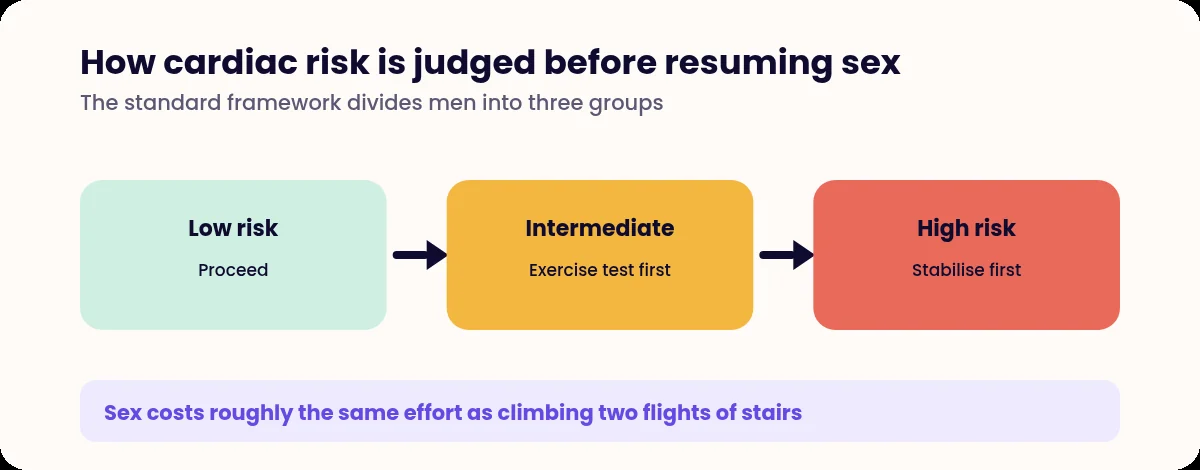
Energy cost is measured in METs, multiples of resting metabolic rate. Foreplay runs at roughly 2 to 3 METs and the effort at orgasm at roughly 3 to 4 METs [1]. That is comparable to walking briskly on the flat, doing the hoovering, or climbing two flights of stairs.
The stairs comparison is not a metaphor. It is the working heuristic UK cardiac rehabilitation actually uses: if you can climb two flights of stairs, or walk briskly, without chest pain, undue breathlessness or palpitations, you can manage the exertion of sex [2, 3]. Most people reach that point around four weeks after an uncomplicated heart attack, though recovery varies and your rehabilitation team is better placed to say than any article.
This is one of the clearer differences between UK and US practice. The American framework leans on formal exercise testing to stratify risk. UK cardiac rehabilitation leans on the functional heuristic, in the context of a supervised programme where your exercise tolerance is already being observed week by week [4, 6]. Both are trying to answer the same question.
The risk tiers
The Princeton IV consensus, published in 2024, sorts people into three groups. It is worth recognising which one you are likely in, though the categorisation is a clinical judgement rather than a self-assessment [1].
Low risk. Able to achieve 5 METs without evidence of ischaemia; controlled high blood pressure; mild, stable angina; heart failure at NYHA class I or II; asymptomatic with fewer than three cardiovascular risk factors; successful revascularisation; mild valvular disease. Sexual activity can proceed without further cardiac testing.
Intermediate risk. Three or more risk factors; moderate stable angina; a heart attack two to eight weeks previously; NYHA class III heart failure; atherosclerotic disease elsewhere in the body. The recommendation is exercise testing first — completing four minutes of the standard Bruce protocol without symptoms allows reclassification into the low-risk group.
High risk. Unstable or refractory angina; uncontrolled high blood pressure; NYHA class IV heart failure; a heart attack within the past two weeks; high-risk arrhythmias; obstructive hypertrophic cardiomyopathy; moderate to severe valvular disease, particularly aortic stenosis. Sexual activity should be deferred until the underlying condition has been stabilised and reassessed.
If you are not sure which applies to you, that is precisely the question to put to your cardiac rehabilitation nurse or cardiologist.
The nitrate rule, which is not negotiable
This is the part that matters most.
PDE5 inhibitors — the class used to treat erectile dysfunction — and nitrates both lower blood pressure, by mechanisms that amplify each other. Taken together they can produce a profound and dangerous drop. The combination is an absolute contraindication, not a caution [5].
Nitrates include glyceryl trinitrate (GTN) spray or tablets, isosorbide mononitrate and dinitrate, and nicorandil. Recreational alkyl nitrites, sold as poppers, count too. A GTN spray used only occasionally still counts.
The washout times to know:
- 24 hours must pass after a short-acting PDE5 inhibitor before a nitrate may be given
- 48 hours must pass after the long-acting one, which stays in the system considerably longer
That matters in an emergency. If you take a PDE5 inhibitor and then develop chest pain, tell the paramedics or A&E staff what you have taken and when. They need to know, because it changes what they can safely give you, and there is nothing to be embarrassed about in a resuscitation bay.
If you use nitrates regularly, a PDE5 inhibitor is not an option for you at all, and the conversation with your clinician becomes one about alternatives. Our guide to erectile dysfunction and heart disease covers that ground in more detail.
Erection problems after a cardiac event
They are extremely common, and there are usually several reasons at once.
The arterial disease that produced the heart attack affects penile arteries too — typically several years earlier, since they are narrower and show trouble sooner. Anxiety about triggering another event is near-universal and physiologically counterproductive, since the sympathetic arousal that anxiety produces actively opposes erection. Depression after a cardiac event is common and affects desire and function. And some cardiac medicines contribute, though the evidence there is considerably more equivocal than the popular version suggests, as our guide to blood pressure medicines and erections explains.
One point deserves careful handling. Retrospective registry data cited in the Princeton IV consensus found PDE5 inhibitor use associated with lower rates of major adverse cardiac events and lower all-cause mortality [1]. This is an association in observational data, not a demonstrated causal benefit, and it is very likely confounded — men well enough to be prescribed one and well enough to be having sex are a healthier group to begin with. It is not a reason to take a PDE5 inhibitor, and anyone presenting it as cardiac protection is overreading it.
Practical things that help
Resume gradually. Start with contact, closeness and non-penetrative intimacy before anything more demanding, which also lets you see how your body responds.
Pick your moment. Not straight after a heavy meal, not after alcohol, not when exhausted. Warm rather than cold rooms.
Have your GTN spray to hand if you use one, in the same way you would for a walk.
Talk about it. Partners after a cardiac event are frequently more frightened than the patient, and the fear of causing harm is a common reason couples stop — often without either person saying so. Our guide to talking to your partner about erection problems is a reasonable starting point for the conversation.
Use cardiac rehabilitation. It is a chronically under-used NHS service, attendance improves outcomes, and sexual activity is a legitimate thing to raise there. Staff will not be surprised.
When to stop and seek help
Stop and seek urgent help if you develop chest pain during or after sex that does not settle with rest and your usual GTN, severe breathlessness, or palpitations with dizziness or fainting. Chest pain lasting more than fifteen minutes, or associated with sweating, nausea or pain into the arm or jaw, means calling 999.
Frequently asked questions
How long after a heart attack can I have sex?
UK cardiac rehabilitation guidance generally puts it at around four weeks after an uncomplicated heart attack, and ties it to function rather than the calendar: if you can climb two flights of stairs or walk briskly without chest pain, breathlessness or palpitations, you can manage the exertion of sex. Ask your rehab team, who know your specific case.
Can I take an erection tablet after a heart attack?
That depends on your risk category and your other medicines. The absolute rule is that PDE5 inhibitors and nitrates must never be combined, because the blood pressure drop can be severe. If you take any nitrate, including a GTN spray you only use occasionally, say so explicitly. Whether a PDE5 inhibitor is suitable is a decision for a prescriber after assessment.
Is it dangerous to have sex if I get angina?
Mild, stable, well-controlled angina usually falls into the low or intermediate risk group and is not a bar to sexual activity, though it warrants a conversation with your cardiology team first. Unstable angina, or angina that comes on at low levels of exertion, is a reason to defer until it has been assessed and treated.
Why do I have erection problems since my heart attack?
Several reasons overlap. The underlying arterial disease that caused the heart attack affects penile arteries too, often years earlier. Anxiety about triggering another event is extremely common. Depression after a cardiac event is common and affects sexual function. Some cardiac medicines contribute. All of these are worth raising with your rehab team.
References
- Kloner RA, et al. Princeton IV Consensus Recommendations: Management of Erectile Dysfunction and Cardiovascular Disease. www.mayoclinicproceedings.org/
- British Heart Foundation. Sex and heart conditions. www.bhf.org.uk/informationsupport/support/practical-support/sex-and-he
- NHS. Recovery: heart attack. www.nhs.uk/conditions/heart-attack/recovery/
- British Association for Cardiovascular Prevention and Rehabilitation. Standards and Core Components for Cardiovascular Disease Prevention and Rehabilitation. www.bacpr.net/resources
- BNF. Nitrates: interactions with phosphodiesterase type-5 inhibitors. bnf.nice.org.uk/interactions/
- NICE. Myocardial infarction: cardiac rehabilitation and prevention of further cardiovascular disease (CG172). www.nice.org.uk/guidance/cg172
Medical reviewer
Naeem Teni
Clinical Lead at Manova. Registered pharmacist and independent prescriber, GPhC 2215591. Reviews Manova’s clinical content for accuracy and safety.
Written by
Manova Editorial Team
Researched and written to our editorial policy, using NICE, NHS, MHRA and peer-reviewed sources.
This article is for general information and isn’t a substitute for advice from your own clinician. If you feel unwell, contact your GP or NHS 111. In an emergency, call 999.