

Key takeaways
- Most testosterone release happens during sleep and is tied to sleep architecture, so short or fragmented sleep lowers it independently of anything else.
- Obstructive sleep apnoea is common, strongly associated with erectile dysfunction, treatable, and frequently missed for years.
- Healthy men have several erections during REM sleep each night, which is why loss of morning erections is a useful signal rather than a trivial one.
- The relationship runs both ways — sexual difficulty disturbs sleep through anxiety, and poor sleep worsens sexual difficulty.
Sexual function is usually investigated as a daytime problem. Blood pressure, cholesterol, glucose, mood, medication. All of that is right, and it leaves out the eight hours in which a good deal of the relevant physiology actually happens.
Testosterone is released largely during sleep. Erections occur during sleep, several times a night, in healthy men. Sleep-disordered breathing damages the endothelium overnight, silently, for years before anyone mentions it.
If sexual function has changed and nothing in the daytime picture explains it, the night is the obvious place to look next.
What sleep does for sexual function
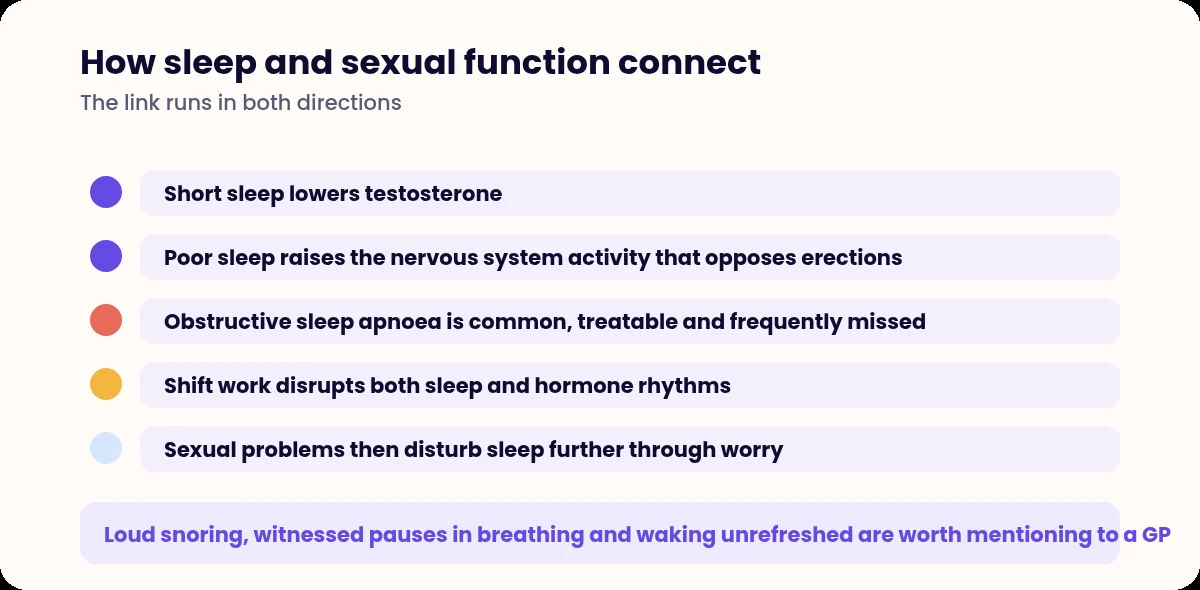
Testosterone. Release is tied to sleep architecture rather than simply to the clock, with the bulk occurring during sleep and rising across the night. Experimental sleep restriction in healthy young men — around five hours a night for a week — produces a measurable fall in daytime testosterone, which recovers with normal sleep. Chronic short sleep is therefore a genuine and reversible contributor to low testosterone, and it is far commoner than any of the endocrine causes people go looking for. Our guide to low testosterone symptoms covers how testing should be done: fasting, before 11am, and repeated.
Nocturnal erections. Healthy men have several erections during REM sleep, lasting collectively a substantial part of the night. They are thought to serve a tissue-oxygenation function rather than anything psychological. This is why their presence or absence is clinically useful — and why morning erections get asked about in every erectile dysfunction consultation. Preserved morning erections point towards a psychological or situational contribution; their disappearance points towards an organic one. The caveat is that plenty of men simply do not wake at the right point in the cycle to notice.
Autonomic balance. Erection requires parasympathetic dominance. Short and fragmented sleep raises sympathetic tone — the alert, vigilant state — which actively opposes it. This is the same mechanism by which anxiety interferes with erections.
Desire and mood. Poor sleep lowers mood and increases irritability, both of which reduce desire independently of hormones. In couples it also reduces the amount of time spent awake together in a state where sex is plausible, which sounds trivial and is not.
Obstructive sleep apnoea
Sleep apnoea deserves its own section, because it is common, treatable, strongly linked to sexual dysfunction, and routinely missed for years.
In obstructive sleep apnoea the upper airway repeatedly collapses during sleep. Breathing stops for seconds at a time, oxygen levels dip, and the brain partially rouses to restore the airway — often hundreds of times a night, usually without the person remembering any of it [1].
The link to erectile dysfunction runs through several mechanisms at once: intermittent oxygen desaturation damaging endothelial function, fragmented sleep suppressing testosterone, and sustained sympathetic activation with raised blood pressure. Sleep apnoea also travels with obesity, hypertension and type 2 diabetes, each of which causes erectile dysfunction on its own. Disentangling those is not really necessary — they all point the same way.
The features that should prompt investigation:
- Loud snoring, particularly with witnessed pauses in breathing, gasping or choking
- Waking unrefreshed however long you were in bed
- Daytime sleepiness, especially falling asleep while driving or in meetings
- Morning headache, dry mouth, nocturia
- A partner who has moved to another room
A partner’s account is usually more informative than your own, because the whole condition happens while you are unconscious.
Getting it assessed. Your GP can refer you for a sleep study, which in most UK services is now a home-based oximetry or limited-channel recording rather than a night in a laboratory [2]. Treatment depends on severity: CPAP for moderate to severe disease, mandibular advancement devices for milder cases, alongside weight management where relevant — our guide to sleep apnoea and weight covers that relationship.
One practical note that catches people out: untreated sleep apnoea with excessive sleepiness has implications for driving, and the DVLA must be told. That is a reason to get it assessed rather than a reason to avoid the question.
Shift work
Shift work disrupts both how much you sleep and when, and the timing matters because testosterone release is tied to the sleep period rather than to a fixed hour. Night and rotating shift workers report more erectile difficulty, lower desire and more sexual dissatisfaction than day workers, and the effect appears related to how disrupted the pattern is rather than to the hours worked.
Most people cannot change the job. What helps is protecting the sleep that is available:
- Keep the sleep period as long and as consistent as the rota allows, including on rest days rather than flipping fully back
- Blackout blinds, an eye mask, and treating daytime sleep as real sleep rather than a nap
- Caffeine early in the shift, not in the last few hours
- Avoid using alcohol to get to sleep after a night shift; it fragments sleep and worsens apnoea
The relationship runs both ways
This is the part that turns a contributing factor into a cycle.
Poor sleep worsens sexual function. Sexual difficulty then generates anxiety, and anxiety is one of the commonest causes of insomnia — particularly the lying-awake-rehearsing kind that follows a disappointing evening. Reduced sexual activity also removes one of the more reliable routes into sleep for many people.
Depression sits in the middle of both, worsening sleep and sexual function simultaneously, and so do some of the medicines used to treat it.
Breaking the loop usually means treating whichever end is more tractable rather than looking for the root cause. If the insomnia is the more fixable, treat that. CBT for insomnia is the recommended first-line treatment in the UK, ahead of sleeping tablets, and is available through NHS Talking Therapies by self-referral in England as well as through digital programmes [5, 6].
What to do with this
If sexual function has changed, bring sleep to the appointment deliberately — how long you sleep, whether you wake unrefreshed, whether anyone has mentioned snoring or pauses, and what your shift pattern is. It will not be asked about as reliably as blood pressure and it is at least as relevant.
Alongside that, the assessment for erectile dysfunction should still cover cardiovascular risk properly, since it precedes cardiac events by several years — see erectile dysfunction and heart disease — and the other contributors in our guide to what causes erectile dysfunction.
Frequently asked questions
Can sleep apnoea cause erectile dysfunction?
Obstructive sleep apnoea is strongly associated with erectile dysfunction, through repeated oxygen desaturation, endothelial damage, fragmented sleep suppressing testosterone, and raised sympathetic activity. It also travels with obesity, hypertension and type 2 diabetes, which cause ED in their own right. Treating the apnoea improves sleep quality and daytime function, and is worth pursuing regardless.
How much does poor sleep lower testosterone?
Testosterone release is closely tied to sleep, and studies restricting healthy young men's sleep to around five hours a night have shown meaningful falls in daytime testosterone within a week. The effect is reversible with recovery sleep. This is also why a testosterone blood test should be taken fasting and before 11am, and repeated before anything is concluded.
Should I mention snoring to my GP?
Yes, particularly if a partner has noticed you stopping breathing or gasping, or if you wake unrefreshed and are sleepy during the day. Those are the features that prompt referral for a sleep study. Snoring alone is common, but the combination is what identifies apnoea, and it is routinely missed for years.
Does shift work affect sexual function?
Shift work disrupts both the amount and the timing of sleep, and night workers report more sexual difficulty and lower desire than day workers. The circadian disruption also affects the timing of testosterone release. It is rarely possible to change the job, but protecting sleep duration, using blackout and consistent sleep timing on rest days helps.
References
- NHS. Obstructive sleep apnoea. www.nhs.uk/conditions/obstructive-sleep-apnoea/
- NICE. NG202: Obstructive sleep apnoea/hypopnoea syndrome and obesity hypoventilation syndrome in over 16s. www.nice.org.uk/guidance/ng202
- British Society for Sexual Medicine. Guidelines on the management of erectile dysfunction in men. www.bssm.org.uk/guidelines/
- European Association of Urology. Guidelines on Sexual and Reproductive Health. uroweb.org/guidelines/sexual-and-reproductive-health
- NHS. Insomnia. www.nhs.uk/conditions/insomnia/
- NHS Talking Therapies for anxiety and depression. www.nhs.uk/mental-health/talking-therapies-medicine-treatments/talking
Medical reviewer
Naeem Teni
Clinical Lead at Manova. Registered pharmacist and independent prescriber, GPhC 2215591. Reviews Manova’s clinical content for accuracy and safety.
Written by
Manova Editorial Team
Researched and written to our editorial policy, using NICE, NHS, MHRA and peer-reviewed sources.
This article is for general information and isn’t a substitute for advice from your own clinician. If you feel unwell, contact your GP or NHS 111. In an emergency, call 999.