
Key takeaways
- A meta-analysis found obesity associated with odds of low back pain in the past year of 1.33, and of seeking care for it of 1.56, with a dose-response gradient through the overweight range.
- These associations are modest, considerably weaker than the link between obesity and knee osteoarthritis.
- Adiposity is also associated with pain at non-weight-bearing sites, which argues against a purely mechanical explanation.
- NICE NG59 recommends exercise as first-line treatment and does not recommend weight loss as a treatment for back pain.
If you carry extra weight and your back hurts, you have probably been told the two are connected. They are. What is less often said is how modest the connection is, and how little evidence there is that losing weight will fix the pain.
Both of those things can be true without the advice to lose weight being wrong. They just change what you should expect from it.
What the association looks like
The key meta-analysis pooled observational studies comparing people with obesity to people of normal weight [1]:
- Low back pain in the past 12 months: OR 1.33 (95% CI 1.14 to 1.54)
- Seeking care for low back pain: OR 1.56 (1.46 to 1.67)
- Chronic low back pain: OR 1.43 (1.28 to 1.60)
- Incident low back pain in cohort studies: OR 1.53 (1.22 to 1.92)
The overweight category sat between normal weight and obesity on each measure, producing a dose-response gradient. That gradient is one of the better arguments that the relationship is not entirely an artefact.
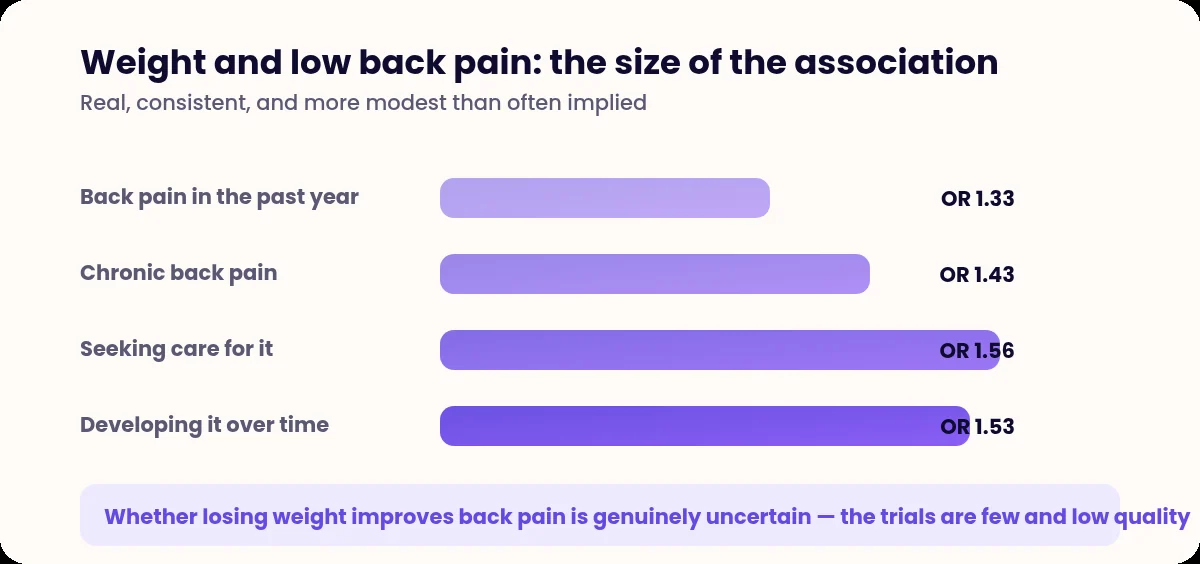
Now the calibration. These are modest associations. An odds ratio of 1.33 is nothing like the relationship between obesity and knee osteoarthritis, where the effect sizes are several times larger and the mechanical logic is much tighter. It is also worth noting that the largest single figure here is for seeking care, which is partly a measure of healthcare behaviour rather than of pain itself.
Why it is probably not just load
The obvious explanation is that a heavier body puts more compressive load through the lumbar spine. That is likely part of it, and the proposed mechanical pathways are:
- Increased axial load and altered lumbar lordosis
- Accelerated disc degeneration
- Deconditioning of trunk musculature, which reduces the muscular support the spine relies on
But there is an observation that does not fit a purely mechanical story. Adiposity is also associated with pain at non-weight-bearing sites, including the hands. Nothing about carrying more body mass adds load to a finger joint. That association points instead towards systemic low-grade inflammation as a contributor, with adipose tissue acting as an endocrine organ rather than simply as ballast.
There are also shared risk factors doing some of the work. Smoking, deprivation, physical inactivity, poor sleep and depression are each associated with both higher body weight and more back pain. Observational studies adjust for what they measured, and not for what they did not.
These mechanisms are partly speculative. The honest position is that we have a consistent association, several plausible explanations, and no clean way of apportioning it between them.
Does losing weight help
This is where the evidence is thinnest, and where most online content overstates its case.
A systematic review of weight loss programmes for low back pain found few trials, small samples, heterogeneous interventions and inconsistent effects. The evidence was judged low quality and insufficient to draw a conclusion [4].
Bariatric surgery cohorts do report improvement in back pain after substantial weight loss. Those cohorts are uncontrolled, the participants are highly selected, and the surgery changes a great deal besides weight, including activity levels and expectations. They are suggestive, not conclusive.
So the honest answer is: plausible, biologically reasonable, and not demonstrated. Weight loss is better framed as an adjunct that may help, alongside other benefits worth having in their own right, than as a treatment for back pain.
What NICE recommends instead
NICE NG59 recommends exercise as the first-line treatment for low back pain [2]. Not a specific exercise, and explicitly not one form over another — the guidance is to choose an approach taking into account the person’s preferences and what they will keep doing. Group exercise, biomechanical approaches, aerobic activity and mind-body approaches are all within scope.
Alongside that: self-management advice, reassurance that most episodes settle, and encouragement to continue normal activities including work.
NG59 does not recommend weight loss as a treatment for back pain. If a source tells you UK guidance says otherwise, check it.
NHS advice for most episodes is broadly the same: stay active, continue normal activities as far as pain allows, and expect gradual improvement [3].
NG59 is also notable for what it advises against, including several passive treatments people commonly expect. Belts, traction and acupuncture for low back pain are not recommended. That tends to disappoint, but the absence of a passive fix is precisely why the active ones matter.
Where weight does change the picture
Two situations where body weight is more directly relevant than the general association suggests.
Sciatica and disc-related pain. Some of the disc degeneration evidence is stronger than the generic back pain evidence, though it still comes from observational data.
Surgical and imaging pathways. Body weight can affect the practicality of imaging and the risk profile of spinal surgery, which is a different argument from pain relief but a real one if surgery is being considered.
Neither of these turns weight loss into a treatment for pain. They are reasons it may come up in a consultation even though NG59 does not list it as therapy.
Putting it together practically
If you have both back pain and excess weight, the sequence that makes sense is:
Start with exercise, because that is the recommended treatment. It is also a route to weight loss, which is convenient, but the pain rationale stands on its own.
Pick something the back tolerates. Pain often limits high-impact activity, which pushes people towards walking, cycling, swimming or resistance work with appropriate loading. Best exercise for weight loss covers the options.
Do not let pain become a reason to stop moving entirely. Deconditioning of trunk musculature is one of the proposed mechanisms, and prolonged rest is not recommended.
Give it a realistic starting point. If you have not been active, the first weeks are the hardest and the most often abandoned. How to start losing weight covers building something sustainable rather than something impressive.
Treat weight loss as worth doing for its own reasons, including joint pain elsewhere. If you also have knee pain, the evidence there is stronger and more mechanical, covered in weight and knee pain.
Do not expect a proportional payoff. Some people find their back improves markedly with weight loss. Others lose a great deal of weight and find the pain unchanged. Both outcomes are consistent with the evidence, which is exactly why it would be wrong to promise either.
Red flags that need assessment
- Loss of bladder or bowel control, numbness around the saddle area, or weakness in both legs — go to A&E immediately
- New back pain with fever, unexplained weight loss, or a history of cancer — same-week GP appointment
- Progressive leg weakness or numbness
- Back pain after significant trauma, or in anyone with osteoporosis or on long-term steroids
Frequently asked questions
Does being overweight cause back pain?
It is associated with it, consistently and with a dose-response gradient, but the effect sizes are modest. Obesity was associated with odds of low back pain in the past 12 months of about 1.33 compared with normal weight. Association in observational data is not proof of cause, and several shared risk factors could explain part of it.
Will losing weight fix my back pain?
This is genuinely uncertain. A systematic review of weight loss programmes for low back pain found few trials, small samples, inconsistent effects and low quality evidence. Bariatric surgery cohorts report improvement but are uncontrolled. Weight loss is a plausible adjunct, not an established treatment.
What does NICE recommend for low back pain?
NICE NG59 recommends exercise as the first-line treatment, in whatever form the person will actually do, alongside self-management advice and staying active. It does not recommend weight loss as a specific treatment for back pain, and it advises against several passive treatments people often expect.
Is back pain in obesity purely mechanical?
Probably not. Adiposity is also associated with pain at sites that carry no extra load, such as the hands. That observation argues against load alone explaining the association and points towards systemic low-grade inflammation and deconditioning playing a part.
References
- Shiri R, Karppinen J, Leino-Arjas P, et al. The association between obesity and low back pain: a meta-analysis. American Journal of Epidemiology. 2010;171(2):135-154. doi.org/10.1093/aje/kwp356
- NICE. Low back pain and sciatica in over 16s: assessment and management. NG59. www.nice.org.uk/guidance/ng59
- NHS. Back pain. www.nhs.uk/conditions/back-pain/
- Systematic review of weight loss interventions for low back pain outcomes. www.ncbi.nlm.nih.gov/
Medical reviewer
Naeem Teni
Clinical Lead at Manova. Registered pharmacist and independent prescriber, GPhC 2215591. Reviews Manova’s clinical content for accuracy and safety.
Written by
Manova Editorial Team
Researched and written to our editorial policy, using NICE, NHS, MHRA and peer-reviewed sources.
This article is for general information and isn’t a substitute for advice from your own clinician. If you feel unwell, contact your GP or NHS 111. In an emergency, call 999.