

Key takeaways
- Observational studies consistently link weight variability to higher cardiovascular and all-cause mortality, but publication bias was formally detected in the largest meta-analysis.
- These studies cannot separate intentional from unintentional weight loss, and unintentional loss marks cancer, heart failure, COPD, frailty, depression and alcohol misuse.
- Weight loss trials, where loss is by definition intentional, do not show excess cardiovascular harm.
- There is no good evidence that weight cycling permanently damages metabolic rate or makes later attempts harder; the demonstrated harms of repeated failed attempts are psychological.
Weight cycling, or yo-yo dieting, is the pattern of losing weight and regaining it, often repeatedly. It is very common, and it is regularly described as dangerous in its own right.
The evidence for that claim is more interesting and much weaker than the headlines suggest. It hinges on a confounding problem that no amount of statistical adjustment has solved, and getting it wrong has a specific cost: people who would benefit from treating obesity talk themselves out of trying.
What the observational data show
The association is consistent, and it is worth stating fairly before taking it apart.
A 2019 meta-analysis pooled 23 studies and 441,199 participants [1]. Weight fluctuation was associated with:
- all-cause mortality, relative risk 1.41
- cardiovascular mortality, relative risk 1.36
- incident cardiovascular disease, relative risk 1.49
- hypertension, relative risk 1.35
- no association with cancer mortality, relative risk 1.01
That last line is the first hint that something odd is going on, and the authors also formally detected publication bias for the all-cause mortality outcome. Studies finding an association were more likely to be published than those that did not, which means the pooled estimate is probably inflated.
A 2024 analysis using two large cohorts, the US Million Veteran Program and UK Biobank, found the same direction of effect [2]. Greater variability in BMI was associated with a composite cardiovascular outcome, hazard ratio 1.16 in the veteran cohort; in UK Biobank each one standard deviation increase in BMI variability was associated with cardiovascular death, hazard ratio 1.08. Both analyses adjusted for mean BMI and for a BMI polygenic score, which is more careful than most.
The confounding problem is decisive
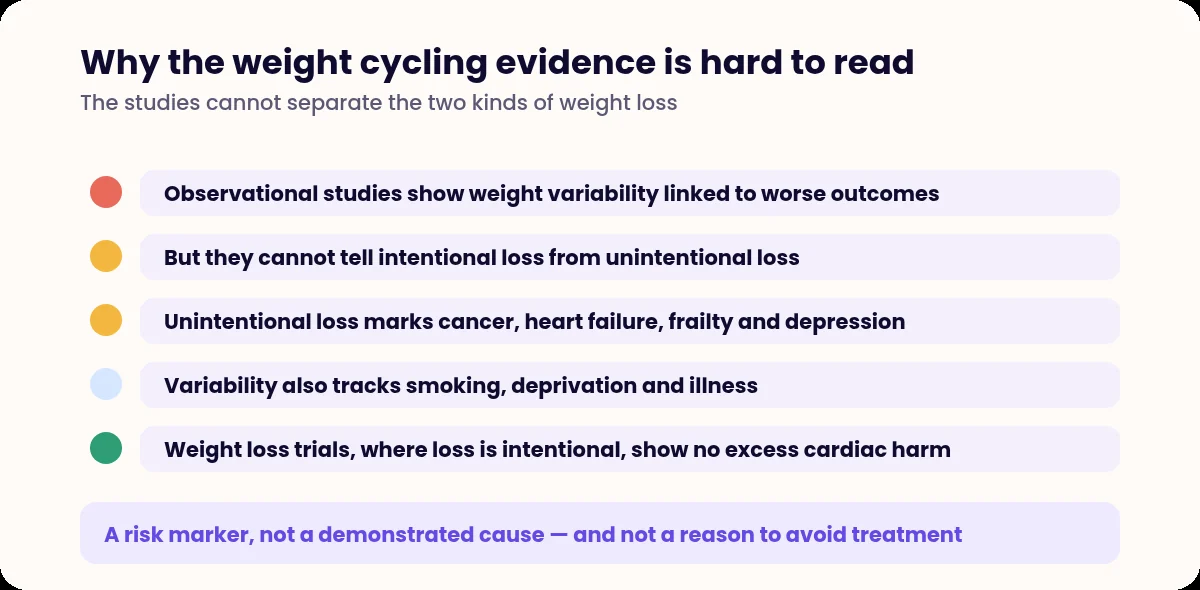
Almost all of this evidence is observational, and observational data on weight change cannot separate intentional from unintentional weight loss.
That distinction is not a technicality. Unintentional weight loss is a marker of serious illness. It is one of the classic presentations of occult cancer, and it accompanies heart failure, COPD, frailty, depression and alcohol misuse [6]. Someone who loses 8kg because a tumour is growing and then regains some of it after treatment appears in these datasets as a weight cycler.
This is reverse causation, and no covariate adjustment resolves it, because the researchers do not have the variable that would. Nobody recorded why the weight changed.
Weight variability also tracks a list of other things that carry risk of their own: smoking cessation and relapse, deprivation, mental illness, and changes in medication. Each of those would produce the observed association without weight cycling doing anything at all.
What the trials show
Where weight loss is intentional by design, the picture changes.
Weight loss trials do not show excess cardiovascular harm. Look AHEAD followed an intensive lifestyle intervention in people with type 2 diabetes for around a decade and found no increase in cardiovascular events despite considerable loss and regain within the intervention arm [4]. That is the cleanest available test of the hypothesis, and it does not support it.
The same conclusion was reached three decades ago. The US National Task Force on the Prevention and Treatment of Obesity reviewed the evidence in 1994 and concluded that “the majority of studies do not support an adverse effect of weight cycling on metabolism”, and that “the currently available evidence is not sufficiently compelling to override the potential benefits of moderate weight loss in significantly obese patients” [3]. Very little has changed that verdict since.
The “ruined metabolism” claim
This is the version of the story that does the most harm: that each failed diet permanently lowers your metabolic rate, so every subsequent attempt starts from a worse position.
It is not supported. There is no good evidence that weight cycling permanently damages metabolic rate, and no reliable evidence that it makes later weight loss harder. What does happen — a fall in energy expenditure while you are in deficit and at a lower body weight — is real, measurable and largely reverses with weight stabilisation. It is covered properly in metabolic adaptation, including why the figures people quote come from an extreme and unrepresentative study.
The related idea that your body has locked in a higher defended weight after each cycle is also more confident than the evidence allows; set point and body weight covers what can actually be said about defended weight.
What the real harms are
None of this means repeated failed attempts are harmless. The best-evidenced harms are psychological.
- Demoralisation. Each cycle tends to lower expectations of success, and low expectation predicts early abandonment
- Weight stigma, both from others and internalised, which is associated with worse health behaviours and avoidance of healthcare
- Disordered eating. Repeated restriction is a recognised risk factor, and some people move from dieting into a pattern that needs clinical help
These point in a very specific direction. They argue for supported, maintenance-oriented programmes with realistic targets and long follow-up, which is how NICE frames obesity management [5]. They do not argue for leaving obesity untreated. Weight and mental health covers this in more depth.
So should fear of regain stop you?
No. That is the practical conclusion, and it follows from the evidence rather than from optimism.
Weight variability is a consistent risk marker, not a demonstrated causal risk factor. The benefits of weight loss for blood pressure, glucose, liver fat, joint pain, sleep apnoea and function are well established and measurable. Trading those against a confounded association would be a poor deal.
What the evidence does justify is planning differently. If regain is the likely failure mode, then the maintenance phase deserves as much attention as the loss phase, which is the argument in keeping weight off. It also argues for taking seriously what happens at the end of any intervention, including stopping weight loss medication, where regain after discontinuation is expected rather than surprising.
Obesity is a long-term condition, and long-term conditions are managed rather than cured. Judging a treatment by whether the effect persists after you stop it is a standard nobody applies to blood pressure medication.
When to speak to a clinician
- Unintentional weight loss of any significant degree — arrange a GP appointment, as this needs assessment rather than reassurance
- Repeated cycles of loss and regain alongside low mood, shame or avoidance of healthcare
- Any pattern of bingeing, restricting or compensatory behaviour — ask your GP about eating disorder services
- Before starting another attempt, it is worth asking specifically what maintenance support is included
Frequently asked questions
Is yo-yo dieting bad for your heart?
Observational data consistently associate weight variability with cardiovascular events and mortality. What those data cannot do is distinguish deliberate weight loss from weight lost because of illness, and illness-related loss is strongly linked to poor outcomes. Randomised weight loss trials, where loss is intentional by design, have not shown excess cardiovascular harm.
Does weight cycling ruin your metabolism?
There is no good evidence for it. A US expert task force reviewing this in 1994 concluded that most studies did not support an adverse metabolic effect of weight cycling, and nothing since has overturned that. Repeated loss and regain does not appear to make a subsequent attempt harder in a way that has been reliably measured.
Is it better not to try losing weight if I might regain it?
Fear of cycling is not a good reason to avoid treatment. The evidence that variability causes harm is weak and confounded, while the benefits of weight loss for blood pressure, glucose, joints, sleep apnoea and liver health are well established. The sensible response is to plan for maintenance from the start rather than to avoid starting.
What are the real harms of repeated failed diets?
The best-evidenced harms are psychological: demoralisation, exposure to weight stigma, and in some people disordered eating. Those are genuine and they argue for supported, maintenance-oriented programmes with realistic goals, rather than for leaving obesity untreated.
References
- Zou H, Yin P, Liu L, et al. Body-weight fluctuation was associated with increased risk for cardiovascular disease, all-cause and cardiovascular mortality: a systematic review and meta-analysis. Frontiers in Endocrinology. 2019;10:728. doi.org/10.3389/fendo.2019.00728
- Almuwaqqat Z, et al. Body mass index variability and cardiovascular outcomes. JAMA Network Open. 2024;7(3):e243062. doi.org/10.1001/jamanetworkopen.2024.3062
- National Task Force on the Prevention and Treatment of Obesity. Weight cycling. JAMA. 1994;272(15):1196-1202. doi.org/10.1001/jama.1994.03520150064038
- Look AHEAD Research Group. Cardiovascular effects of intensive lifestyle intervention in type 2 diabetes. New England Journal of Medicine. 2013;369:145-154. doi.org/10.1056/NEJMoa1212914
- NICE. Overweight and obesity management. NG246. www.nice.org.uk/guidance/ng246
- NHS. Unintentional weight loss. www.nhs.uk/conditions/unintentional-weight-loss/
Medical reviewer
Naeem Teni
Clinical Lead at Manova. Registered pharmacist and independent prescriber, GPhC 2215591. Reviews Manova’s clinical content for accuracy and safety.
Written by
Manova Editorial Team
Researched and written to our editorial policy, using NICE, NHS, MHRA and peer-reviewed sources.
This article is for general information and isn’t a substitute for advice from your own clinician. If you feel unwell, contact your GP or NHS 111. In an emergency, call 999.