

Key takeaways
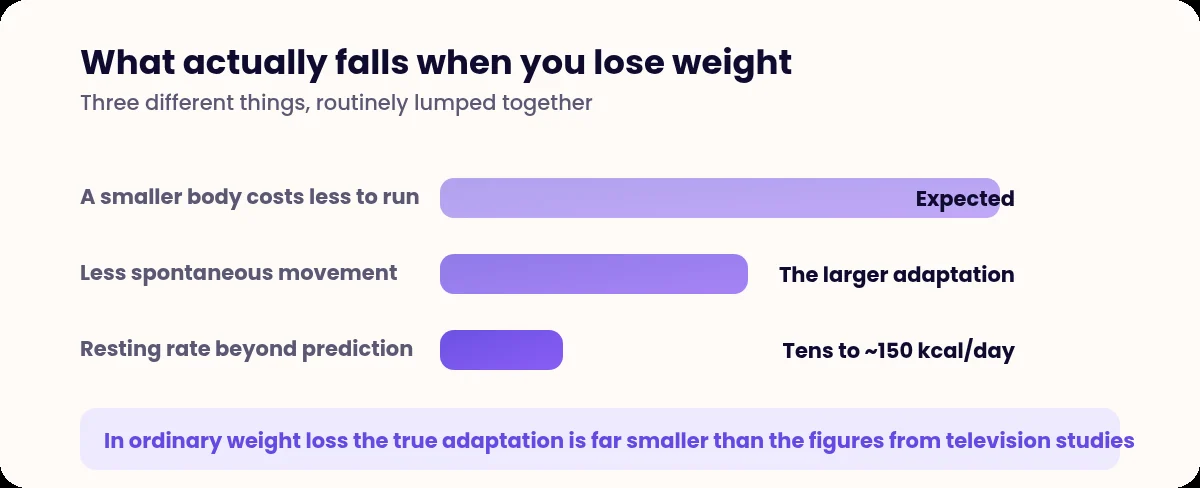
- Three separate things get conflated: the obligatory fall because a smaller body costs less to run, adaptive thermogenesis as a residual after adjusting for body composition, and reduced non-exercise movement.
- In the Biggest Loser cohort, metabolic adaptation did not predict who regained weight, and those who kept more off at six years had greater metabolic slowing.
- Typical adaptive thermogenesis in ordinary weight loss is on the order of tens to about 100-150 kcal a day, not the roughly 500 kcal seen in that extreme cohort.
- A systematic review found adaptation appears attenuated or non-existent after periods of weight stabilisation, so it is not a permanent setting.
“My metabolism has slowed down” covers at least three different physiological events, which behave differently, are measured differently and have very different implications. Keeping them apart is most of the work.
The three components
1. The obligatory fall in energy expenditure. A smaller body costs less to run. Less tissue to maintain, less mass to move. This is arithmetic, not adaptation, and it accounts for the majority of the fall in total energy expenditure after weight loss. Someone who loses 20kg genuinely needs fewer calories than they did, and always will at that weight.
2. Adaptive thermogenesis. The residual fall in resting metabolic rate after statistically adjusting for the change in fat mass, fat-free mass and age. This is the part that is genuinely more than arithmetic predicts, and it is the thing the technical literature means by metabolic adaptation.
3. Reduced non-exercise activity thermogenesis, or NEAT. A fall in fidgeting, standing, walking around, general restlessness. This is a behavioural and motor output change, not a change in resting cellular metabolism, and it is measured completely differently — doubly-labelled water total expenditure, minus resting metabolic rate, minus the thermic effect of food and exercise. It is typically the larger component of total compensation.
Most popular writing merges all three and labels the result “starvation mode”. That merged version overstates the mysterious part and understates the behavioural part, which is unhelpful because the behavioural part is the one you can do something about.
The Biggest Loser study
This is the study behind every alarming headline on the subject, and it deserves a careful reading [1].
What it found. Fourteen of the sixteen competitors were assessed with DXA and indirect calorimetry at baseline, at 30 weeks and at six years. At the end of the competition, mean weight loss was 58.3kg and resting metabolic rate had fallen by 610 kcal/day. At six years, participants had regained a mean of 41.0kg, resting metabolic rate was still 704 kcal/day below baseline, and metabolic adaptation was -499 kcal/day.
Those numbers are real and the finding of persistence is important.
The nuance that is almost always omitted
Two results from the same paper get left out of essentially every summary.
Weight regain was not correlated with metabolic adaptation at the end of the competition. The correlation was effectively zero. The adaptation did not predict who regained.
Those who kept more weight off at six years had greater metabolic slowing. The correlation ran in the opposite direction to the popular narrative. Keeping weight off was associated with more adaptation, not less.
The authors’ own conclusion is that adaptation is “a proportional, but incomplete, response to contemporaneous efforts to reduce body weight” — that is, it tracks how hard you are currently working to stay lighter, rather than representing permanent damage inflicted by past dieting.
The criticisms
- n=14, no control group
- An extreme, non-generalisable intervention: roughly 30 weeks of televised semi-starvation combined with very high exercise volumes. Nothing about that resembles ordinary weight loss
- Adaptive thermogenesis is a residual, which makes it highly sensitive to the regression model used to adjust for body composition. Different adjustment methods produce materially different “adaptation” from the same raw data
- DXA-derived fat-free mass does not distinguish organ mass, which has a high metabolic rate, from skeletal muscle, which has a much lower one. Two people with identical fat-free mass can have genuinely different expected resting rates
Kevin Hall, who led the analysis, has repeatedly cautioned against the popular reading that metabolism is permanently broken. When the author of the study spends a decade correcting the coverage of it, that is worth noting.
How large is it really
A systematic review covering 33 studies and 2,528 participants found adaptive thermogenesis in 27 of them [2]. Its three conclusions are the practical ones:
- there is large heterogeneity in the methods used to quantify it
- better-designed studies reported lower or non-significant values
- adaptation “seems to be attenuated, or non-existent, after periods of weight stabilisation or neutral energy balance”
That last point matters most. Adaptation appears to be substantially a feature of being in an energy deficit, not a permanent recalibration that survives it.
A workable figure: typical adaptive thermogenesis in ordinary weight loss is on the order of tens to around 100-150 kcal a day, not the roughly 500 kcal of the Biggest Loser cohort, and it is smaller once weight has stabilised. Total energy-expenditure compensation including NEAT is larger than adaptive thermogenesis alone.
100 kcal a day is not nothing. It is also roughly a twenty-minute walk, which is a rather different problem from a broken metabolism.
The NEAT component
The best-known demonstration of how much NEAT can move is an overfeeding study: sixteen non-obese adults were fed an extra 1,000 kcal a day for eight weeks [3]. Two-thirds of the increase in total daily energy expenditure was NEAT, and differences in NEAT accounted for roughly ten-fold differences in how much fat was stored.
Flag the obvious limitations: sixteen people, and it was an overfeeding study, not a weight loss one. The reciprocal fall in NEAT during energy restriction is less well quantified, though it is consistently observed.
The everyday version of this is familiar. During a sustained deficit people take the lift, drive the short journey, sit rather than stand, and move less within the movements they do make. Almost none of it is conscious. NEAT and everyday movement covers how to notice and counter it.
What to do with this
Expect a plateau, and do not read it as metabolic damage. The usual causes, in order of size, are the obligatory fall in expenditure, a quiet upward drift in intake, and reduced everyday movement. Adaptive thermogenesis is real but is rarely the main item. Weight loss plateau covers the practical sequence.
Protect fat-free mass. Resistance training and adequate protein during weight loss reduce the loss of tissue that contributes to resting expenditure, which is covered in losing weight without losing muscle.
Plan maintenance breaks deliberately. The evidence that adaptation is attenuated after weight stabilisation is a reasonable argument for periods of neutral energy balance built into a long attempt, rather than one continuous deficit until something breaks.
Be sceptical of extreme approaches. The largest adaptation figures come from the most aggressive interventions. Very low calorie diets have legitimate supervised uses, but they are not the default.
Treat maintenance as a continuing task. The adaptation literature and the set point and body weight literature converge on the same conclusion: the effort does not become unnecessary once the target is reached.
When to speak to a clinician
- Weight loss that stalls completely for more than a couple of months despite a consistent, accurately tracked intake
- Fatigue, cold intolerance, hair thinning or very low mood during weight loss, which needs assessment rather than pushing through
- Any planned very low calorie approach, which should be clinically supervised
- Loss of periods, or a resting heart rate that has fallen sharply alongside weight loss — arrange a same-week GP appointment
Frequently asked questions
Is starvation mode real?
Something real sits behind the phrase, but the phrase overstates it. Energy expenditure falls during and after weight loss, mostly because a smaller body costs less to run. A smaller residual fall beyond that is genuine but typically modest, and it does not stop weight loss from happening in an adequate energy deficit.
How much does metabolism slow after weight loss?
Most of the fall is obligatory and proportional to the weight lost. The additional adaptive component in ordinary weight loss is typically on the order of tens to about 100-150 kcal a day. The figure of around 500 kcal a day comes from a very small cohort after an extreme televised intervention and should not be generalised.
Did the Biggest Loser study show permanently broken metabolism?
That is the popular reading and the study's own lead author has repeatedly cautioned against it. Fourteen participants, no control group, and an extreme intervention. Crucially, metabolic adaptation did not correlate with weight regain, and those who kept more weight off at six years had greater metabolic slowing, which is the opposite of the popular narrative.
Does eating more fix a slowed metabolism?
Reverse dieting as usually marketed is not supported by trial evidence. What the systematic review evidence does suggest is that adaptation appears attenuated or absent after a period of weight stability in neutral energy balance, so a planned maintenance phase is reasonable. That is different from a promise that eating more raises metabolic rate.
References
- Fothergill E, Guo J, Howard L, et al. Persistent metabolic adaptation 6 years after The Biggest Loser competition. Obesity. 2016;24(8):1612-1619. doi.org/10.1002/oby.21538
- Nunes CL, Casanova N, Francisco R, et al. Does adaptive thermogenesis occur after weight loss in adults? A systematic review. British Journal of Nutrition. 2022;127(3):451-469. doi.org/10.1017/S0007114521001094
- Levine JA, Eberhardt NL, Jensen MD. Role of nonexercise activity thermogenesis in resistance to fat gain in humans. Science. 1999;283(5399):212-214. doi.org/10.1126/science.283.5399.212
- NHS. Understanding calories. www.nhs.uk/live-well/healthy-weight/managing-your-weight/understanding
- NICE. Overweight and obesity management. NG246. www.nice.org.uk/guidance/ng246
- Speakman JR, Hall KD. Models of body weight and fatness regulation. Philosophical Transactions of the Royal Society B. 2023;378:20220231. doi.org/10.1098/rstb.2022.0231
Medical reviewer
Naeem Teni
Clinical Lead at Manova. Registered pharmacist and independent prescriber, GPhC 2215591. Reviews Manova’s clinical content for accuracy and safety.
Written by
Manova Editorial Team
Researched and written to our editorial policy, using NICE, NHS, MHRA and peer-reviewed sources.
This article is for general information and isn’t a substitute for advice from your own clinician. If you feel unwell, contact your GP or NHS 111. In an emergency, call 999.