

Key takeaways
- NEAT accounts for roughly 6-10% of total daily energy expenditure in very sedentary people but over 50% in highly active ones.
- In an eight-week overfeeding study, NEAT responses ranged from -98 to +692 kcal a day between individuals, and predicted who resisted fat gain.
- The often-quoted 2,000 kcal figure is the extreme gap between two different people, not an amount any individual can add to their day.
- Energy restriction reliably reduces spontaneous movement, largely without conscious awareness, and this is a major contributor to the plateau.
Most people think of daily energy use as two buckets: what the body burns at rest, and what they burn at the gym. The larger of the two variable buckets is neither. It is everything else you do while awake — walking, standing, carrying, cleaning, fidgeting, going up stairs rather than waiting for a lift.
That bucket has a name, non-exercise activity thermogenesis, and it is both the most variable part of daily energy expenditure and the part most likely to shrink while you are trying to lose weight.
How large is it
In very sedentary people, NEAT accounts for roughly 6 to 10% of total daily energy expenditure. In highly active people it can exceed 50%. That spread is wider than any other component.
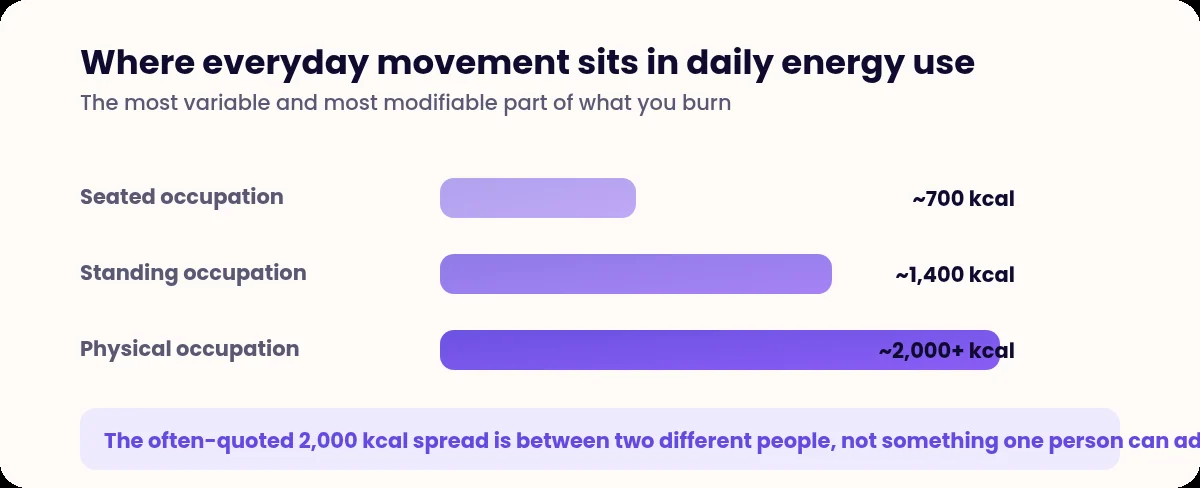
The occupational gradient makes the point concretely. Seated work is associated with roughly 700 kcal a day of activity energy; standing occupations up to around 1,400; agricultural work 2,000 or more.
The 2,000 calorie figure, and why it is misused
You will see it claimed that NEAT can vary by up to 2,000 kcal a day, and that claim is then used to imply you could add 2,000 kcal of burn to your own day by moving more. It cannot mean that.
The figure describes the gap between two different individuals of similar body size at opposite ends of the activity spectrum — the office worker and the field labourer above. It is a between-person extreme, not personal headroom. Nobody goes from a desk job to a farm without changing their entire life, and if they did, their appetite would come with them.
What an individual can realistically add through deliberate changes is in the low hundreds of calories a day. That is still worth having. It is just not 2,000.
The overfeeding experiment
The foundational study deliberately overfed 16 non-obese adults by 1,000 kcal a day for eight weeks and measured where the surplus went [1].
The mean rise in NEAT was around 336 kcal a day. The individual range was -98 to +692 kcal a day. Some participants unconsciously moved substantially more in response to the surplus; at least one moved less.
The finding that matters: the change in NEAT predicted who resisted fat gain. People whose bodies spontaneously ramped up movement stored less of the surplus. This is a small study, and it was done in non-obese volunteers under tightly controlled conditions, so treat the numbers as illustrative rather than as constants. But it is the clearest demonstration that spontaneous movement is a regulated variable, not simply a matter of willpower.
The direction that matters for dieting
Overfeeding raises NEAT in most people. Energy restriction does the opposite, and this is the part with direct practical consequences.
Energy restriction consistently reduces NEAT and spontaneous movement. People in a deficit take fewer steps, stand less, fidget less, and walk more slowly. Crucially, this happens largely without conscious awareness. Almost nobody decides to move less. They simply find themselves sitting down more, taking the lift, driving the short journey.
The reduction is a major contributor to the weight loss plateau and to regain after weight loss, and in most analyses it is larger than the reduction in resting metabolic rate that gets all the attention. When people describe their metabolism as having broken, what has usually happened is a combination of a genuinely smaller body, less accurate food tracking than they think, and several hundred fewer calories of daily movement. The weight loss plateau covers the full picture.
This also applies during treatment with weight loss medicines. Reduced appetite and reduced energy intake do not exempt anyone from the adaptive drop in movement, and fatigue in the first weeks can make it worse.
What to do about it
The point of understanding NEAT is not to add another target to obsess over. It is to defend a variable that otherwise erodes silently.
Measure something. A step count is a crude proxy but it is the only readily available window onto NEAT. The number matters less than the trend: if your average has fallen by 2,000 steps a day since you started dieting, that is the plateau explaining itself.
Set a floor, not a ceiling. A daily minimum you will hit on a bad day is more useful than a target you hit twice a week.
Break up sitting. The NHS guidance is 150 minutes of moderate activity a week plus reducing time spent sitting [2]. The second half is the NEAT half, and it is the half most often ignored.
The UK Chief Medical Officers make the same two-part point, pairing an activity target with the instruction to minimise sedentary time [4].
Attach movement to things that already happen. A walk after a particular meal, stairs by default, a standing block in the working day. Behaviour that depends on motivation is the first thing to go in a deficit, which is exactly when you need it.
Do not stop resistance training to make room. NEAT and structured training solve different problems. Training protects muscle while you lose weight, covered in losing weight without losing muscle.
For a practical starting point built around the most accessible form of everyday movement, see walking for weight loss.
A worked example
A 90 kg adult walking an extra 4,000 steps a day, spread through the day rather than in one block, uses somewhere in the region of 150 to 200 kcal. Over a week that is roughly 1,000 to 1,400 kcal, which is not trivial against a 500 kcal daily deficit. Add a standing hour and taking the stairs, and the total climbs further.
Treat those figures as estimates. Energy cost varies with body weight, pace, terrain and load, and no consumer device measures it accurately. The reason to do it is that it is sustainable and it does not make you as hungry as an equivalent block of hard training tends to.
What NEAT is not
It is not a substitute for energy balance, and it is not a way to out-move an intake problem. It is also not a moral category: people whose NEAT falls hard in a deficit are not lazier than those whose does not, they are exhibiting a normal physiological response with unusually inconvenient timing.
Nor is it precisely measurable outside a research setting. Wearables estimate it badly, and their calorie figures should not be eaten back.
When to check in with a clinician
- New breathlessness, chest pain or dizziness on exertion — same-week GP appointment, or A&E if chest pain is severe or ongoing
- Joint pain that worsens with increased activity, particularly hip or knee
- Existing heart, lung or musculoskeletal conditions, before increasing activity substantially
- Falls, unsteadiness or a marked drop in walking speed, particularly over 65
Frequently asked questions
What is NEAT?
Non-exercise activity thermogenesis: all the energy you use moving that is not sleeping, eating or deliberate exercise. Walking to the shop, standing at a desk, housework, fidgeting, carrying shopping. It is the most variable component of daily energy expenditure and the most modifiable.
Can I really burn 2,000 extra calories a day through NEAT?
No. That figure describes the gap between two different individuals of similar size at opposite extremes of daily activity, typically a desk worker versus someone doing manual agricultural labour. It is not headroom available to one person. Realistic gains from deliberately moving more are in the low hundreds of calories.
Why do I stop losing weight even though nothing has changed?
Part of the answer is that something did change without you deciding it. Energy restriction reduces spontaneous movement: fewer steps, less fidgeting, more sitting, slower walking. The drop is largely unconscious and is generally larger than the fall in resting metabolic rate.
Is walking better than the gym for weight loss?
They do different jobs. Structured exercise is usually a smaller share of daily energy expenditure than people assume, while resistance training protects muscle during weight loss. Walking and general movement contribute more energy than most gym schedules and are easier to sustain daily.
References
- Levine JA, Eberhardt NL, Jensen MD. Role of nonexercise activity thermogenesis in resistance to fat gain in humans. Science. 1999;283(5399):212-214. doi.org/10.1126/science.283.5399.212
- NHS. Physical activity guidelines for adults aged 19 to 64. www.nhs.uk/live-well/exercise/physical-activity-guidelines-19-64-years
- NICE. Overweight and obesity management. NG246. January 2025. www.nice.org.uk/guidance/ng246
- UK Chief Medical Officers. Physical activity guidelines. 2019. www.gov.uk/government/publications/physical-activity-guidelines-uk-chi
Medical reviewer
Naeem Teni
Clinical Lead at Manova. Registered pharmacist and independent prescriber, GPhC 2215591. Reviews Manova’s clinical content for accuracy and safety.
Written by
Manova Editorial Team
Researched and written to our editorial policy, using NICE, NHS, MHRA and peer-reviewed sources.
This article is for general information and isn’t a substitute for advice from your own clinician. If you feel unwell, contact your GP or NHS 111. In an emergency, call 999.