

Key takeaways
- In heart failure cohorts, higher BMI is associated with lower mortality — a finding that largely disappears when body fat percentage or waist circumference is used instead of BMI.
- Obesity-related HFpEF is now recognised as a distinct phenotype involving plasma volume expansion, pericardial restraint and systemic inflammation.
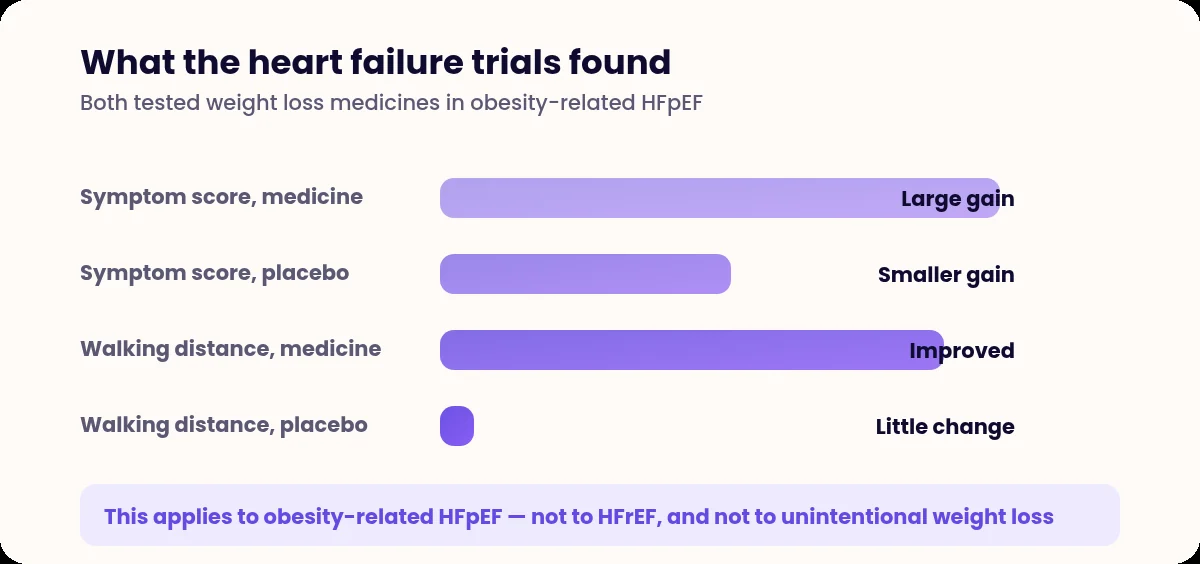
- Two randomised trials in obesity-related HFpEF found improved symptoms and exercise capacity, and one found fewer worsening heart failure events.
- None of this applies to HFrEF, and none of it applies to unintentional weight loss, which signals cardiac cachexia and carries a poor prognosis.
For most of the last two decades, the data on weight and heart failure said something uncomfortable: among people who already had heart failure, those carrying more weight lived longer.
That observation is real and it has been replicated many times. It is also, on the best current reading, not what it appears to be. Understanding why is the key to everything else in this article.
The obesity paradox, and why it is an artefact
Several explanations account for the finding without requiring that excess adiposity protects a failing heart.
BMI cannot separate muscle, fat and fluid. This is the big one. Heart failure causes fluid retention, and oedema inflates BMI in decompensated patients. A person retaining several litres of fluid registers a higher BMI while being sicker, not healthier. Studies that use waist circumference or body fat percentage instead of BMI largely attenuate or abolish the paradox — which is close to a decisive argument.
Reverse causation through cardiac cachexia. Advanced heart failure causes weight loss. So a low BMI in an established heart failure cohort often marks severe disease rather than good health. The comparison is between people whose low weight is a symptom and people whose higher weight is not.
Collider or index event bias. Restricting analysis to people who already have heart failure introduces selection effects. Someone with a normal BMI who develops heart failure likely has a different, often more aggressive, set of causes than someone whose heart failure is largely obesity-driven.
Earlier diagnosis. People with obesity present with breathlessness sooner and are investigated sooner, so they enter cohorts at an earlier disease stage.
Better drug tolerance. Larger patients often tolerate higher doses of guideline-directed heart failure therapy without symptomatic hypotension, and dose achieved predicts outcome.
Obesity remains a strong risk factor for developing heart failure. The paradox concerns what happens after diagnosis, and it does not undo that — the broader case for treating excess weight as a disease driver is set out in obesity as a chronic disease.
Obesity-related HFpEF is its own condition
Heart failure with preserved ejection fraction — where the heart pumps with a normal ejection fraction but fills poorly — used to be described simply as diastolic stiffening.
The obesity-related form is now recognised as a distinct phenotype with its own mechanisms:
- Plasma volume expansion, increasing filling pressures
- Epicardial and paracardiac adipose tissue, which physically surrounds the heart
- Pericardial restraint, where that surrounding fat and an expanded volume limit how the heart can fill
- Systemic inflammation driven by adipose tissue
- Impaired exercise capacity out of proportion to resting measurements
It is among the fastest-growing heart failure phenotypes, and the mechanisms above are directly weight-related — which is why weight loss became a plausible treatment rather than just general advice. The same visceral and ectopic fat pattern drives several other cardiometabolic problems, including the ones covered in weight loss and blood pressure.
What the two trials found
Both tested weight loss medicines in obesity-related HFpEF. They are described here by what they tested rather than by product name.
STEP-HFpEF tested a once-weekly GLP-1 receptor agonist against placebo in 529 patients over 52 weeks. Median age 69, 56.1% women, median weight 105.1 kg, median BMI 37.0 [1].
- Kansas City Cardiomyopathy Questionnaire clinical summary score: +16.6 points versus +8.7 on placebo
- Body weight: −13.3% versus −2.6%
- Six-minute walk distance: +21.5 m versus +1.2 m
- Adjudicated heart failure hospitalisations or urgent visits: 1 patient versus 12
- Serious adverse events: 35 (13.3%) versus 71 (26.7%) — fewer on treatment
- C-reactive protein reduced
A companion trial replicated the findings in people with type 2 diabetes. Notably, the symptom improvement exceeded what the degree of weight loss alone would have predicted, implying additional anti-inflammatory or haemodynamic effects rather than a pure weight effect.
SUMMIT tested a dual GIP and GLP-1 receptor agonist against placebo in 731 patients with obesity-related HFpEF, median follow-up two years [2].
- Primary endpoint of cardiovascular death or a worsening heart failure event: 36 versus 56 patients, HR 0.62 (95% CI 0.41–0.95, p=0.026)
- That result was driven by worsening heart failure events; there was no significant difference in cardiovascular death alone
- At 52 weeks: greater KCCQ improvement, greater six-minute walk distance, weight −11.6%, reduced hs-CRP
- A cardiac MRI substudy in 106 patients found left ventricular mass −11 g and paracardiac adipose tissue −45 mL versus placebo
The imaging substudy is the part that makes the mechanism concrete: the fat around the heart came down, and so did left ventricular mass.
For how these medicines behave outside weight loss generally, GLP-1 medicines beyond weight covers the wider evidence in more detail.
Three limits that matter
This does not extend to HFrEF. Heart failure with reduced ejection fraction is a different condition with a different evidence base, and the trials above did not include it. Evidence for intentional weight loss there is weaker, and the treatment priorities are the established four-pillar medical therapy.
This does not apply to unintentional weight loss. Losing weight without trying in heart failure suggests cardiac cachexia — a wasting syndrome of advanced disease involving muscle as well as fat loss. It marks severity and carries a poor prognosis. It needs prompt assessment, not congratulation. This distinction is not a technicality; it is the difference between a treatment effect and a warning sign.
UK guidance lags the evidence. NICE NG106 on chronic heart failure dates from 2018 and predates all of this, with no recommendation on GLP-1 medicines for HFpEF [3]. The relevant NICE technology appraisals cover obesity management on BMI and comorbidity criteria, not a heart failure indication [4]. In practice, UK clinicians prescribing these medicines to someone with HFpEF are working from obesity eligibility rules rather than a cardiac one. What those rules require is set out in weight loss medication eligibility in the UK.
What this means in practice
If you have obesity-related HFpEF, intentional and supervised weight loss now has randomised evidence behind it for symptoms, exercise capacity and, in one trial, worsening heart failure events. That is a meaningful change from a few years ago, when the advice was largely to leave weight alone.
The word doing the work is supervised. Heart failure involves fluid balance, diuretics and often several interacting medicines. Rapid weight change alters fluid status, can affect drug handling, and makes daily weights — the standard self-monitoring tool in heart failure — much harder to interpret. Agree any plan with your cardiology team first, and be clear with them about what you are doing, so that a two-kilo change can be read correctly.
Do not stop or alter a heart failure medicine because you are losing weight. Raise it with your prescriber instead.
When to speak to a clinician
Arrange assessment if you:
- are losing weight without trying, particularly with worsening breathlessness, fatigue or loss of appetite — this needs a same-week GP appointment
- have heart failure and want to lose weight deliberately, which should be planned with your cardiology team before you begin
- gain more than about 1.5 to 2 kg over two or three days, which usually indicates fluid retention and needs prompt review [5, 6]
- notice increasing ankle or abdominal swelling, or breathlessness when lying flat
Call 999 if you have sudden severe breathlessness, chest pain, or you are coughing up pink frothy sputum.
Frequently asked questions
What is the obesity paradox in heart failure?
In people who already have heart failure, those with a higher BMI have been observed to have lower mortality than those with a normal BMI. The finding is widely replicated in observational cohorts. It is almost certainly an artefact of measurement and selection rather than evidence that carrying excess weight protects the heart.
Is losing weight safe if I have heart failure?
Intentional, supervised weight loss in obesity-related heart failure with preserved ejection fraction now has randomised trial support for symptoms and exercise capacity. That does not extend automatically to heart failure with reduced ejection fraction, where evidence is weaker. Any weight loss plan in heart failure should be agreed with your cardiology team.
Why is unintentional weight loss in heart failure a bad sign?
It suggests cardiac cachexia, a wasting process seen in advanced heart failure involving loss of muscle as well as fat. It marks disease severity and carries a poor prognosis. Losing weight without trying, particularly alongside worsening breathlessness or fatigue, needs prompt medical assessment rather than encouragement.
Does UK guidance cover weight loss medicines for heart failure?
Not yet in the way the trial evidence might suggest. NICE guidance on chronic heart failure, NG106, dates from 2018 and predates these trials. The relevant NICE technology appraisals cover obesity management based on BMI and comorbidity criteria rather than a heart failure indication, so UK clinicians are working from obesity criteria.
References
- Kosiborod MN, Abildstrøm SZ, Borlaug BA, et al. STEP-HFpEF: randomised trial of a once-weekly GLP-1 receptor agonist in heart failure with preserved ejection fraction and obesity. New England Journal of Medicine. 2023;389:1069-1084. doi.org/10.1056/NEJMoa2306963
- Packer M, Zile MR, Kramer CM, et al. SUMMIT: randomised trial of a dual GIP and GLP-1 receptor agonist in obesity-related heart failure with preserved ejection fraction. New England Journal of Medicine. 2025;392:427-437. doi.org/10.1056/NEJMoa2410027
- NICE. Chronic heart failure in adults: diagnosis and management. NG106. 2018. www.nice.org.uk/guidance/ng106
- NICE. Technology appraisal guidance on medicines for weight management (TA875, TA1026). www.nice.org.uk/guidance
- NHS. Heart failure. www.nhs.uk/conditions/heart-failure/
- British Heart Foundation. Heart failure. www.bhf.org.uk/informationsupport/conditions/heart-failure
Medical reviewer
Naeem Teni
Clinical Lead at Manova. Registered pharmacist and independent prescriber, GPhC 2215591. Reviews Manova’s clinical content for accuracy and safety.
Written by
Manova Editorial Team
Researched and written to our editorial policy, using NICE, NHS, MHRA and peer-reviewed sources.
This article is for general information and isn’t a substitute for advice from your own clinician. If you feel unwell, contact your GP or NHS 111. In an emergency, call 999.