
Key takeaways
- Male pattern baldness is caused by genetically sensitive follicles gradually miniaturising under the influence of dihydrotestosterone (DHT).
- Hair is not lost suddenly — each growth cycle produces a finer, shorter hair until the follicle stops producing visible hair at all.
- Treatment is better at keeping what is there than at regrowing what has gone, so the earlier it starts the more there is to keep.
- The two treatments with the strongest evidence in the UK are finasteride and topical minoxidil.
Most men picture hair loss as hairs falling out. What actually happens is smaller and slower than that, and understanding it explains why treatment works the way it does.
Miniaturisation
Each hair follicle runs a cycle: a growth phase lasting years, a brief transition, a resting phase, then shedding and regrowth. In male pattern baldness — androgenetic alopecia — the growth phase shortens with each cycle in follicles that are genetically sensitive to androgens [2, 4].
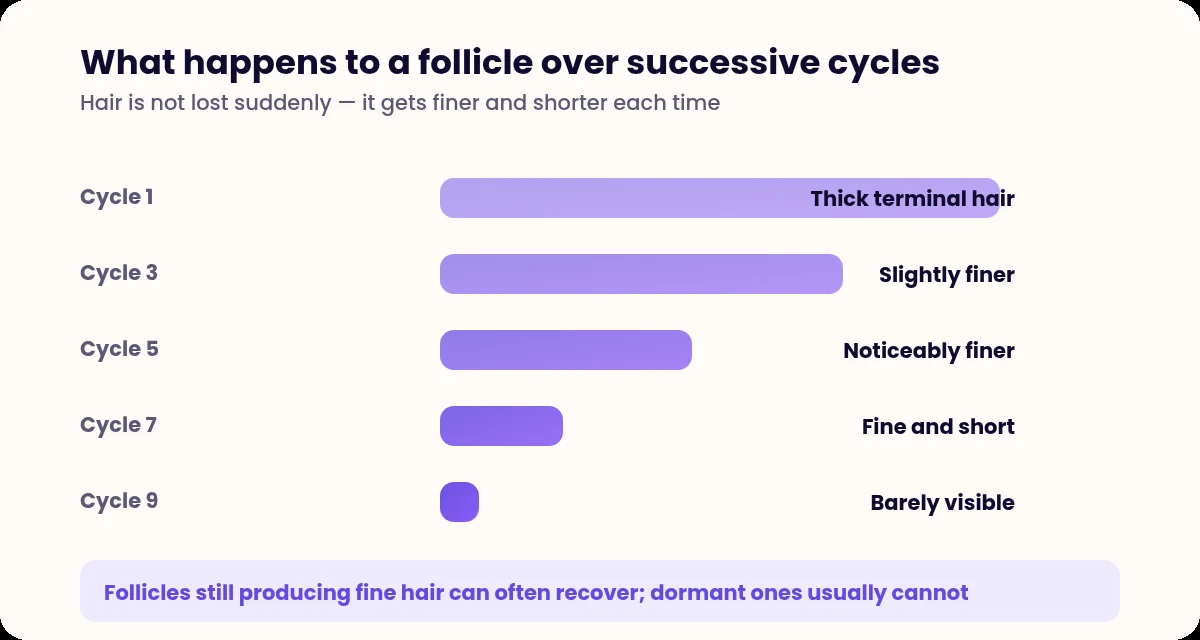
The follicle produces a slightly finer, shorter, less pigmented hair each time. Over years, a thick terminal hair becomes a fine vellus hair barely visible at arm’s length, and eventually the follicle stops producing anything worth seeing. The area doesn’t go bald overnight; it fades.
The hormone driving this is dihydrotestosterone (DHT), converted from testosterone by the enzyme 5-alpha reductase. Men with pattern baldness do not generally have unusual hormone levels — the difference is in how sensitive their follicles are, which is genetic [4].
Two consequences follow from this, and they matter more than anything else on the page:
- Follicles still producing fine hair can often be restored; follicles dormant for years usually cannot. Treatment is far better at holding a line than pushing it back.
- Without treatment, progression continues. Whatever treatment is doing, it is doing it against a moving background.
Why the pattern is a pattern
Follicles at the temples and crown are androgen-sensitive; those at the back and sides of the head are largely not. That regional difference is why the pattern is so recognisable, and it is also the entire basis of hair transplantation — hair moved from the back retains its insensitivity in its new position.
The Norwood scale describes the stages: a mature hairline, then recession at the temples, then thinning at the crown, then the two meeting, leaving the horseshoe of retained hair [4]. It is a description, not a prophecy; not everyone progresses through every stage, and the rate varies enormously.
Genetics
Inheritance is polygenic. The androgen receptor gene on the X chromosome — inherited from your mother — is the single strongest known contributor, which is where the “look at your maternal grandfather” folk wisdom comes from. But dozens of other variants on other chromosomes contribute, so paternal inheritance matters too [4].
Practically: family history is a useful predictor of likelihood but a poor predictor of timing or severity.
What it isn’t
A few things are routinely blamed and are not causes [1, 3]:
- Hats. No.
- Frequent washing. Washing releases hairs already in the shedding phase; it does not cause loss.
- Poor circulation to the scalp. A theory from the era of scalp massage devices; not supported.
- Stress, in the pattern sense. Severe stress can cause telogen effluvium, a diffuse temporary shedding — a different condition that recovers — but it does not cause androgenetic alopecia.
Our guide to hair loss myths goes through the rest.
When it might not be pattern baldness
Worth seeing a clinician rather than assuming, if [1, 3]:
- hair comes out in discrete round patches (possible alopecia areata)
- the scalp is itchy, scaly, painful or scarred (scarring alopecias need prompt treatment, because the damage is permanent)
- shedding is sudden and diffuse over the whole scalp, especially a few months after illness, surgery, major stress, childbirth in a partner’s case, or starting a new medicine (telogen effluvium)
- there are other symptoms — fatigue, weight change, altered periods in women, changes to nails
- you are a woman with hair thinning: the pattern, causes and investigations differ, and our guide to female pattern hair loss covers them
Our guide to blood tests for hair loss covers what is worth checking and what generally isn’t.
What has evidence
Two treatments have substantial randomised evidence in men and are the mainstay in the UK [2, 3]:
- Finasteride, a tablet that inhibits 5-alpha reductase and lowers scalp DHT. Prescription only. See finasteride explained.
- Topical minoxidil, applied to the scalp, which prolongs the growth phase. Available from pharmacies. See minoxidil explained.
They work by different mechanisms and are often used together; our finasteride vs minoxidil guide compares them.
Hair transplantation redistributes androgen-insensitive follicles and is the only way to restore hair to an area that has been bald for years. It does not stop ongoing loss elsewhere, which is why surgeons usually recommend medical treatment alongside — see hair transplants in the UK.
Low-level laser devices have some published trials and a mixed reputation; evidence quality is lower than for the two medicines above. Supplements help only where there is a genuine deficiency. Shampoos can improve the appearance and health of the hair you have but do not alter miniaturisation.
The part that isn’t medical
Hair loss affects how a lot of men feel about themselves, and that is not vanity — it is a visible change to your face that you did not choose and cannot hide. Some men treat it, some shave it off and are happier, and both are reasonable. What is worth avoiding is spending years and a lot of money on things with no evidence because the decision felt too uncomfortable to have properly.
Frequently asked questions
At what age does male pattern baldness start?
It can begin any time after puberty. Studies of UK and European men report visible androgenetic alopecia in a substantial minority by the thirties, rising with each subsequent decade. Starting in the early twenties is common and not in itself unusual.
Is baldness inherited from my mother's side?
Partly. One important gene sits on the X chromosome, which men inherit from their mother, but many other genes on other chromosomes are involved. Looking at both sides of the family gives a better picture than either alone.
Can hair loss be reversed?
Follicles that have miniaturised but are still producing fine hair can often improve with treatment. Follicles that have been dormant for years are unlikely to. This is why treatment results depend heavily on how early it starts.
What is the Norwood scale?
A seven-stage classification of male pattern hair loss, from a mature hairline through progressive recession at the temples and thinning at the crown, to the two areas joining. Clinicians use it to describe the pattern and track change over time.
References
- NHS. Hair loss. www.nhs.uk/conditions/hair-loss/
- NICE Clinical Knowledge Summaries. Alopecia, androgenetic – male. cks.nice.org.uk/topics/alopecia-androgenetic-male/
- British Association of Dermatologists. Androgenetic alopecia patient information leaflet. www.skinhealthinfo.org.uk/
- DermNet. Androgenetic alopecia. dermnetnz.org/topics/androgenetic-alopecia
Medical reviewer
Naeem Teni
Clinical Lead at Manova. Registered pharmacist and independent prescriber, GPhC 2215591. Reviews Manova’s clinical content for accuracy and safety.
Written by
Manova Editorial Team
Researched and written to our editorial policy, using NICE, NHS, MHRA and peer-reviewed sources.
This article is for general information and isn’t a substitute for advice from your own clinician. If you feel unwell, contact your GP or NHS 111. In an emergency, call 999.