

Key takeaways
- Low desire in men is usually multifactorial, with mood, sleep, medication and relationship factors far more common than hormonal causes.
- Low libido is simultaneously a symptom of depression, a side effect of antidepressants, and a feature of testosterone deficiency, which is why it is so often misattributed.
- If testosterone is measured it must be a morning, fasting total testosterone, confirmed on a second sample — a single afternoon result means very little.
- UK practice is markedly more conservative about testosterone replacement than direct-to-consumer clinics elsewhere, and the UK thresholds are specific.
Loss of interest in sex is one of the harder things for men to bring to a clinician, partly because there is no obvious mechanical failure to point at, and partly because the culture assumes male desire is a constant.
It is not. It varies with sleep, mood, stress, medication, alcohol, illness and the state of a relationship, and it declines gradually with age in a way that is entirely normal. What matters clinically is a persistent fall from your own baseline that is causing you or your partner distress — not a comparison with anyone else.
Why this is so often misattributed
Here is the tangle that sits at the centre of the subject. Low libido is a diagnostic symptom of depression. It is also one of the commonest side effects of the medicines used to treat depression. And it is also a cardinal feature of testosterone deficiency.
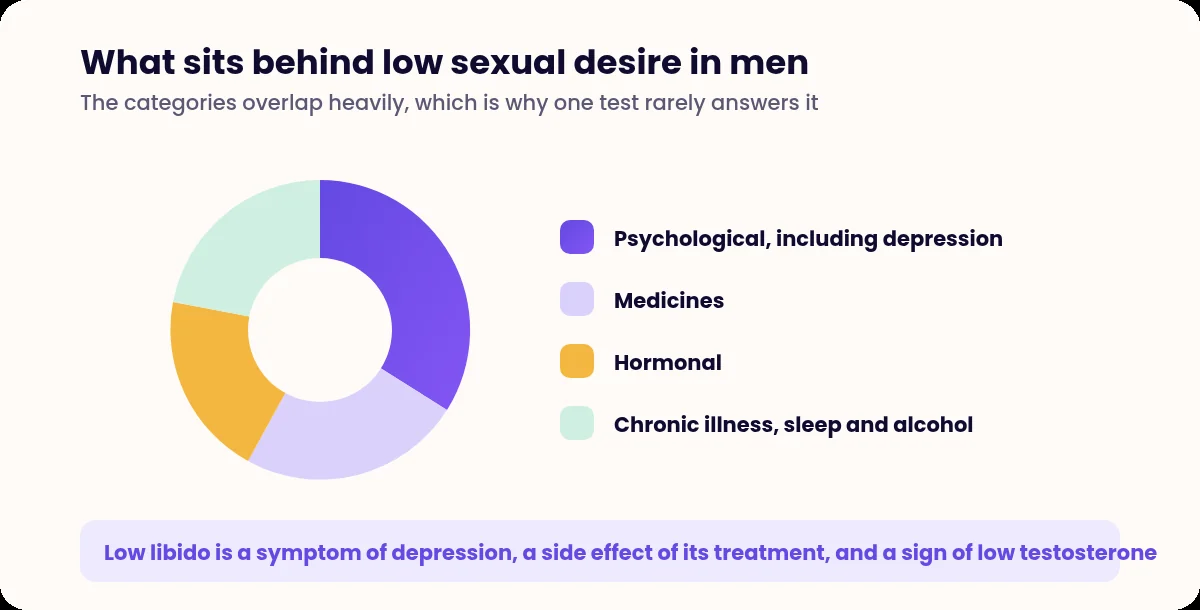
Three different conditions, one presenting symptom, and they are routinely confused for each other. A man who assumes his desire has gone because his testosterone is low may be depressed. A man who stops his antidepressant may relapse into the condition that reduced his desire in the first place.
Getting the sequence right is most of the work, which is why a good assessment starts with history rather than a blood test.
The causes worth working through
Psychological. Depression, anxiety, chronic stress, burnout and relationship difficulty. This is the largest group by some distance. A PHQ-9 depression screen is a reasonable early step [3].
Medicines. SSRIs and SNRIs most prominently, but also antipsychotics, opioids, finasteride and dutasteride, some beta blockers, and alcohol in quantity. Sexual side effects from antidepressants are common, under-reported and often manageable without stopping treatment, so they are worth raising with your prescriber rather than absorbing.
Endocrine. Testosterone deficiency, raised prolactin, and thyroid disease. Hypogonadism can be primary, arising in the testes, or secondary, arising in the pituitary or hypothalamus, and the distinction changes the investigation. Less common than the internet suggests, but genuinely checkable and occasionally the whole answer. A markedly raised prolactin in particular needs following up properly.
Chronic disease. Type 2 diabetes, obesity, chronic kidney disease, and obstructive sleep apnoea. Each reduces desire through more than one route.
Sleep. Short sleep, fragmented sleep and shift work all lower testosterone and blunt desire. Untreated sleep apnoea is a common and very treatable cause, and it often travels with weight — our article on sleep apnoea and weight covers the overlap.
Secondary loss of desire. This one is underestimated. A man who has developed erectile difficulty or premature ejaculation often stops wanting sex, because wanting something you expect to go badly is uncomfortable. The desire problem is real, but the treatable problem sits upstream of it. Our guide to what causes erectile dysfunction is the place to start if that describes you.
Testing testosterone properly
If testosterone is going to be measured, it has to be measured correctly, because a badly taken sample generates months of confusion.
Total testosterone, morning, fasting. Between 7am and 11am, before eating. Levels follow a daily rhythm and fall after food. European guidance grades this recommendation as strong [2].
Confirm on a second sample. A single low result is not a diagnosis. Illness, sleep deprivation and acute stress all suppress testosterone transiently.
UK thresholds. British Society for Sexual Medicine guidance puts total testosterone below 8 nmol/L as supporting a diagnosis, 8 to 12 nmol/L as equivocal and requiring interpretation alongside symptoms and calculated free testosterone, and above 12 nmol/L as making deficiency unlikely [1].
Bloods usually taken alongside: LH, FSH, prolactin, SHBG, thyroid function, HbA1c, lipids, full blood count and, depending on age and symptoms, PSA.
A note on UK practice
UK practice is markedly more conservative about testosterone replacement than the direct-to-consumer “low T” clinics that dominate search results, most of which are American. In the UK, treatment follows a symptomatic diagnosis confirmed on repeat morning fasting sampling, with reversible causes addressed first, and it is managed with ongoing monitoring under specialist or GP supervision.
Manova does not provide a testosterone service, and this article is not a route to one. If your results and symptoms point that way, the conversation belongs with your GP or an endocrinology or andrology service. Our overview of testosterone replacement in the UK explains how that pathway works, and low testosterone symptoms covers what the picture typically looks like.
What actually helps
For most men, the effective interventions are unglamorous and aimed at the cause rather than at desire itself.
Treat the mood problem. If depression or anxiety is present, treating it does more for libido than anything else — with the caveat that some treatments cause the symptom, which is a conversation to have at the start rather than after six months.
Review the medicines. Every man with new low libido deserves a proper look at his prescription list. Never stop anything unilaterally; raise it with your prescriber and ask whether an alternative exists.
Sleep and alcohol. Both are usually dismissed and both have a measurable effect. The UK Chief Medical Officers’ guidance is no more than 14 units a week, spread over three or more days, with several drink-free days.
Weight and metabolic health. Obesity lowers testosterone through several routes and brings sleep apnoea and insulin resistance with it. Our article on weight and testosterone in men covers what the evidence shows.
Address the relationship context honestly. Desire is responsive as well as spontaneous. Long-term couples often find that waiting to feel desire before initiating produces less of it, not more. Psychosexual therapy is genuinely effective here and is available through the NHS in some areas and privately through COSRT-registered therapists.
When to see a clinician
Book an appointment if the change has persisted for more than a few months, if it came on abruptly, or if it is accompanied by fatigue, low mood, loss of morning erections, reduced shaving frequency, breast tenderness or visual changes.
Two situations need faster attention. New headaches or visual field changes alongside low libido need a same-week GP appointment, because a pituitary cause needs excluding. And any thoughts of self-harm need urgent help — contact your GP the same day, call 111, or go to A&E.
Frequently asked questions
Is low sex drive in men usually a testosterone problem?
Usually not. Psychological factors, sleep, alcohol, medication and relationship context account for far more cases than testosterone deficiency does. Testosterone is still worth measuring when desire has fallen persistently, particularly alongside fatigue, low mood or reduced morning erections, but most men who have it checked turn out to be within the normal range.
How should testosterone be tested?
Total testosterone from a blood sample taken in the morning, between 7am and 11am, while fasting. Levels vary through the day and after food, so an afternoon or post-breakfast sample is unreliable. A low result should be confirmed with a second morning fasting sample before anything is concluded, and usually alongside LH, FSH, prolactin and SHBG.
What counts as a low testosterone level in the UK?
British Society for Sexual Medicine thresholds put a total testosterone below 8 nmol/L as supporting treatment, 8 to 12 nmol/L as equivocal and requiring interpretation alongside symptoms and free testosterone, and above 12 nmol/L as making deficiency unlikely. These are guide values interpreted with symptoms, not a pass or fail line.
Can losing weight improve sex drive?
Often, yes. Obesity is associated with lower testosterone through several mechanisms, and it commonly travels with obstructive sleep apnoea, type 2 diabetes and low mood, all of which reduce desire independently. Weight loss improves several of these at once, which is why it tends to help more than any single intervention aimed at desire alone.
References
- British Society for Sexual Medicine. Guidelines on adult testosterone deficiency. www.bssm.org.uk/guidelines/
- European Association of Urology. Guidelines on Sexual and Reproductive Health. uroweb.org/guidelines/sexual-and-reproductive-health
- NICE. Depression in adults: treatment and management. NG222. www.nice.org.uk/guidance/ng222
- NICE Clinical Knowledge Summaries. Erectile dysfunction. cks.nice.org.uk/topics/erectile-dysfunction/
- NHS. Loss of libido (reduced sex drive). www.nhs.uk/conditions/loss-of-libido/
- British National Formulary. bnf.nice.org.uk/
Medical reviewer
Naeem Teni
Clinical Lead at Manova. Registered pharmacist and independent prescriber, GPhC 2215591. Reviews Manova’s clinical content for accuracy and safety.
Written by
Manova Editorial Team
Researched and written to our editorial policy, using NICE, NHS, MHRA and peer-reviewed sources.
This article is for general information and isn’t a substitute for advice from your own clinician. If you feel unwell, contact your GP or NHS 111. In an emergency, call 999.