

Key takeaways
- Excess adiposity raises serum urate mainly through insulin resistance increasing urate reabsorption by the kidney.
- Rapid weight loss, fasting and very-low-calorie diets can transiently raise urate and precipitate acute flares in the first weeks to months.
- NICE NG219 states there is not enough evidence that any specific diet prevents flares or lowers serum urate, which is notably more sceptical than most US patient material.
- The NICE serum urate target is below 360 micromol/L, or below 300 where there are tophi, chronic gouty arthritis or continuing flares.
Gout and excess weight are closely linked, and the link is well understood mechanistically. What is less well known, and far more likely to catch someone out, is that the process of losing weight can make gout worse before it makes it better.
If you have gout and you are starting a weight loss programme, that short-term risk is the single most useful thing to know in advance.
How excess weight raises urate
Several pathways run in parallel, and they are not equally important.
Insulin resistance is the dominant one. Higher circulating insulin increases reabsorption of urate by the renal tubules, so less is excreted and serum levels rise. This is the main reason the association between adiposity and urate is as strong as it is.
Alongside that:
- Increased purine turnover from a larger tissue mass
- Adipokine-driven inflammation, which lowers the threshold at which crystals provoke a flare
- Associated intake patterns, particularly high-fructose drinks and alcohol, which independently raise urate
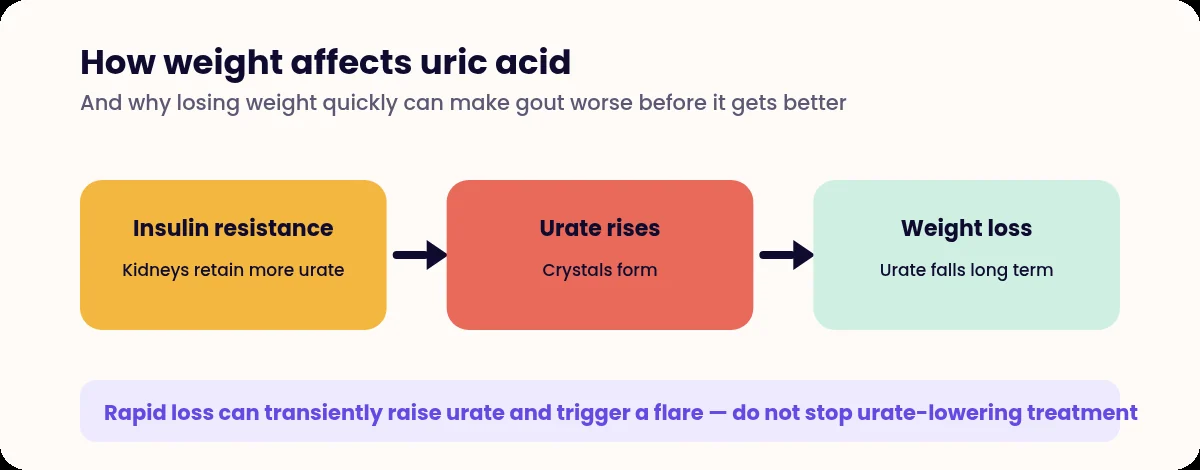
The inflammation point is worth dwelling on. Urate level and flare risk are related but not the same thing. Two people with identical urate levels can have very different flare frequencies, and the inflammatory environment is part of why. This is one of several ways excess adiposity behaves as a driver of long-term disease rather than a cosmetic matter, a theme covered in obesity as a chronic disease.
Does weight loss lower urate
Over the longer term, yes. A systematic review in the Annals of the Rheumatic Diseases found that weight loss consistently reduced serum urate and reduced long-term flare frequency [2].
The certainty of that evidence was rated very low. Most of it comes from non-randomised cohorts, heavily weighted towards bariatric surgery populations, with short follow-up and no comparison group doing nothing. That does not make the conclusion wrong. It does mean the size of the benefit is poorly quantified.
The short-term risk nobody warns about
Here is the nuance that matters most clinically.
Rapid weight loss, fasting and very-low-calorie diets can cause a transient rise in serum urate and precipitate acute flares in the first weeks to months.
Two mechanisms drive it. Ketone bodies, produced in quantity during marked energy restriction, compete with urate for renal tubular excretion — the kidney effectively prioritises clearing ketones, and urate backs up. At the same time, increased tissue catabolism releases additional purines into circulation.
This has been reported after bariatric surgery and with the rapid weight loss produced by GLP-1 and dual-agonist weight loss medicines. The NHS describes gout flares as coming on rapidly, often overnight, and typically peaking within 24 hours [3]. It is not a sign that the weight loss is going wrong. It is a predictable consequence of losing weight quickly in someone whose urate handling is already impaired.
The practical implications:
- A flare in the first weeks of a new regimen is not a reason to abandon the regimen
- A slower rate of loss is preferable where gout is established, for this reason as well as others
- Very-low-calorie approaches deserve particular caution here, and they belong in a supervised setting anyway — see very low calorie diets
- Urate-lowering therapy and any flare prophylaxis should be continued through the weight loss phase
If you are taking a weight loss medicine obtained privately, make sure whoever manages your gout knows. The MHRA noted in January 2026 that privately prescribed GLP-1 medicines may be absent from GP records, so it is worth stating directly rather than assuming it is on file [4].
What NICE actually says about diet
This is where UK guidance diverges sharply from much of what you will read online.
NICE NG219, published 9 June 2022, states in recommendation 1.4.1 that “there is not enough evidence to show that any specific diet prevents flares or lowers serum urate levels” [1].
Recommendation 1.4.2 says that excess body weight or obesity, and excessive alcohol consumption, may exacerbate gout flares and symptoms.
That is the whole of it. No purine tables, no list of forbidden foods, no seafood ranking. Compared with the detailed dietary prescriptions common in US patient material, NICE is markedly more sceptical, and deliberately so: the trials underpinning those lists are small, short and inconsistent.
This is not a licence to ignore diet entirely. Alcohol and sugar-sweetened drinks are specifically flagged, and body weight is named. But the honest framing is that managing weight and alcohol is worth doing, and micromanaging individual purine-containing foods is not supported.
The urate targets
NICE gives clear numbers, which is useful because they let you judge whether treatment is working [1]:
- Below 360 micromol/L as the standard target
- Below 300 micromol/L where there are tophi, chronic gouty arthritis, or continuing flares
If you are on urate-lowering therapy and have not had a level checked recently, that is a reasonable thing to ask about.
Do not stop allopurinol during a flare
This is the most common self-managed error in gout. Urate-lowering therapy should be continued during an acute flare, not paused. Starting, stopping or changing the dose during a flare can destabilise urate levels and prolong the episode. Flares are treated with anti-inflammatory treatment on top of the existing urate-lowering therapy, not instead of it.
The same applies during weight loss. If flares become more frequent while you are losing weight, raise it with your prescriber. The answer is usually adjustment of prophylaxis or the rate of loss, not discontinuation.
Why the level and the flare are not the same question
Lowering urate below the target dissolves existing crystal deposits, and that is what prevents flares over years. But crystal dissolution itself can provoke flares while it is happening, which is why prophylaxis is usually given when urate-lowering therapy is started or increased.
Set against that, the first months of any effective gout treatment can feel like it is not working. Judging success over weeks is misleading; judging it over a year, by flare frequency and by the urate level, is not.
A sensible approach if you have gout
- Aim for a steady rate of loss rather than a rapid one
- Keep urate-lowering therapy going throughout, and get levels checked
- Reduce alcohol and sugar-sweetened drinks — the two dietary factors with the best support
- Expect the possibility of a flare early, and plan for it with your clinician rather than being surprised
- Do not build the whole plan around avoiding specific foods
Gout rarely travels alone. Weight-related joint pain elsewhere, particularly at the knee, has stronger and more mechanical evidence behind it and is worth addressing at the same time — see weight and knee pain.
When to seek urgent help
- A hot, swollen, very painful joint with fever or feeling systemically unwell — this can be septic arthritis, seek same-day assessment or go to A&E
- A first suspected gout flare that has not been assessed, to confirm the diagnosis
- Flares becoming more frequent or severe during weight loss — contact your prescriber
- Any new joint symptoms while taking a weight loss medicine
Frequently asked questions
Does losing weight help gout?
In the longer term, yes: a systematic review found weight loss consistently reduced serum urate and long-term flare frequency. The certainty of that evidence was judged very low, because most of it comes from non-randomised bariatric surgery cohorts with short follow-up. The short-term picture is different and can involve more flares, not fewer.
Why did I get a gout attack after starting a diet?
Rapid weight loss, fasting and very-low-calorie diets can cause a transient rise in serum urate. Ketone bodies compete with urate for excretion by the kidney, and tissue breakdown releases extra purines. Both push urate up temporarily, which can precipitate a flare in the first weeks to months.
Should I stop allopurinol during a gout flare?
No. Urate-lowering therapy should be continued through a flare, and it should be continued through a weight loss phase as well. Changing the dose during a flare can make things worse. If you are having flares, raise it with your prescriber rather than stopping treatment.
What diet prevents gout?
NICE takes the position that there is not enough evidence to show any specific diet prevents flares or lowers serum urate. It does say excess body weight and excessive alcohol may exacerbate flares and symptoms. That is a meaningfully more cautious position than the detailed purine-avoidance lists common in US material.
References
- NICE. Gout: diagnosis and management. NG219. Published 9 June 2022. www.nice.org.uk/guidance/ng219
- Systematic review of weight loss and serum urate/gout outcomes. Annals of the Rheumatic Diseases. ard.bmj.com/
- NHS. Gout. www.nhs.uk/conditions/gout/
- MHRA. Drug Safety Update. 29 January 2026. www.gov.uk/drug-safety-update
Medical reviewer
Naeem Teni
Clinical Lead at Manova. Registered pharmacist and independent prescriber, GPhC 2215591. Reviews Manova’s clinical content for accuracy and safety.
Written by
Manova Editorial Team
Researched and written to our editorial policy, using NICE, NHS, MHRA and peer-reviewed sources.
This article is for general information and isn’t a substitute for advice from your own clinician. If you feel unwell, contact your GP or NHS 111. In an emergency, call 999.