

Key takeaways
- Rapid weight loss mobilises cholesterol into bile while low fat intake reduces gallbladder emptying, and supersaturation plus stasis forms stones.
- Gallstones form in roughly 10 to 25% of people on very-low-calorie diets or rapid weight loss over 8 to 16 weeks, with a minority becoming symptomatic.
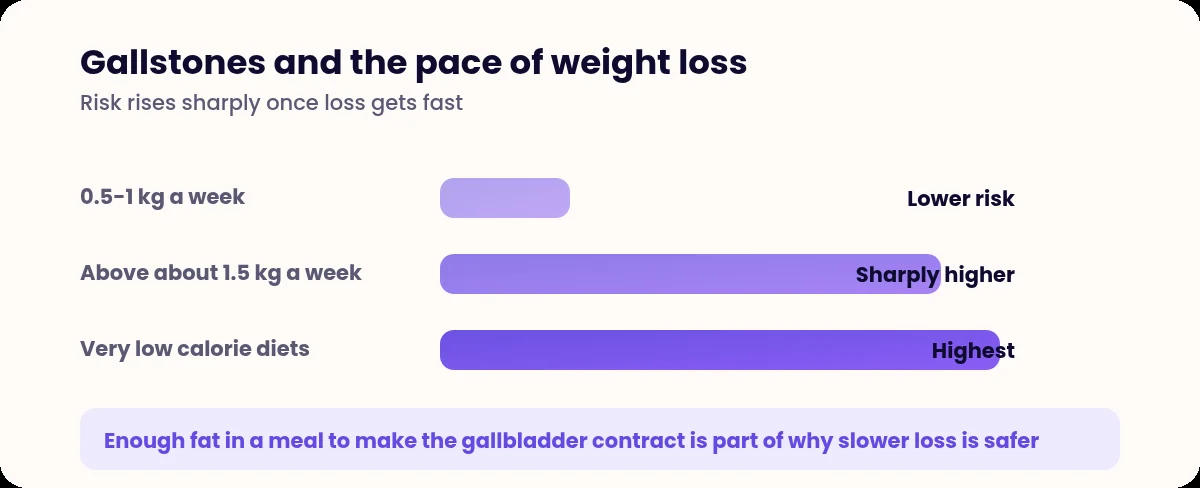
- Risk rises sharply above roughly 1.5 kg a week; 0.5 to 1.0 kg a week carries much lower risk.
- A meta-analysis of GLP-1 trials found an increased risk of gallbladder disease, with the effect concentrated at higher doses and in weight loss indications.
Almost every organ benefits from losing weight. The gallbladder is the exception, and only when the losing is fast.
This is worth understanding properly rather than worrying about vaguely, because the mechanism points directly at what to do about it.
Why fast weight loss makes stones
Two things happen at once, and neither on its own would be enough.
Cholesterol floods into bile. Body fat stores cholesterol. Mobilising fat rapidly moves that cholesterol into the circulation and the liver excretes the excess into bile. Bile becomes supersaturated with cholesterol — lithogenic, in the jargon — meaning crystals can come out of solution.
The gallbladder stops emptying properly. Dietary fat is the trigger for cholecystokinin release, which is what makes the gallbladder contract. A very low fat intake means less cholecystokinin, less contraction, and bile sitting in the gallbladder rather than moving through. Increased biliary mucin and calcium add to the problem.
Supersaturated bile plus stasis is how stones form. The classic high-risk pattern is a large deficit achieved through a very low fat, very low energy diet — which is exactly what a lot of aggressive dieting looks like.
How common it is
Gallstone formation is reported in roughly 10 to 25% of people undergoing very-low-calorie diets or rapid weight loss over 8 to 16 weeks. Only a minority of those become symptomatic — many stones are silent and stay that way.
After bariatric surgery, new stone formation is reported in around 30% within one to two years, which is why gallbladder management is a standard part of those pathways and is discussed in bariatric surgery explained.
The rate threshold
Risk rises sharply above roughly 1.5 kg, or about 1.5% of body weight, a week. At 0.5 to 1.0 kg a week the risk is much lower.
Treat this figure as approximate and directional. It is derived from very-low-calorie diet cohorts rather than trials that randomised people to different rates of loss, so it is a threshold observed in one setting rather than a dose-response curve. The underlying principle — faster mobilisation of fat means more cholesterol into bile — is not in doubt even if the exact number is soft.
This is one of several reasons the standard advice lands around 0.5 to 1.0 kg a week rather than as fast as possible, and it is part of why very low calorie diets are recommended only within specialist services and for limited periods. If you are wondering what a realistic pace looks like, how much weight can you lose in a month sets out the arithmetic.
What actually prevents stones
Two interventions have randomised trial support, from a 2014 meta-analysis [3].
Higher dietary fat during the weight-loss diet. Enough fat per meal to trigger gallbladder contraction — commonly cited as around 7 to 10 g — reduces stasis. This is the more useful finding for most people, because it costs nothing and requires no prescription. It also argues against the ultra-low-fat approach that some rapid weight loss plans take.
In practice that means not stripping fat out entirely: olive oil on vegetables, a portion of oily fish, nuts, avocado, full-fat yoghurt in reasonable quantities. Fat has more calories per gram than anything else, so it has to be accounted for, but going to near-zero is counterproductive here.
Ursodeoxycholic acid, typically 500 to 600 mg a day, substantially reduced gallstone formation during weight loss in the same meta-analysis.
An important UK caveat: using ursodeoxycholic acid for gallstone prophylaxis during weight loss is off-label in the UK, and it is not recommended for this purpose in NICE CG188 [1]. It is used in some UK bariatric pathways, under specialist care. It is not routine UK practice, it is not something to request as standard alongside a weight loss programme, and any UK source presenting it as normal preventive treatment is describing a different system.
Weight loss medicines and the gallbladder
The largest analysis here pooled 76 randomised trials with 103,371 participants [2]. Compared with controls, GLP-1 medicines were associated with:
- Composite gallbladder or biliary disease: RR 1.37 (1.23–1.52)
- Cholelithiasis (gallstones): RR 1.27 (1.10–1.47)
- Cholecystitis (gallbladder inflammation): RR 1.36 (1.14–1.62)
- Biliary disease: RR 1.55 (1.08–2.22)
The subgroup pattern is the interesting part:
- By indication: weight loss trials RR 2.29 (1.64–3.18) versus diabetes and other indications RR 1.27 (1.14–1.45)
- By dose: higher doses RR 1.56 (1.36–1.78) versus lower doses RR 0.99 (0.73–1.33)
- By duration: longer trials RR 1.40 (1.26–1.56) versus shorter RR 0.79 (0.48–1.31)
It is not resolved whether this is a direct class effect — GLP-1 receptors are present on gallbladder smooth muscle and could reduce contraction directly — or simply the consequence of rapid weight loss. The dose- and indication-dependence is what tilts the interpretation: the risk is highest exactly where weight loss is greatest, which is what you would expect if weight loss were doing the work.
Either way, absolute risk remains low, and UK summaries of product characteristics for these medicines list cholelithiasis as an adverse reaction. It is a recognised, uncommon effect rather than a surprise, and it belongs in the same conversation as the other side effects of weight loss medicines when weighing up treatment.
The practical implications are the same as for any rapid loss: do not chase the fastest possible rate, do not cut fat to nothing, and know the symptoms.
Red flags — what needs urgent attention
Most gallstones cause nothing. Biliary colic is the usual first symptom: severe, constant pain in the upper right abdomen or below the breastbone, often after a fatty meal, lasting one to several hours, sometimes radiating to the right shoulder blade, often with nausea [4].
Seek same-day medical assessment, or go to A&E, if you have:
- Severe right upper quadrant abdominal pain with a fever — this suggests acute cholecystitis
- Jaundice — yellowing of the skin or the whites of the eyes
- Pale stools with dark urine
- Pain lasting more than a few hours that is not settling
- Pain with vomiting you cannot keep fluids down against
These indicate possible infection, duct obstruction or pancreatitis and need assessment rather than watchful waiting.
Do not stop a prescribed weight loss medicine on your own if you develop symptoms. Get assessed and raise it with your prescriber, who can advise on whether to pause or continue.
When to speak to a clinician
Raise it with a clinician if you:
- are losing more than about 1.5 kg a week and want advice on slowing the rate safely
- have a known history of gallstones and are planning significant weight loss
- develop any of the red flag symptoms above, which need urgent rather than routine assessment
- are on a weight loss medicine and getting recurrent upper abdominal pain after eating
- are under a bariatric service and want to know whether prophylaxis applies to your pathway
Frequently asked questions
Does losing weight cause gallstones?
Losing weight quickly can. Rapid loss pushes cholesterol out of fat stores into bile, making it supersaturated, while a low-fat diet means the gallbladder contracts less and bile sits still. Gallstone formation is reported in roughly 10 to 25% of people undergoing very-low-calorie diets over 8 to 16 weeks, though only a minority develop symptoms.
How fast is too fast?
Risk rises sharply above roughly 1.5 kg, or about 1.5% of body weight, a week. Losing 0.5 to 1.0 kg a week carries a much lower risk. Treat the threshold as approximate: it comes from very-low-calorie diet cohorts rather than trials that tested different rates against each other.
Do weight loss injections cause gallstones?
A meta-analysis of 76 randomised trials including 103,371 participants found an increased risk of gallbladder and biliary disease with GLP-1 medicines. Risk was higher at higher doses, in longer trials, and in weight loss trials compared with diabetes trials. Absolute risk remains low, and UK product information lists cholelithiasis as an adverse reaction.
What do gallstone symptoms feel like?
Typically a severe, constant pain in the upper right abdomen or just below the breastbone, often after a fatty meal, lasting from one to several hours, sometimes spreading to the right shoulder blade. Nausea and vomiting are common. Pain with fever, jaundice or pale stools needs urgent medical assessment.
References
- NICE. Gallstone disease: diagnosis and management. CG188. www.nice.org.uk/guidance/cg188
- He L, Wang J, Ping F, et al. Association of glucagon-like peptide-1 receptor agonist use with risk of gallbladder and biliary diseases: a systematic review and meta-analysis of randomized clinical trials. JAMA Internal Medicine. 2022;182(5):513-519. doi.org/10.1001/jamainternmed.2022.0338
- Stokes CS, Gluud LL, Casper M, Lammert F. Ursodeoxycholic acid and diets higher in fat prevent gallbladder stones during weight loss: a meta-analysis of randomized controlled trials. Clinical Gastroenterology and Hepatology. 2014;12(7):1090-1100. doi.org/10.1016/j.cgh.2013.11.031
- NHS. Gallstones. www.nhs.uk/conditions/gallstones/
- NICE. Overweight and obesity management. NG246. January 2025. www.nice.org.uk/guidance/ng246
Medical reviewer
Naeem Teni
Clinical Lead at Manova. Registered pharmacist and independent prescriber, GPhC 2215591. Reviews Manova’s clinical content for accuracy and safety.
Written by
Manova Editorial Team
Researched and written to our editorial policy, using NICE, NHS, MHRA and peer-reviewed sources.
This article is for general information and isn’t a substitute for advice from your own clinician. If you feel unwell, contact your GP or NHS 111. In an emergency, call 999.