

Key takeaways
- A meta-analysis of seven prospective studies in over 300,000 adults found the odds of incident asthma were 1.5 in overweight and 1.9 in obesity versus normal weight.
- Obesity-related asthma is often non-Type-2, with low FeNO and low eosinophils despite poor control, and inhaled corticosteroid responsiveness is genuinely reduced.
- Obesity is associated with over-diagnosis of asthma, because breathlessness from deconditioning and restrictive physiology gets misattributed, so objective testing matters.
- Weight loss of 5% or more produces significant improvements in asthma control, peak flow and spirometry.
Two things about asthma and weight are under-appreciated, and both change what you should do.
The first is that obesity-related asthma is often a different inflammatory disease from the atopic asthma that inhaled steroids were developed for, which is why the usual treatment sometimes underperforms. The second is that a proportion of people with obesity who carry an asthma diagnosis do not have asthma.
The association, and its size
Beuther and Sutherland pooled seven prospective studies in more than 300,000 adults and found a dose-response relationship: compared with normal weight, the odds of developing asthma were 1.5 in overweight and 1.9 in obesity [1].
Alongside the risk of developing it, obesity is associated with worse symptom control, more exacerbations, more courses of systemic corticosteroids and worse quality of life. Roughly 60% of adults with severe asthma in US cohorts are obese, which is why obesity has become a defining feature of severe asthma clinics.
Why it behaves differently
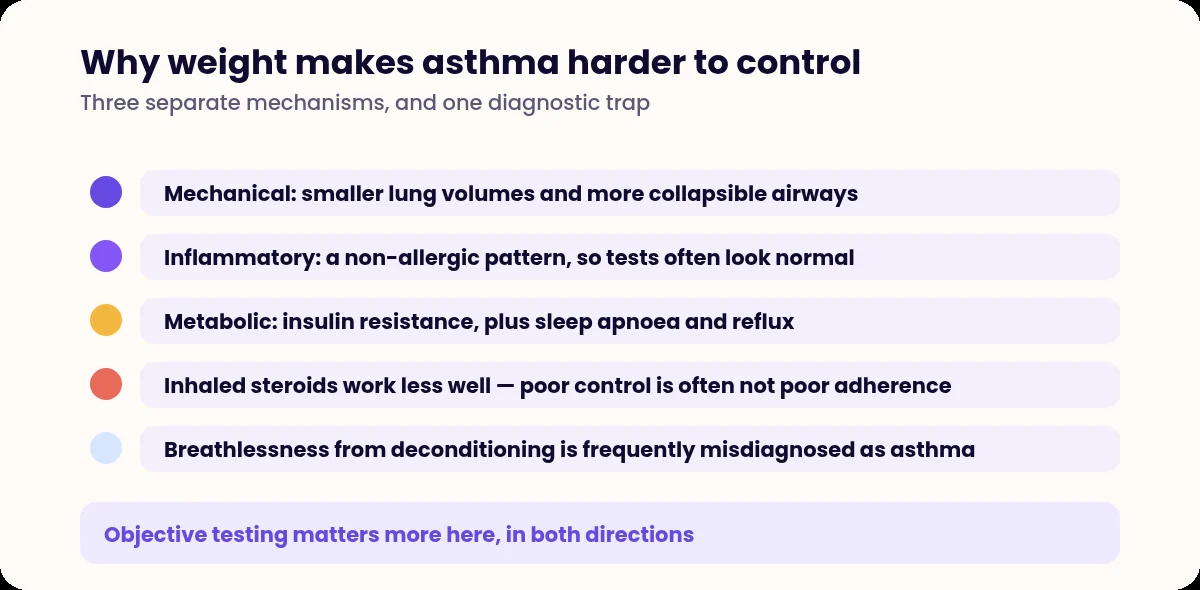
Three groups of mechanisms, and they overlap.
Mechanical. Excess adipose tissue on the chest wall and in the abdomen reduces functional residual capacity and expiratory reserve volume. Breathing happens at lower lung volumes, so the airway smooth muscle gets less tidal stretch. Muscle that is not periodically stretched becomes more prone to sustained narrowing, and the airways become more collapsible. This is genuine restriction of lung mechanics, and it produces breathlessness whether or not asthma is present.
Inflammatory. Adipose tissue releases IL-6, TNF-alpha and leptin. The resulting picture shifts away from Type 2 inflammation — the eosinophilic, allergy-driven pattern — toward a neutrophilic one.
Metabolic and comorbid. Insulin resistance is associated with worse lung function. Obstructive sleep apnoea and gastro-oesophageal reflux are both more common with obesity and both independently worsen asthma control. Untreated sleep apnoea in particular can look like poorly controlled asthma at night, and is covered in sleep apnoea and weight.
The point about FeNO, eosinophils and inhalers
This follows directly from the inflammatory mechanism and it matters clinically.
Because obesity-related asthma is often not Type 2, people frequently have low FeNO and low blood eosinophils despite genuinely poor control. Those two tests are the standard markers of Type 2 inflammation. A normal result in someone who is clearly struggling is easily read as “this is not really asthma” or, more often and more damagingly, as “you must not be taking your preventer”.
At the same time, obese adults and children show reduced responsiveness to inhaled corticosteroids. Inhaled steroids are most effective against Type 2 inflammation, and where that is not the dominant process they do less.
Put together: poor control in obesity is often not an adherence problem. It can be a pharmacological one. That does not mean adherence and inhaler technique should not be checked — they should, every time, because they are still the commonest reversible cause of poor control in everyone. It means that when they have been checked and are fine, the next step is not to assume the patient is not telling the truth.
Two phenotypes are usually distinguished: early-onset atopic asthma where obesity acts as an aggravator, and late-onset non-atopic asthma related to obesity itself. The second is the one where the pattern above is most pronounced.
The over-diagnosis problem
This is the finding that most surprises people.
Breathlessness on exertion, deconditioning and obesity-related restrictive physiology all produce symptoms that look like asthma. If a clinician hears “breathless walking up hills, better when I stop” and prescribes an inhaler, the label often sticks for years — and because a reliever inhaler can produce a subjective improvement in anyone who is anxious and breathless, the trial of treatment appears to confirm it.
Obesity is associated with over-diagnosis of asthma. The consequences are not trivial: unnecessary long-term inhaled corticosteroids, escalating treatment for a condition that is not responding because it is not there, and courses of oral steroids that carry their own weight and metabolic costs.
The answer is objective testing — spirometry with reversibility, FeNO, and peak flow variability — rather than symptoms alone. UK practice here is clear. The current UK standard is the joint BTS, NICE and SIGN asthma guideline NG245, published in November 2024, which replaced both the separate BTS/SIGN guideline and NICE NG80 [2]. If you were diagnosed on symptoms alone, particularly in adulthood and particularly alongside weight gain, it is reasonable to ask your GP practice whether objective testing has ever been done.
What weight loss does
Weight loss of 5% or more has been associated with significant improvements in asthma control, peak flow and spirometry. That is a small enough target to be realistic, and it puts asthma in the same category as several other conditions where a modest loss produces disproportionate benefit — the pattern described in obesity as a chronic disease.
Bariatric surgery cohorts report roughly a 60% reduction in exacerbation risk.
The asymmetry is worth flagging honestly. The strongest signal comes from uncontrolled surgical cohorts, where people who have surgery differ systematically from those who do not, and where nobody is blinded. Non-surgical weight loss trials are smaller, with more modest and less consistent effects. So the direction of benefit is well supported; the magnitude in someone losing weight through diet, activity or medication is less certain than the surgical figures suggest.
Exercise deserves a specific mention, because it is the thing people with breathlessness avoid. Deconditioning worsens exertional breathlessness, which reduces activity, which worsens deconditioning. Breaking that loop — gradually, with a reliever inhaler available and a plan agreed with your asthma clinician — improves both symptoms and weight. NHS guidance of 150 minutes of moderate activity a week is the destination, not the starting point [5].
If weight is affecting a long-term condition and you are unsure how to raise it, talking to your GP about weight covers how those conversations tend to go, including eligibility routes for treatment.
Practical steps
- Confirm the diagnosis. Ask whether spirometry, FeNO or peak flow variability were ever recorded. If not, ask for objective testing.
- Check for sleep apnoea and reflux. Both are common, both worsen control, and both are treatable.
- Do not assume treatment failure means you are doing it wrong. Have technique checked, then push for review rather than escalation by default.
- Aim for 5%. It is a meaningful target for asthma outcomes and an achievable one.
- Keep your reliever accessible when increasing activity, and agree a plan with your asthma review clinician first.
When to speak to a clinician
Arrange a review if you:
- have asthma symptoms that are not controlled despite regular preventer use — book a routine asthma review rather than increasing treatment yourself
- have needed two or more courses of oral steroids in a year, which warrants specialist referral consideration
- were diagnosed with asthma without objective testing, particularly as an adult
- snore heavily, wake unrefreshed, or have witnessed pauses in breathing, which may indicate sleep apnoea
Go to A&E or call 999 if you are too breathless to speak in full sentences, your reliever inhaler is not helping or is needed more than every four hours, your lips or fingers look blue, or you are exhausted from the effort of breathing [3].
Frequently asked questions
Does being overweight make asthma worse?
It is associated with worse symptom control, more exacerbations, more courses of systemic corticosteroids and worse quality of life. A meta-analysis of prospective studies also found a dose-response relationship with developing asthma in the first place, with odds of 1.5 in overweight and 1.9 in obesity compared with normal weight.
Why does my preventer inhaler not seem to work?
Obese adults and children show reduced responsiveness to inhaled corticosteroids. The inflammation in obesity-related asthma is often neutrophilic rather than Type 2, and inhaled steroids work best against Type 2 inflammation. Poor control in this setting is frequently not an adherence problem, though it is worth checking technique too.
Can asthma be misdiagnosed in people with obesity?
Yes, and it commonly is. Breathlessness on exertion from deconditioning, and obesity-related restrictive lung physiology, are frequently misattributed to asthma. Objective testing such as spirometry with reversibility, FeNO and peak flow variability is essential before accepting the label, and worth revisiting if you were diagnosed without it.
How much weight loss improves asthma?
Weight loss of 5% or more has been associated with significant improvements in asthma control, peak flow and spirometry. Bariatric surgery cohorts report roughly a 60% reduction in exacerbation risk, though those studies are uncontrolled and non-surgical trials show more modest and less consistent effects.
References
- Beuther DA, Sutherland ER. Overweight, obesity, and incident asthma: a meta-analysis of prospective epidemiologic studies. American Journal of Respiratory and Critical Care Medicine. 2007;175(7):661-666. doi.org/10.1164/rccm.200611-1717OC
- NICE, BTS and SIGN. Asthma: diagnosis, monitoring and chronic asthma management. NG245. November 2024. www.nice.org.uk/guidance/ng245
- NHS. Asthma. www.nhs.uk/conditions/asthma/
- NICE. Overweight and obesity management. NG246. January 2025. www.nice.org.uk/guidance/ng246
- NHS. Physical activity guidelines for adults aged 19 to 64. www.nhs.uk/live-well/exercise/physical-activity-guidelines-for-adults-
Medical reviewer
Naeem Teni
Clinical Lead at Manova. Registered pharmacist and independent prescriber, GPhC 2215591. Reviews Manova’s clinical content for accuracy and safety.
Written by
Manova Editorial Team
Researched and written to our editorial policy, using NICE, NHS, MHRA and peer-reviewed sources.
This article is for general information and isn’t a substitute for advice from your own clinician. If you feel unwell, contact your GP or NHS 111. In an emergency, call 999.