

Key takeaways
- The harmonised 2009 definition requires any three of five criteria, and waist measurement is no longer obligatory.
- NICE has no guideline on metabolic syndrome and does not use it as a management category; UK practice assesses cardiovascular risk with QRISK3 and diabetes risk with HbA1c.
- A joint ADA and EASD appraisal concluded the cardiovascular risk carried by the cluster is no greater than the sum of its parts, and advised clinicians to avoid labelling patients with the term.
- Treat the individual components. There is no separate treatment for the syndrome, because no unifying cause has been demonstrated.
Metabolic syndrome is one of the most widely used terms in health writing that has almost no formal standing in UK medicine. There is an NHS information page. There is no NICE guideline, and there never has been.
That gap is not an oversight. It reflects a long-running and largely European argument about whether the syndrome is a real clinical entity or a convenient name for several common risk factors that happen to travel together.
This page sets out the criteria, because they are useful, and then explains honestly why a UK clinician is unlikely to write the phrase in your notes.
The criteria
There is no UK-specific definition. Where the term is used, it defaults to the harmonised Joint Interim Statement published in 2009, agreed between several international bodies to end a decade of competing definitions [1].
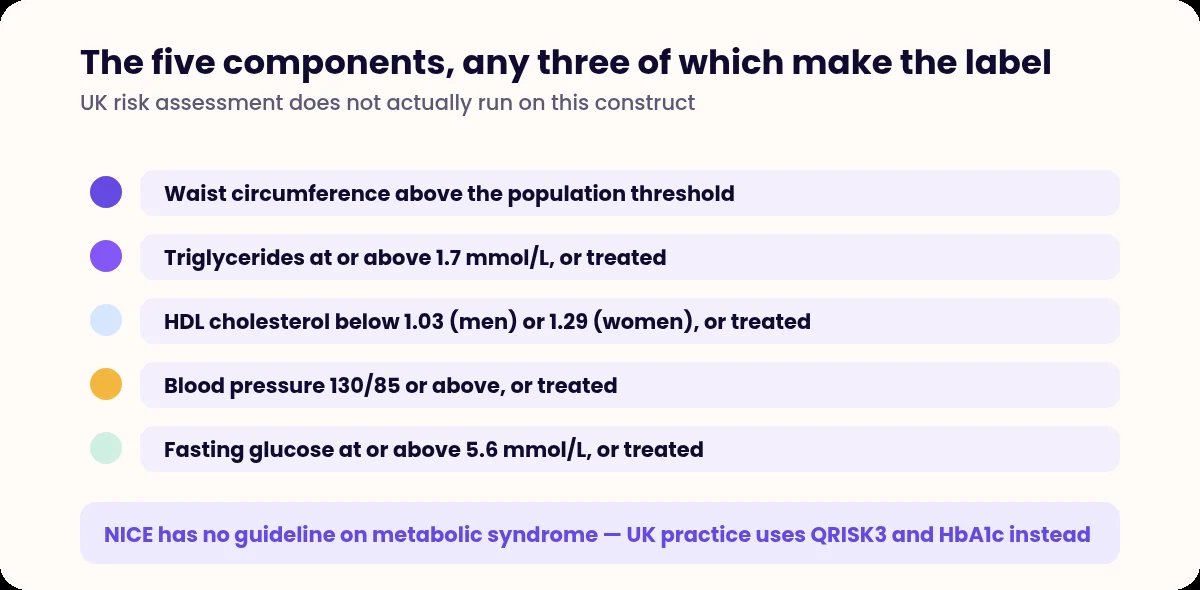
Any three of the following five. Waist circumference is no longer obligatory, which was the substantive change from the earlier IDF 2005 definition.
- Waist circumference of 94cm or more in men, 80cm or more in women, using the Europid cut points. The harmonised statement also permits 102cm and 88cm, which is a genuine source of disagreement between published prevalence figures
- Triglycerides of 1.7 mmol/L or above, or treatment for raised triglycerides
- HDL cholesterol below 1.03 mmol/L in men, below 1.29 mmol/L in women, or treatment
- Blood pressure of 130 systolic and/or 85 diastolic or above, or treatment for hypertension
- Fasting glucose of 5.6 mmol/L or above, or treatment for raised glucose
Note how many of those criteria can be met by taking a medicine for the problem. Someone whose blood pressure and lipids are well controlled on treatment still counts. That is deliberate, and it is also one of the reasons the label behaves oddly.
What the NHS actually says
The NHS page on metabolic syndrome is short and unusually non-committal. It gives no numeric thresholds, states that the cause is “not known”, and says treatment “usually involves making changes to your lifestyle” [2]. It was last reviewed in November 2023.
Compare that with the NHS pages on high blood pressure or type 2 diabetes, which are full of numbers, and the difference in confidence is obvious.
NICE has no guideline on metabolic syndrome and does not use it as a management category. UK cardiovascular risk is assessed with QRISK3, which estimates ten-year risk from age, sex, ethnicity, deprivation, smoking, blood pressure, cholesterol ratio, BMI, family history and a list of relevant conditions [6]. Diabetes risk is assessed with HbA1c, or fasting glucose where HbA1c is unreliable.
This is the single most important divergence between UK and US practice on this topic. American material treats metabolic syndrome as a diagnosis. UK practice treats the underlying numbers and skips the label.
Why the label fell out of favour
Two papers, both from 2005, did most of the damage, and neither has been convincingly answered.
The joint ADA and EASD appraisal [3] made four findings that still stand:
- The criteria are ambiguous and arbitrary — the choice of thresholds, and which factors were included, was not derived from evidence about combined risk
- The cardiovascular risk associated with the cluster is no greater than the sum of its parts. Having three factors is not worse than having those three factors
- The treatment is no different from treating each factor individually
- Clinicians should “avoid labelling patients with the term metabolic syndrome”
Edwin Gale’s paper, bluntly titled “The myth of the metabolic syndrome” [4], argued that the construct had no agreed definition, no demonstrated unifying cause and no distinct treatment, and that a syndrome without those three things is a name rather than a disease.
There is a further detail worth knowing. Gerald Reaven, who originated the concept as “Syndrome X” in 1988, later rejected the diagnostic construct that grew out of it. He continued to argue that insulin resistance was important. He stopped arguing that it should be packaged as a syndrome with a checklist.
Is the criticism fair?
Partly. The cluster is real in the sense that these factors genuinely do co-occur more often than chance, and knowing that is useful. If someone has a raised waist measurement, it is sensible to check their blood pressure, lipids and glucose rather than any one of them in isolation.
What does not follow is that the co-occurrence constitutes a disease with its own prognosis and its own treatment. A teaching heuristic is not a diagnosis.
How common is it
This is where you should be most suspicious of confident numbers.
A 2025 global modelling study using the harmonised criteria estimated that prevalence rose from 11.9% to 28.4% between 2000 and 2023, affecting around 1.54 billion adults, with 2023 estimates in high-income Western populations of 38.0% in women and 45.9% in men [5]. Those figures are modelled, not measured, and they inherit every uncertainty in the underlying surveys.
There is no current Health Survey for England figure for metabolic syndrome specifically. Any article that tells you what percentage of UK adults have it is extrapolating, usually from data collected elsewhere, and often without saying which waist threshold was used. Switching between the 94/80 and 102/88 cut points alone moves prevalence substantially.
What to do with the individual numbers
If you have been told you meet several of these criteria, the useful response is to treat them as separate pieces of information rather than a single verdict.
- Waist. Waist to height ratio is the measure with the better UK evidence base, and it is easier to interpret than an absolute centimetre threshold across different heights and ethnic groups
- Glucose. A fasting glucose of 5.6 mmol/L or above sits in the range covered by prediabetes and weight, and HbA1c is the test your GP will use
- Blood pressure and lipids. Both respond to weight loss, and both have their own evidence base — see weight loss and blood pressure and weight loss and cholesterol
- The underlying physiology. Insulin resistance explained covers what most of these criteria are indirectly pointing at, and why it is not measured routinely either
Weight reduction improves all five components, which is the practical reason the cluster matters even if the label does not. Where weight loss is clinically indicated, the options range from structured dietary and activity change to weight loss medicines and surgery, and which of those is appropriate is a matter for assessment rather than self-diagnosis.
What has replaced it
Two newer frameworks have more momentum than metabolic syndrome, though neither has been adopted in NICE guidance as of late 2026.
The American Heart Association published cardiovascular-kidney-metabolic staging in 2023, which treats cardiac, renal and metabolic dysfunction as one continuum with defined stages rather than a yes-or-no cluster. The Lancet Commission on Clinical Obesity, published in January 2025, proposed distinguishing preclinical obesity from clinical obesity on the basis of demonstrated organ dysfunction rather than BMI alone [7]. That is a more useful question than whether someone ticks three boxes out of five.
When to speak to a clinician
- A fasting glucose of 5.6 mmol/L or above, or an HbA1c in the prediabetes range — ask for a repeat and a risk discussion
- Blood pressure readings persistently at or above 140/90 at home, or any single reading above 180/120, which needs same-day assessment
- Chest pain, breathlessness on mild exertion or new leg swelling — arrange urgent assessment, and call 999 for chest pain that is severe or persists at rest
- Before starting any weight loss medicine, if you already take treatment for blood pressure, lipids or diabetes
Frequently asked questions
What are the criteria for metabolic syndrome?
Under the 2009 harmonised definition, any three of five: raised waist circumference, triglycerides of 1.7 mmol/L or above, HDL cholesterol below 1.03 mmol/L in men or 1.29 in women, blood pressure of 130 systolic and/or 85 diastolic or above, and fasting glucose of 5.6 mmol/L or above. Treatment for any of these counts towards the total.
Does the NHS diagnose metabolic syndrome?
Not as a management category. NHS.uk has an information page but gives no numeric thresholds, and NICE has never published a guideline on it. UK cardiovascular risk assessment uses QRISK3, and diabetes risk uses HbA1c or fasting glucose. You are far more likely to be told you have raised blood pressure and prediabetes than to be given the syndrome label.
Is metabolic syndrome more dangerous than its individual parts?
A joint statement from the American Diabetes Association and the European Association for the Study of Diabetes concluded that it is not, and that the risk associated with the cluster is no greater than the sum of its components. That finding is the main reason the construct fell out of favour in UK practice.
How is metabolic syndrome treated?
Each component is treated on its own terms: blood pressure lowering, lipid management, glycaemic assessment, and weight reduction where relevant. There is no distinct treatment for the syndrome as an entity, which was one of the original criticisms of the concept.
References
- Alberti KGMM, Eckel RH, Grundy SM, et al. Harmonizing the metabolic syndrome: a joint interim statement. Circulation. 2009;120(16):1640-1645. doi.org/10.1161/CIRCULATIONAHA.109.192644
- NHS. Metabolic syndrome. www.nhs.uk/conditions/metabolic-syndrome/
- Kahn R, Buse J, Ferrannini E, Stern M. The metabolic syndrome: time for a critical appraisal. Diabetes Care. 2005;28(9):2289-2304. doi.org/10.2337/diacare.28.9.2289
- Gale EAM. The myth of the metabolic syndrome. Diabetologia. 2005;48(9):1679-1683. doi.org/10.1007/s00125-005-1873-5
- Hua J, et al. Global, regional and national burden of metabolic syndrome, 2000-2023. Nature Communications. 6 December 2025. www.nature.com/ncomms/
- NICE. Cardiovascular disease: risk assessment and reduction, including lipid modification. CG181. www.nice.org.uk/guidance/cg181
- Rubino F, et al. Definition and diagnostic criteria of clinical obesity. Lancet Diabetes & Endocrinology Commission. January 2025. doi.org/10.1016/S2213-8587(24)00316-4
Medical reviewer
Naeem Teni
Clinical Lead at Manova. Registered pharmacist and independent prescriber, GPhC 2215591. Reviews Manova’s clinical content for accuracy and safety.
Written by
Manova Editorial Team
Researched and written to our editorial policy, using NICE, NHS, MHRA and peer-reviewed sources.
This article is for general information and isn’t a substitute for advice from your own clinician. If you feel unwell, contact your GP or NHS 111. In an emergency, call 999.