

Key takeaways
- Insulin resistance is a reduced tissue response to insulin, compensated by higher insulin output until the pancreas can no longer keep up.
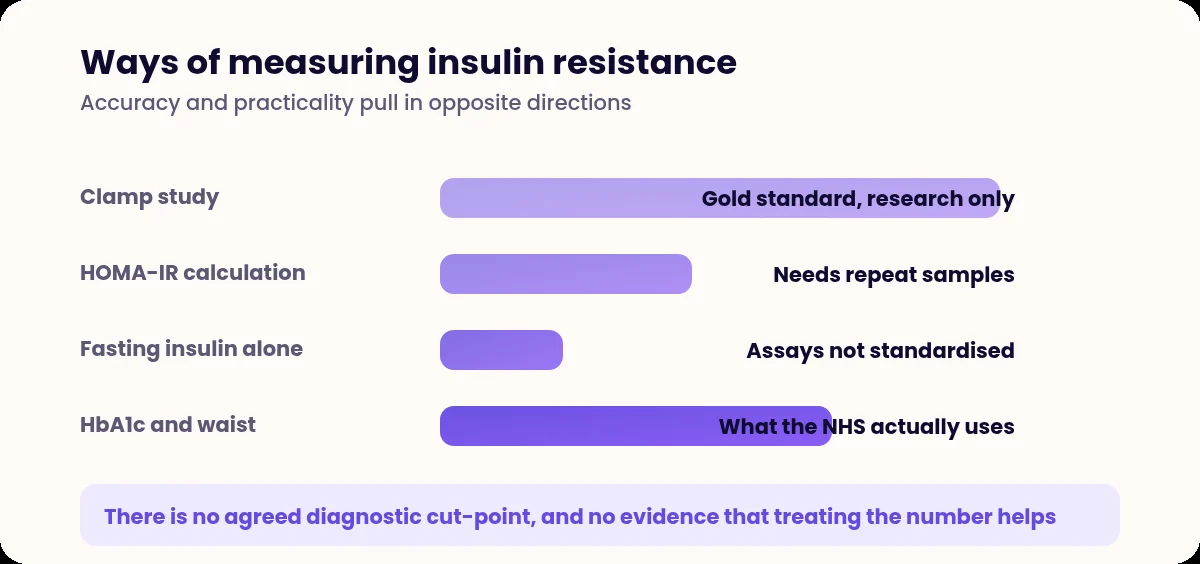
- HOMA-IR is not an NHS test because insulin assays are not standardised between laboratories, single samples are biologically noisy, there is no agreed cut-point, and no evidence that treating the number improves outcomes.
- The causal link to visceral fat is weaker than commonly stated; fat inside the liver and pancreas is the better-supported modern explanation.
- Sustained weight loss is the strongest lever, and the UK DiRECT trial showed 46% remission of type 2 diabetes at one year in primary care.
Insulin resistance is a reduced response of muscle, liver and fat tissue to insulin. The pancreas compensates by producing more, which keeps blood glucose in range for years. The problem becomes visible when that compensation starts to fail.
That is the whole mechanism in two sentences, and almost everything contested about the subject sits downstream of it: how you measure it, what causes it, and whether a number is worth chasing.
It is not one thing
Insulin resistance is tissue-specific, and the parts can behave independently. Resistance in the liver shows up mainly as a raised fasting glucose, because the liver keeps releasing glucose overnight when it should have stopped. Resistance in skeletal muscle shows up mainly as a raised glucose after a meal or glucose load, because muscle is the main destination for glucose after eating.
Those two can be dissociated in the same person. Someone can have a normal fasting glucose and an abnormal post-load result, or the reverse. A single number does not capture that, which is the first practical reason to be cautious about scores.
How it is measured, and why not on the NHS
The gold standard is the hyperinsulinaemic-euglycaemic clamp, described in 1979 [7]. Insulin is infused at a fixed rate while glucose is infused at whatever rate is needed to hold blood glucose steady; the glucose infusion rate is the measure of sensitivity. It takes three to four hours, requires two cannulae and constant supervision, and exists only in research settings.
HOMA-IR was published in 1985 as a practical alternative [1]. The original formula is fasting insulin in mU/L multiplied by fasting glucose in mmol/L, divided by 22.5, calibrated so that a healthy young normal-weight adult scores about 1.0. HOMA2 is the correctly solved non-linear version of the same model. HOMA1 and HOMA2 are not interchangeable, and a great deal of online material quietly conflates them.
The authors’ own warnings
In 2004 the original authors published a paper called “Use and Abuse of HOMA Modeling” [2]. It is the clearest single explanation of why this is not a routine NHS test.
- Insulin immunoassays are not standardised between laboratories. A value produced by one lab is not directly comparable with a value from another. This alone undermines the idea of a universal cut-point
- Biological variability is substantial. The coefficient of variation is around 10.3% on a single sample, falling to 5.8% with three. The authors advise triplicate sampling when assessing an individual, and consider single samples adequate only for population estimates
- It is invalid in anyone on injected insulin, and unreliable in advanced beta-cell failure
- The distribution is not normal, so it requires log transformation before statistical use
- There is no agreed diagnostic cut-point
To which UK practice adds two more: NHS laboratories largely do not offer fasting insulin outside specialist endocrine indications, and there is no evidence that treating a HOMA-IR number improves outcomes over treating HbA1c, blood pressure, lipids and weight.
What the NHS measures instead
- HbA1c, and fasting or oral glucose tolerance testing where indicated
- Waist circumference, and increasingly waist to height ratio
- The triglyceride to HDL ratio, a crude but cheap proxy visible on any lipid panel
- ALT and liver imaging where fatty liver is suspected
- Acanthosis nigricans, the velvety darkening in skin folds, which is a clinical sign rather than a test
The commercial flag
HOMA-IR, fasting insulin panels and “metabolic age” scores are marketed heavily by UK private testing companies. The clinical utility claim behind them is not supported by NICE or Diabetes UK.
That does not mean the biology is fake. It means that paying for a single fasting insulin sample, from a laboratory whose assay is not comparable with anyone else’s, against a cut-point nobody has agreed, is unlikely to change what you should do next. If the result would lead you to lose weight, move more and sleep better, you can do those things without the result.
The visceral fat story is weaker than you have been told
The standard explanation runs: fat around the organs releases free fatty acids directly into the portal vein, the liver is exposed to them first, and insulin resistance follows.
That hypothesis has been challenged for a quarter of a century. A review by Keith Frayn asked directly whether the link was causative or correlative and concluded there was no proof of a causal link [3]. The argument is largely arithmetic: the visceral depot is several times smaller than subcutaneous abdominal fat, which probably drives the great majority of circulating non-esterified fatty acids. A small depot cannot easily be responsible for a systemic effect that a much larger one is better placed to produce.
The better-supported modern view is about ectopic fat rather than visceral volume as such: triacylglycerol accumulating inside the liver and inside the pancreas, where it does not belong. Roy Taylor’s twin cycle hypothesis describes a self-reinforcing loop between hepatic fat, insulin resistance and pancreatic fat that can be broken by sufficient weight loss [4]. That framing also explains why liver fat falls early and dramatically during weight loss, often before much weight has gone.
Visceral fat and fatty liver and weight loss cover both sides of this in more detail.
What actually improves it
Energy deficit and weight loss are the strongest lever, by a distance. The UK DiRECT trial randomised 298 people in primary care and reported 46% remission of type 2 diabetes at 12 months versus 4%, and 36% versus 3% at two years with a mean loss of 7.6kg. The five-year extension reported 13% in remission overall, 34% in the extension group against 12%, and 5% in controls [5]. The authors identified sustained weight loss as the dominant driver of remission.
That programme is now delivered in England as the NHS Type 2 Diabetes Path to Remission Programme [6], which is a genuine UK innovation with no US equivalent. Type 2 diabetes remission covers eligibility and what it involves.
Exercise improves insulin sensitivity partly independently of weight loss, largely through glucose uptake routes that do not require insulin. The important practical detail is that the effect largely dissipates within about 48 to 72 hours of the last session. Frequency matters more than intensity. Three moderate sessions across a week beat one heroic one.
Sleep restriction measurably reduces insulin sensitivity in experimental studies, which is one of the few short-term levers that works in the wrong direction overnight. See sleep and weight loss.
Some medicines used for glycaemic control in type 2 diabetes improve hepatic insulin sensitivity, but they are licensed for blood glucose control, not for “insulin resistance” as a diagnosis. Weight loss medicines improve insulin sensitivity largely through the weight lost.
Weak or contested: specific macronutrient ratios independent of overall energy balance; and berberine, inositol, chromium and cinnamon, where the trials are small, short, poorly controlled and often funded by people selling the product.
When to speak to a clinician
- An HbA1c in the prediabetes or diabetes range, or a fasting glucose of 5.6 mmol/L or above
- Excessive thirst, passing large volumes of urine, unexplained weight loss or blurred vision — arrange a same-week GP appointment
- Raised ALT on a blood test, or fatty liver found incidentally on a scan
- Before paying for a private insulin resistance panel, it is worth asking your GP what they would do differently with the result
Frequently asked questions
Can I get tested for insulin resistance on the NHS?
Not usually. Fasting insulin is not offered routinely outside specialist endocrine indications, and there is no NHS test called an insulin resistance test. The NHS assesses the same underlying problem through HbA1c, fasting or post-load glucose, waist measurement, the triglyceride to HDL ratio and liver enzymes.
Is HOMA-IR accurate?
It is a useful research tool and a poor individual diagnostic. Insulin immunoassays are not standardised between laboratories, so a value from one lab cannot be compared with another's. Biological variation is around 10% on a single sample, falling to under 6% with three, which is why the authors advise triplicate sampling for individuals.
What is a normal HOMA-IR?
There is no agreed diagnostic cut-point. The original model was calibrated so that a healthy young normal-weight adult scores around 1.0, but that is a calibration reference rather than a threshold, and HOMA1 and HOMA2 are not interchangeable. Any company quoting a firm normal range is going beyond the evidence.
Can insulin resistance be reversed?
It improves substantially with sustained weight loss, and the UK DiRECT trial showed 46% of participants in remission from type 2 diabetes at one year compared with 4% of controls. Exercise improves insulin sensitivity partly independently of weight, but the effect largely fades within two to three days of the last session.
References
- Matthews DR, Hosker JP, Rudenski AS, et al. Homeostasis model assessment. Diabetologia. 1985;28(7):412-419. doi.org/10.1007/BF00280883
- Wallace TM, Levy JC, Matthews DR. Use and abuse of HOMA modeling. Diabetes Care. 2004;27(6):1487-1495. doi.org/10.2337/diacare.27.6.1487
- Frayn KN. Visceral fat and insulin resistance: causative or correlative? British Journal of Nutrition. 2000;83(Suppl 1):S71-S77. doi.org/10.1017/S0007114500000982
- Taylor R, Al-Mrabeh A, Sattar N. Understanding the mechanisms of reversal of type 2 diabetes. Cell Metabolism. 2018;28(4):547-556. doi.org/10.1016/j.cmet.2018.07.003
- Lean MEJ, Leslie WS, Barnes AC, et al. 5-year follow-up of the DiRECT trial. Lancet Diabetes & Endocrinology. April 2024. doi.org/10.1016/S2213-8587(24)00074-3
- NHS England. NHS Type 2 Diabetes Path to Remission Programme. www.england.nhs.uk/diabetes/treatment-care/diabetes-remission/
- DeFronzo RA, Tobin JD, Andres R. Glucose clamp technique. American Journal of Physiology. 1979;237(3):E214-223. doi.org/10.1152/ajpendo.1979.237.3.E214
Medical reviewer
Naeem Teni
Clinical Lead at Manova. Registered pharmacist and independent prescriber, GPhC 2215591. Reviews Manova’s clinical content for accuracy and safety.
Written by
Manova Editorial Team
Researched and written to our editorial policy, using NICE, NHS, MHRA and peer-reviewed sources.
This article is for general information and isn’t a substitute for advice from your own clinician. If you feel unwell, contact your GP or NHS 111. In an emergency, call 999.