

Key takeaways
- No model of body weight regulation is established; the researchers who reviewed them concluded that further experiments to distinguish between the models are sorely required.
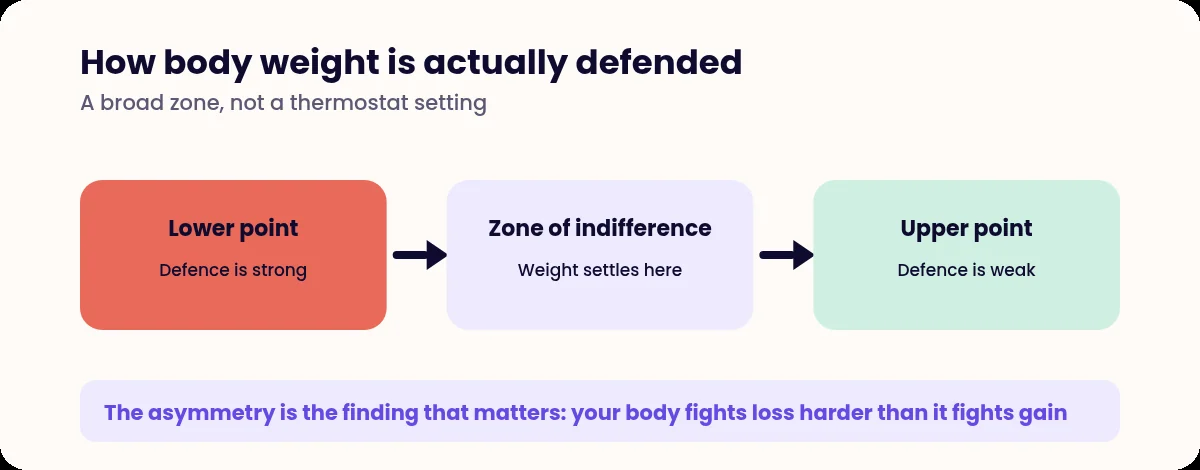
- The dual intervention point model is the most defensible: a broad zone where weight settles passively, bounded by points at which physiology actively engages.
- Defence is asymmetric. The body resists weight loss strongly and weight gain weakly, which is why the range drifts upward over time in an environment of abundant food.
- The defended range moves with prolonged exposure to a new environment, so it is a biased range rather than a fixed value you cannot escape.
Ask why weight tends to return after a diet and you will usually be told about a set point: a weight your body has decided on and will defend, like a thermostat returning a room to twenty degrees.
The observation behind that is real. The mechanism it describes is probably wrong, or at least is only one of several competing models, none of which has been established. The best available synthesis, from researchers at Aberdeen and the US National Institutes of Health, ends with the sentence that “further experiments to test between the models are sorely required” [1].
That honesty is worth passing on, because the popular version of set point theory has hardened into something the evidence does not support and that actively discourages people.
The competing models
Set point. A single defended reference value, monitored and corrected like a thermostat. Intuitive, and the origin of the phrase.
Dynamic equilibrium. The most deflationary option: apparent regulation is largely an illusion produced by the unavoidable rise in energy expenditure as body mass increases. A bigger body costs more to run, so intake and expenditure re-balance without anything actively defending a target.
Settling point and control theory. These treat set point and dynamic equilibrium as opposite ends of a feedback-gain continuum rather than rival explanations. High gain looks like a thermostat; low gain looks like passive settling.
The dual intervention point model. A broad zone of indifference within which weight settles passively according to environment and behaviour, bounded by an upper and a lower intervention point at which physiology actively engages.
There are others, including the Hall-Guo and operation point models. The field is genuinely unresolved.
Why the dual intervention point model fits best
Its main advantage is that it explains the asymmetry, which the strict set point model does not.
Defence against weight loss is strong. Falling energy stores trigger increased hunger, reduced energy expenditure and a set of hormonal changes that all argue for eating more. This is well documented, both in the appetite hormone literature [2] and in measurements of energy expenditure after weight loss [4].
Defence against weight gain is weak. Overfeed people and the compensatory response is modest and inconsistent. If there were a thermostat, it would work in both directions with similar force. It does not.
A single defended value cannot produce that pattern. A zone with a firm lower boundary and a soft upper one can, and it also explains why average weights across whole populations have drifted upward over decades: in an environment where food is abundant, cheap and engineered to be easy to overconsume, weight rises within the zone until it eventually pushes the zone itself upward. The upper boundary is not doing much work.
What the evidence actually supports
Three statements can be made with reasonable confidence.
- Body weight is defended, but asymmetrically and imperfectly. Not a thermostat. A biased range
- The defended range moves with prolonged exposure to a new environment. It is not a constant set in childhood
- No model is established. Anyone telling you definitively how body weight regulation works is ahead of the literature
What should not be said
Do not write, and do not believe, that you have a fixed set point you cannot escape. It is unsupported, and it is demoralising in a way that has real consequences. People who believe their weight is biologically fixed are less likely to attempt change, less likely to persist, and more likely to interpret ordinary fluctuation as proof of futility.
The evidence says the headwind is real. It does not say the destination is fixed.
How this squares with people who do maintain
If weight is defended, how do some people keep it off?
Defence is a persistent headwind, not a ceiling. Maintenance correlates with continued behavioural effort, continued structural support, or continued treatment through pharmacotherapy or surgery. What it does not correlate with is having found a way to switch the biology off.
The most cited evidence here is the US National Weight Control Registry, roughly 10,000 people who have maintained a loss of at least 13.6kg for at least a year [3]. It is often quoted as though it settles the question. It should be flagged carefully: it is self-selected, self-reported, US-only, and has no UK equivalent. It tells you that sustained maintenance is possible. It cannot tell you how common it is, because the people who did not maintain never joined.
The practical version of all this is in keeping weight off: maintenance is a distinct activity with its own requirements, not the absence of dieting.
What this means when you are actually losing weight
A plateau is not the system winning. It is usually a combination of the obligatory fall in energy expenditure as body mass drops, some degree of metabolic adaptation, and a quiet drift upward in intake. Metabolic adaptation separates those components and puts realistic numbers on each, and weight loss plateau covers what to do about it.
Hunger increasing as you succeed is expected. The appetite signalling changes described in appetite hormones explained are exactly what the dual intervention point model would predict at the lower boundary.
The range moves slowly. That argues for durable changes to the environment you live in — what is in the house, how the working day is structured, how much walking is built in rather than added on — over short interventions that end.
Continued support is not a sign of failure. Whether that support is a structured programme, ongoing clinical review, weight loss medicines or surgery, the logic is the same: something has to keep pushing against a persistent headwind. NICE guidance on obesity management is built around long-term follow-up rather than one-off intervention [5].
The honest summary
Your body will resist weight loss, more than it resisted the weight gain. That resistance is real, measurable and does not politely fade after a few months.
It is also not absolute, not the same in everyone, and not a fixed number written into you at birth. The most defensible reading of the evidence is a broad, movable, asymmetrically defended range — which is a far more workable thing to be told than a thermostat you cannot reach.
When to speak to a clinician
- Weight regain that is accompanied by low mood, hopelessness or loss of interest in things you used to enjoy
- Any pattern of restriction, bingeing or compensatory behaviour — ask your GP about eating disorder services
- Unintentional weight loss, which always needs assessment
- If you have lost weight repeatedly and regained it, a conversation about long-term maintenance support is more useful than another short programme
Frequently asked questions
Is set point theory true?
Partly. Body weight is clearly defended against change, which is the observation set point theory was built to explain. But the strict version, a single reference value held by a thermostat-like mechanism, is not the best fit for the evidence. The dual intervention point model, describing a broad range bounded by upper and lower limits, explains more of what is actually observed.
Can you change your set point?
The defended range appears to move with prolonged exposure to a new environment and new behaviours, which is why populations have got heavier over decades rather than everyone returning to a fixed value. That is a slow process and not one you can dial in, but it is not a locked setting either.
Why is it easier to gain weight than lose it?
Because the defence is asymmetric. Falling energy stores trigger strong compensatory responses through appetite and energy expenditure; rising stores trigger comparatively weak ones. That asymmetry has an obvious evolutionary logic and it is one of the best-supported observations in this field.
Does this mean maintaining weight loss is impossible?
No. Defence is a persistent headwind rather than a ceiling. Sustained maintenance is consistently associated with continued behavioural effort, structural support, or continued treatment. The people who maintain are not the ones who found a way to switch the biology off; they are the ones who kept working against it.
References
- Speakman JR, Hall KD. Models of body weight and fatness regulation: what the evidence tells us. Philosophical Transactions of the Royal Society B. 2023;378:20220231. doi.org/10.1098/rstb.2022.0231
- Sumithran P, Prendergast LA, Delbridge E, et al. Long-term persistence of hormonal adaptations to weight loss. New England Journal of Medicine. 2011;365(17):1597-1604. doi.org/10.1056/NEJMoa1105816
- National Weight Control Registry. Research findings. http://www.nwcr.ws/research/
- Fothergill E, Guo J, Howard L, et al. Persistent metabolic adaptation 6 years after The Biggest Loser competition. Obesity. 2016;24(8):1612-1619. doi.org/10.1002/oby.21538
- NICE. Overweight and obesity management. NG246. www.nice.org.uk/guidance/ng246
- NHS. Obesity. www.nhs.uk/conditions/obesity/
Medical reviewer
Naeem Teni
Clinical Lead at Manova. Registered pharmacist and independent prescriber, GPhC 2215591. Reviews Manova’s clinical content for accuracy and safety.
Written by
Manova Editorial Team
Researched and written to our editorial policy, using NICE, NHS, MHRA and peer-reviewed sources.
This article is for general information and isn’t a substitute for advice from your own clinician. If you feel unwell, contact your GP or NHS 111. In an emergency, call 999.