

Key takeaways
- Implant surgery destroys the erectile tissue: after a device is removed, natural erections and every other ED treatment are permanently lost.
- Reported satisfaction is high — 92 to 100 per cent of patients in European data — but comes largely from specialist high-volume centres.
- Infection occurs in roughly 2 to 3 per cent of first implants and usually means removing the whole device.
- Around 87 per cent of devices are still working mechanically at five years and around 77 per cent at ten.
A penile implant is a device surgically placed inside the penis to produce rigidity on demand. It is the most effective treatment for erectile dysfunction by almost every measure reported, and it is the only one that cannot be undone.
Those two sentences belong together. Men researching implants find the satisfaction figures first, and they are genuinely striking. The permanence is the part that deserves equal weight in the decision.
Why it is irreversible
To place the cylinders, the surgeon dilates the corpora cavernosa — the two chambers of spongy tissue that normally fill with blood. That dilation destroys the erectile tissue itself.
The consequence is absolute: if the device is ever removed, natural erections do not return, and PDE5 inhibitor tablets, injections and vacuum devices will no longer work either [1]. There is no going back to an earlier rung of the ladder. This is why every guideline places implants last, after oral treatment, injections and vacuum devices have been properly tried.
It is also why the surgery is not something to arrange quickly. A man who has not had an adequate trial of first-line treatment is not ready for this conversation — our guide to what to do when ED treatment is not working explains what an adequate trial actually means, and a surprising proportion of apparent failure turns out to be correctable.
The two types
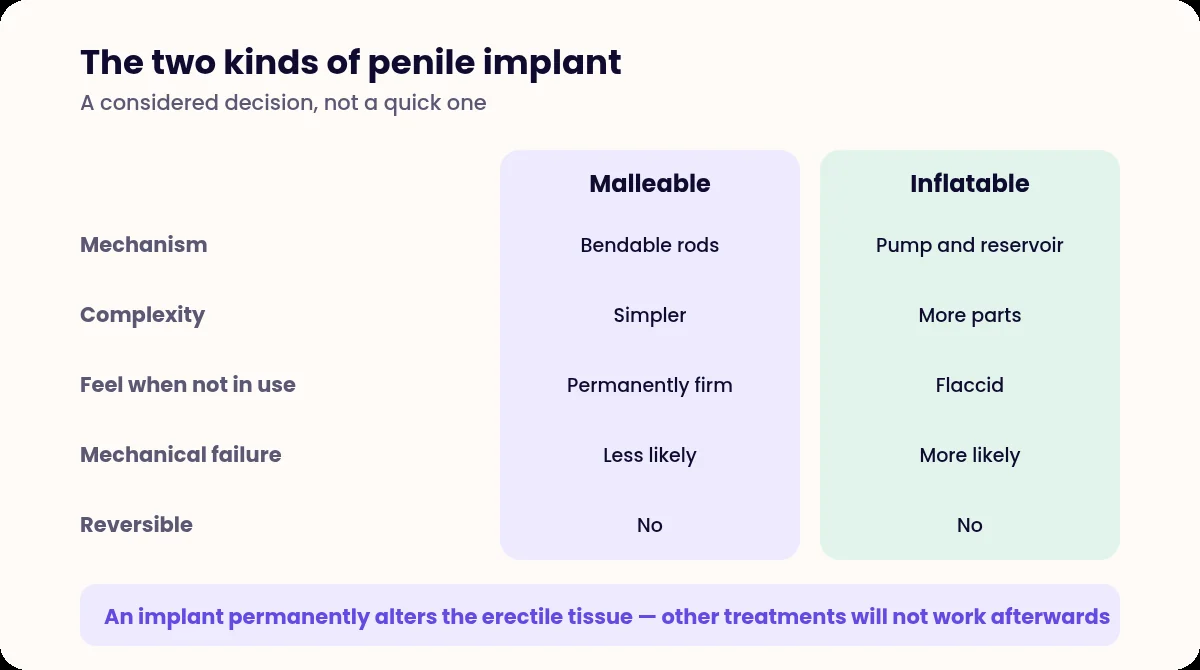
Malleable, or semi-rigid, implants are two bendable rods placed inside the corpora. The penis is permanently semi-firm and is bent up for sex and down the rest of the time. The surgery is simpler, there are no moving parts to fail, and the device costs less. The drawbacks are concealment and the permanently firm state, which some men and partners find difficult.
Inflatable implants, usually three-piece, consist of two cylinders in the penis, a small pump placed in the scrotum, and a fluid reservoir behind the pubic bone. Squeezing the pump moves fluid into the cylinders to produce an erection, and a release valve returns it. This gives much more natural flaccid and erect states and is what most men choose where it is offered. The cost is complexity: more components, more that can fail mechanically, and a slightly larger operation.
Two-piece inflatable devices exist and are occasionally used where a retropubic reservoir is unwise, such as after certain abdominal surgery.
Who is a candidate
Implants are considered for men who have failed or cannot tolerate oral treatment, injections and vacuum devices; men with severe scarring of the erectile tissue; erectile dysfunction after priapism; and selected men after prostate surgery or with Peyronie’s disease. Our guides to erectile dysfunction after prostate surgery and Peyronie’s disease cover those contexts.
British guidance sets out prerequisites before surgery [2]:
- Medically fit for an operation.
- Stopping smoking.
- BMI below 30.
- Acceptable glycaemic control, measured by HbA1c.
Those are not arbitrary hurdles. Diabetes is the single biggest risk factor for device infection, and infection is the complication that costs a man the device permanently.
The numbers
Satisfaction. European guidance reports 92–100% of patients and 91–95% of partners satisfied; a UK series of 434 implants reported 89% [1, 2]. These are the highest satisfaction figures in the erectile dysfunction literature.
They also need a caveat that is rarely printed alongside them. The data come largely from single-centre, high-volume surgical series where patients are carefully selected and the surgeon does a great many of these operations. The true figure across unselected practice is lower. That does not undermine the finding, but it does mean the choice of centre matters.
Infection. Roughly 2–3% for a first implantation in low-risk men, falling to 1–2% with antibiotic-impregnated devices [1]. British guidance gives 2–4% in high-volume centres [2]. Risk is higher in men with diabetes, in revision surgery and after spinal injury. Infection almost always means removing the whole device, and because the erectile tissue is already lost, that is a serious outcome rather than a setback.
Mechanical survival, from European data [1]:
| Time since surgery | Devices still working |
|---|---|
| 1 year | 93.3% |
| 3 years | 91.0% |
| 5 years | 87.2% |
| 10 years | 76.8% |
| 15 years | 63.7% |
| 20 years | 52.9% |
A man having an implant in his fifties should expect the possibility of revision surgery in his lifetime. Manufacturers provide mechanical-failure warranties, and it is a fair question to ask about at consultation.
What to expect practically
The penis after an implant is typically slightly shorter than at its best natural erection, which is one of the commonest sources of disappointment and should be discussed explicitly beforehand. Sensation, orgasm and ejaculation are not affected by the device — the nerves and the urethra are untouched — so a man who could ejaculate before should still be able to. The device produces rigidity, nothing else.
Inflatable devices take practice to operate, and most centres teach activation at a follow-up appointment a few weeks after surgery once the tissues have settled.
The UK route
Referral is through a GP to urology or andrology. It is not a direct-access or online treatment, and no legitimate service offers it without secondary care assessment.
Penile prosthesis surgery is NHS-funded but rationed. It is commissioned through specialist centres, and access depends on local commissioning policy or an individual funding request. There is no single national NHS England commissioning policy for penile prosthesis, so what is available varies markedly by region and waiting times are long [1, 2]. Anyone being told “it’s available on the NHS” without qualification is being told something too simple to be useful — the honest answer is that it depends where you live.
It is also available privately, at significant cost, and the same questions apply: how many of these does the surgeon do a year, which device, what is the warranty, and what happens if it becomes infected.
When to raise it
The right moment is after a genuine trial of the less invasive options, not before. If you have worked through those and they have not given you something you can live with, ask your GP for a referral to urology or andrology and say plainly that you want to discuss a prosthesis. Our overview of ED treatments compared sets out what should have come first.
Frequently asked questions
Can a penile implant be reversed?
No. Placing the cylinders requires dilating the corpora cavernosa, which destroys the spongy erectile tissue. If the device is later removed because of infection or failure, natural erections do not return, and tablets, injections and vacuum devices will no longer work either. This is the reason it sits last in the treatment pathway.
How satisfied are men with implants?
European guidance reports 92 to 100 per cent patient satisfaction and 91 to 95 per cent partner satisfaction, and a UK series of 434 implants reported 89 per cent. Those figures come mostly from single-centre, high-volume surgical practices with selected patients, so the realistic figure in unselected practice is somewhat lower.
What happens if the implant gets infected?
Infection is reported in about 2 to 3 per cent of first implantations in low-risk men, and 1 to 2 per cent with antibiotic-impregnated devices. It usually means the entire device has to be removed. Diabetes with poor glycaemic control, revision surgery and spinal injury all raise the risk, which is why fitness criteria are applied before surgery.
Can I get a penile implant on the NHS?
It is NHS-funded but rationed, through specialist urology and andrology centres, with access depending on local commissioning policy or individual funding. There is no single national England-wide policy, so availability and waiting times vary markedly by region. Referral comes through a GP to urology or andrology, not directly.
References
- European Association of Urology. Guidelines on Sexual and Reproductive Health: Management of Erectile Dysfunction. uroweb.org/guidelines/sexual-and-reproductive-health/chapter/managemen
- British Society for Sexual Medicine. Guidelines on the management of erectile dysfunction in men (2018). bssm.org.uk/wp-content/uploads/2023/02/BSSM-ED-guidelines-2018-1.pdf
- British Association of Urological Surgeons. Patient information: penile prosthesis. www.baus.org.uk/patients/
- NHS. Erection problems (erectile dysfunction). www.nhs.uk/conditions/erection-problems-erectile-dysfunction/
- NHS. How to see a specialist. www.nhs.uk/nhs-services/hospitals/
Medical reviewer
Naeem Teni
Clinical Lead at Manova. Registered pharmacist and independent prescriber, GPhC 2215591. Reviews Manova’s clinical content for accuracy and safety.
Written by
Manova Editorial Team
Researched and written to our editorial policy, using NICE, NHS, MHRA and peer-reviewed sources.
This article is for general information and isn’t a substitute for advice from your own clinician. If you feel unwell, contact your GP or NHS 111. In an emergency, call 999.