
Key takeaways
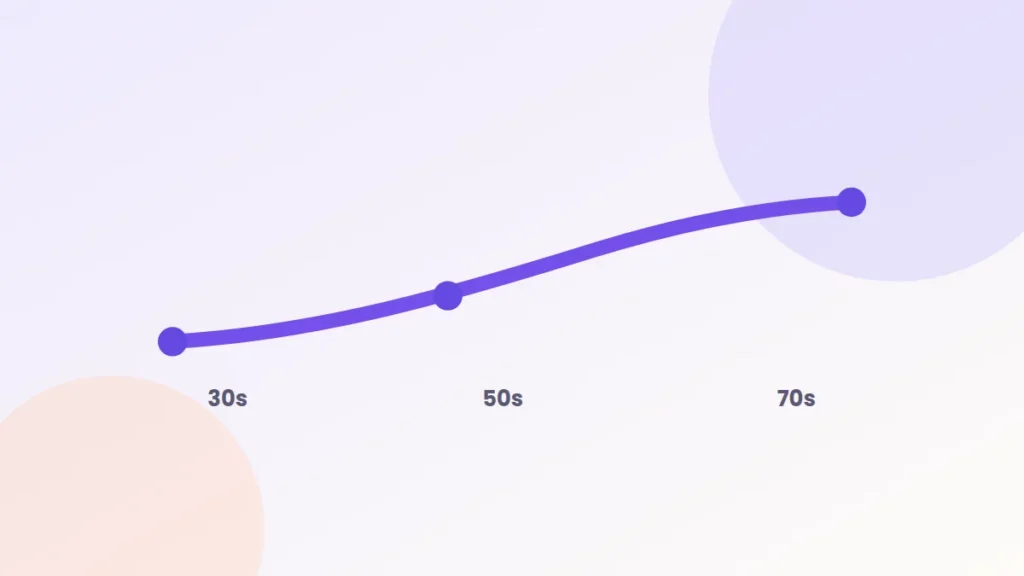
- Slower onset, more dependence on direct touch, less firmness and a much longer refractory period are ordinary age-related changes.
- Losing morning erections is not normal ageing — it points towards an organic cause and warrants assessment.
- Testosterone falls by roughly 1 to 2 per cent a year from the fourth decade, but most older men stay within the reference range and age alone is not a diagnosis.
- Gradual change with preserved morning erections and preserved libido suggests ageing; sudden change, lost libido or lost morning erections suggests disease.
Sexual function changes with age. That is not a controversial statement and it is not a tragedy. What causes trouble is that almost everything gets filed under “getting older” — including several things that are not ageing at all and that respond well to treatment.
This article does one job: separating the changes that are ordinary from the ones that mean something.
What genuinely changes
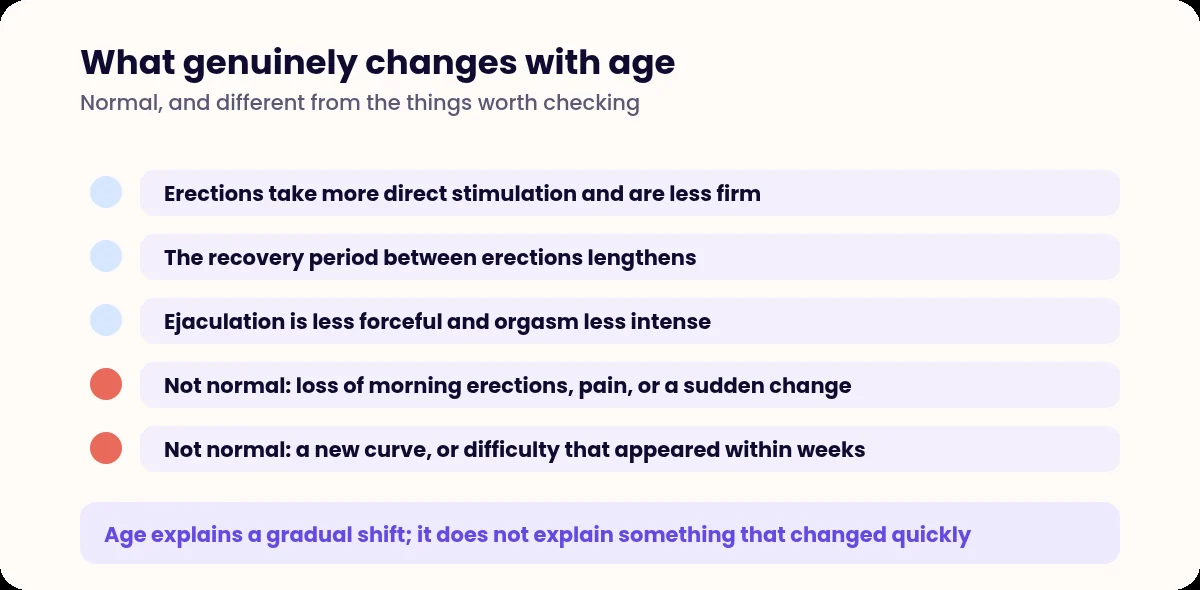
Erections take longer to arrive. And they become more dependent on direct physical stimulation. In your twenties, a thought or an image was often enough. Later, touch does a larger share of the work. This is a normal shift, and one that partners frequently misread as loss of interest.
Erections become less firm and more variable. Not absent — less rigid, and less reliably the same from one occasion to the next.
The refractory period lengthens considerably. The interval before another erection is possible runs from minutes in the late teens to many hours, and often 24 to 48 hours or more, by the sixties and seventies. These are consensus clinical descriptions rather than precisely measured population figures, so treat any website quoting an exact number for your age with suspicion.
Ejaculation changes. Reduced volume, less force behind it, a longer time to reach it, and often a less intense orgasm. Delayed ejaculation becomes more common with age, and our guide to delayed ejaculation covers when it is worth doing something about.
Testosterone declines gradually — roughly 1 to 2 per cent a year in total testosterone from the fourth decade onwards, with a steeper fall in free testosterone as binding protein rises. The important part is what follows: most older men remain within the reference range, and age by itself is not a diagnosis of testosterone deficiency [1].
None of these changes, individually or together, means sex is over. They mean the conditions have shifted. More direct stimulation, more time, less reliance on spontaneity, and a longer interval between occasions.
What is not normal ageing
This is the shorter list and the more important one.
Loss of morning and night-time erections. These happen during REM sleep and require the blood supply and nerve pathways to be working. Their disappearance points towards an organic cause rather than age, and is one of the more useful signals in the whole of male sexual medicine. Our guide to morning erections explains both why it matters and why it is not definitive — plenty of men simply do not wake at the right moment to notice.
Sudden change. Ageing is gradual, over years. Something that changed over weeks did not change because you got older.
Loss of libido. Desire does decline somewhat with age, but a clear loss of interest is not a normal age change and has a list of causes worth working through — mood, medication, thyroid, raised prolactin, testosterone deficiency, alcohol, sleep. Our guide to low libido in men covers it properly.
Pain. Pain on erection, on ejaculation, or in the testicles is never an age change.
Curvature, or a lump in the shaft. Peyronie’s disease can develop at any age and gets more treatment options the earlier it is assessed.
Erectile difficulty out of step with your age and health. A fit 55-year-old with sudden erectile dysfunction is not experiencing ageing.
The practical rule
Slower and less firm, with preserved morning erections, preserved libido and a gradual onset over years — that pattern is ageing.
Sudden onset, absent morning erections, lost libido, or a change out of proportion to age — that pattern needs investigating: cardiovascular risk, diabetes, testosterone, medicines, mood, and the penis itself [1, 2].
The two patterns overlap in real life, and a man can have both. That is a reason to get assessed rather than a reason to guess.
What the prevalence data actually show
The most-quoted figures come from the Massachusetts Male Aging Study: some degree of erectile dysfunction in 52% of men aged 40 to 70, with complete erectile dysfunction rising from 5% at age 40 to 15% at age 70 [3].
Two caveats. It was a US cohort recruited in 1987–89, so it is a historical anchor rather than a current UK prevalence figure. And the headline 52% covers “some degree”, which includes a great many men with occasional difficulty who would not describe themselves as having a problem.
What the data do establish is that this is common and that it increases with age. What they do not establish is that it is therefore untreatable or to be expected.
Why ageing is exactly when assessment matters most
The blood vessels supplying the penis are narrow. They show arterial disease earlier than the coronary arteries do, which is why erectile dysfunction functions as an early warning rather than a standalone complaint. British guidance puts the typical gap between erectile dysfunction and a cardiac event at three to five years, with risk comparable to moderate current smoking [1].
A man in his sixties whose erections have changed needs blood pressure, lipids, HbA1c and a cardiovascular risk assessment — not a shrug. Our guide to ED and heart disease sets out that connection, and it is the single best argument against accepting change quietly.
Medicines matter here too. Many of the drugs commonly prescribed from middle age onwards affect sexual function, and our guide to blood pressure medicines and erections covers the ones most often involved. That is a conversation with a prescriber, not a reason to stop anything.
On testosterone
Because the decline is real, testosterone gets blamed for a great deal. UK guidance is specific: diagnose deficiency only with consistent symptoms plus repeated fasting morning total testosterone below 12 nmol/L, treating below 8 nmol/L and considering a trial between 8 and 12 where symptoms fit [1]. The sample must be taken fasting, in the morning, and confirmed on a second occasion.
Age-related decline within the reference range is not a diagnosis, and treating it as one is how men end up on long-term hormone treatment they did not need. Getting the sample timing right is the part most often skipped.
What actually helps
The unglamorous things, which work at any age: physical activity, not smoking, keeping alcohol moderate, treating sleep apnoea, managing blood pressure and glucose. The evidence behind them applies as much at 70 as at 40.
Beyond that: more time and more direct stimulation, adjusting expectations about frequency rather than about whether sex happens, and talking to a partner about what has changed. Silence tends to be interpreted as disinterest.
Treatment is available and works well in this age group. Being older is not a reason to be offered less.
Frequently asked questions
Is it normal for erections to take longer as you get older?
Yes. Erections take longer to develop, become more dependent on direct physical stimulation rather than arousal alone, and are typically less firm than at 25. These are ordinary changes, described consistently in clinical practice, and on their own they are not a sign of disease.
How long is the refractory period supposed to be at 60?
There is no precise figure, and anyone who gives you one is inventing it. The pattern is well described: minutes in the late teens, lengthening steadily, often many hours and sometimes 24 to 48 hours or more by the sixties and seventies. Wide individual variation is the norm.
Should I have my testosterone checked?
If you have consistent symptoms — low desire, fatigue, loss of morning erections — then yes. UK guidance requires symptoms plus repeated fasting morning total testosterone below 12 nmol/L before diagnosing deficiency, with treatment below 8 nmol/L and a trial considered between 8 and 12 with symptoms. A single result taken in the afternoon proves nothing.
When is a change in erections a reason to see someone?
When it comes on suddenly, when morning erections disappear, when libido drops with it, when there is pain or curvature, or when the change is out of step with your age and general health. Any of those warrants an appointment rather than acceptance.
References
- British Society for Sexual Medicine. Guidelines on the management of erectile dysfunction in men (2018). bssm.org.uk/wp-content/uploads/2023/02/BSSM-ED-guidelines-2018-1.pdf
- European Association of Urology. Guidelines on Sexual and Reproductive Health. uroweb.org/guidelines/sexual-and-reproductive-health
- Feldman HA et al. Impotence and its medical and psychosocial correlates: results of the Massachusetts Male Aging Study. Journal of Urology (1994). pubmed.ncbi.nlm.nih.gov/8254833/
- NHS. Erection problems (erectile dysfunction). www.nhs.uk/conditions/erection-problems-erectile-dysfunction/
- NHS. Sex as you get older. www.nhs.uk/live-well/sexual-health/
Medical reviewer
Naeem Teni
Clinical Lead at Manova. Registered pharmacist and independent prescriber, GPhC 2215591. Reviews Manova’s clinical content for accuracy and safety.
Written by
Manova Editorial Team
Researched and written to our editorial policy, using NICE, NHS, MHRA and peer-reviewed sources.
This article is for general information and isn’t a substitute for advice from your own clinician. If you feel unwell, contact your GP or NHS 111. In an emergency, call 999.