

Key takeaways
- Meta-analysis of randomised trials found statins improved erectile function, with an IIEF-EF increase of roughly 3.4 points in men with ED.
- Observational associations between statins and ED are heavily confounded, because men prescribed statins have more vascular disease and diabetes, which independently cause ED.
- Nocebo is well documented with statins: the SAMSON trial found around 90% of the symptom burden was reproduced by placebo.
- Never stop a statin because of a sexual side effect without discussing it — untreated cardiovascular disease is itself a major cause of erectile dysfunction.
Statins have acquired a reputation for causing erectile dysfunction. It is repeated in forums, in comment sections and in a fair amount of health writing.
The randomised evidence points the other way. A meta-analysis of randomised trials by Kostis and colleagues found that statins improved erectile function, with an increase of roughly 3.4 points on the IIEF-EF score in men who had erectile dysfunction [1]. That is a clinically meaningful change in the direction opposite to the popular belief.
This matters more than an academic disagreement, because the men affected by this belief are men with cardiovascular risk — the group for whom stopping does the most damage.
Why the belief is so persistent
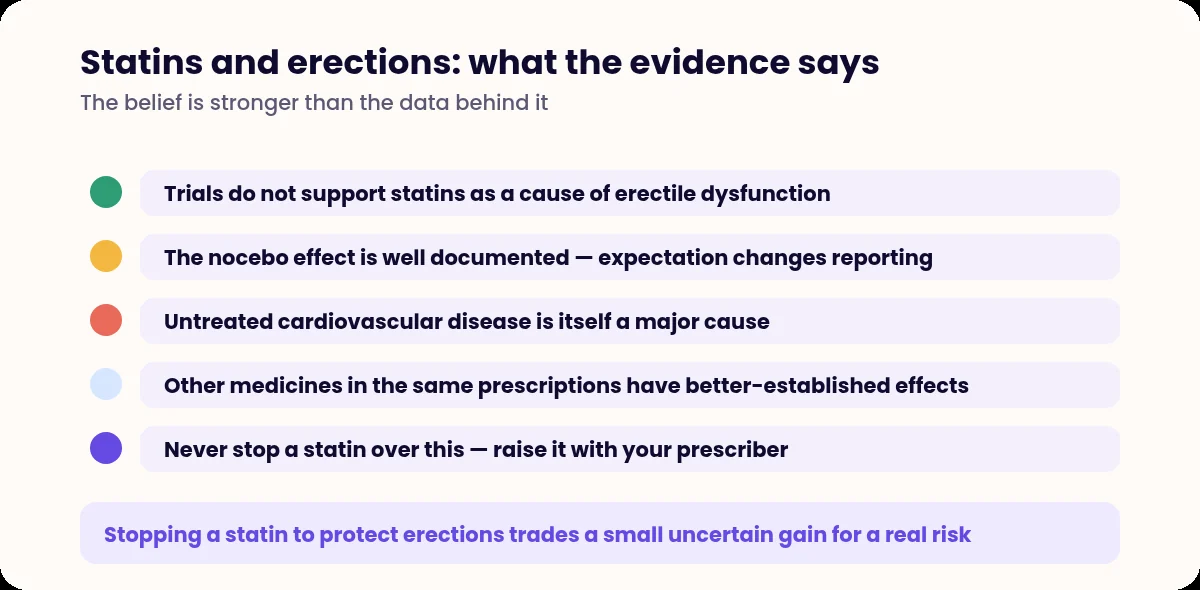
Three things generate it, and each is understandable.
Confounding by indication. Statins are prescribed to men with raised cholesterol, hypertension, diabetes, established vascular disease or a high calculated risk. Every one of those independently causes erectile dysfunction. Look at a database of men on statins and you will find more ED than in the general population — not because of the tablet, but because of who is given the tablet. A systematic review by Corona and colleagues examining new-onset ED found no convincing signal of harm from randomised data and concluded that the observational associations are confounded in exactly this way [2].
Timing. A man’s first statin prescription typically follows a cardiovascular scare, a poor blood test or a birthday with a review attached. It arrives at the same time as new health anxiety, often new blood pressure medication, sometimes new lifestyle restriction, and frequently at an age when erections are changing anyway. Attribution follows the newest variable.
Expectation. The belief is in circulation, and belief produces symptoms.
The nocebo evidence, which is the decisive part
Nocebo — symptoms produced by the expectation of harm rather than by the drug — is unusually well studied with statins, because two trials were designed specifically to test it.
SAMSON used an n-of-1 design in which patients cycled through periods of statin, identical placebo and no tablet, recording symptoms daily. Around 90% of the symptom burden reported on the statin was reproduced on placebo.
StatinWISE, a UK trial published in the BMJ, used the same approach in patients who had previously stopped or considered stopping statins because of side effects, and found no overall difference in symptom scores between statin and placebo periods [3].
Neither trial was about sexual function specifically, and it would be overreaching to claim they settle that question. But the mechanism they demonstrate is general: symptoms attributed to statins largely occur regardless of whether the statin is present. A man who reads that statins cause erectile dysfunction, starts one, and then notices erectile difficulty is very likely experiencing that effect layered on top of the vascular disease that prompted the prescription in the first place.
The mechanistic argument goes both ways
It is fair to acknowledge a plausible route to harm rather than pretend there is none.
Statins produce a small reduction in total testosterone — typically a few per cent, usually within the reference range, and rarely clinically meaningful [2]. In a man already sitting at the bottom of the range it is at least conceivable that this matters.
Against that, statins improve endothelial function and nitric oxide bioavailability. Erection is a vascular event dependent on nitric oxide, so the mechanistic case for benefit is at least as strong as the case for harm — and it is the one the randomised data support.
A minority of observational studies and case reports do still report erectile dysfunction with statins, and patient forums amplify these heavily. Individual variation is real. The honest position is that the population-level evidence favours benefit, and that an individual man’s experience still deserves to be taken seriously rather than argued with.
The thing most likely to be causing it
Untreated cardiovascular disease is one of the major causes of erectile dysfunction, and the timeline runs in a direction that is worth knowing.
Erectile dysfunction typically precedes a cardiac event by three to five years, and carries a risk comparable to moderate current smoking [5]. The penile arteries are narrower than the coronary arteries, so endothelial disease shows up there first. This is why a man presenting with ED should have blood pressure, lipids, HbA1c or glucose and a full cardiovascular risk assessment, not just a prescription — our guide to erectile dysfunction and heart disease covers this in detail.
Put that together and the logic of stopping a statin for ED becomes difficult. You would be removing treatment for the condition most likely to be responsible.
What about high cholesterol itself?
It is worth separating the drug from the condition it treats. Raised LDL cholesterol contributes to atherosclerosis, and atherosclerosis is the dominant physical cause of erectile dysfunction in men over 40. The small arteries supplying the corpora cavernosa are roughly a third to a half the diameter of the coronary arteries, so a degree of narrowing that produces no chest pain at all can be enough to blunt an erection.
That is the uncomfortable part of this topic for anyone who wants a simple villain. If your cholesterol is high enough to warrant treatment, the underlying process is already plausibly affecting your erections — and it was doing so before the first tablet. Our guide to weight loss and cholesterol covers the non-drug side of the same problem.
What to do instead
Raise it with your prescriber rather than stopping. This is not a formality. Statins are among the most commonly stopped medicines, and the consequence is measured in cardiovascular events.
Ask about a structured rechallenge. The n-of-1 approach used in SAMSON and StatinWISE can be done informally in practice — a planned break, then restarting, with symptoms recorded rather than remembered. Many men find the symptom is present in both periods.
Ask about switching. If a genuine effect is suspected, a different statin or a different dose is a reasonable next step, and is a decision for your prescriber.
Review everything else you take. Beta-blockers, thiazide diuretics, some antidepressants and finasteride all have better-established sexual effects than statins, and men on a statin are frequently on several of them. Our guide to blood pressure medicines and erections covers that group specifically.
Treat the erectile dysfunction directly. Statins and PDE5 inhibitors combine without interaction. The interaction that does matter in this population is with nitrates and nicorandil, which are absolutely contraindicated with the whole PDE5 inhibitor class — see our explainer on PDE5 inhibitors.
Do the things that help both problems. Weight, exercise, smoking and alcohol affect cholesterol and erections through the same vascular mechanism, which our guide to lifestyle changes for erections sets out.
Frequently asked questions
Do statins cause erectile dysfunction?
Randomised evidence does not support it. A meta-analysis of randomised trials found statins improved erectile function scores in men with ED. Observational studies that report harm are confounded, because statins are prescribed to men who already have the vascular disease and diabetes that cause ED. Individual variation exists, but the population-level signal points the other way.
Should I stop my statin if my erections have got worse?
No — not without discussing it with your prescriber first. Stopping raises your cardiovascular risk, and cardiovascular disease is one of the commonest causes of erectile dysfunction, so you may worsen the thing you are trying to fix. Raise it at an appointment; a structured rechallenge or a switch to a different statin can be arranged.
Do statins lower testosterone?
They produce a small reduction in total testosterone, typically of a few per cent, which is rarely clinically meaningful and usually stays within the reference range. It is not generally the explanation for new erectile difficulty, and testosterone should be measured properly — fasting, before 11am, repeated — before anything is concluded.
Can I take erection medicines with a statin?
There is no interaction between statins and PDE5 inhibitors, and they are commonly prescribed together. The important interaction to check is with nitrates and nicorandil, which are absolutely contraindicated with PDE5 inhibitors and are often prescribed to the same group of men.
References
- Kostis JB et al. The effect of statins on erectile dysfunction: a meta-analysis of randomised trials. Journal of Sexual Medicine, 2014. pubmed.ncbi.nlm.nih.gov/24684744/
- Corona G et al. The effect of statin therapy on testosterone levels and erectile function. American Journal of Medicine, 2018. www.amjmed.com/article/S0002-9343(17)31125-7/abstract
- StatinWISE: n-of-1 randomised trials of statin adverse effects. BMJ, 2021. www.bmj.com/content/372/bmj.n135
- NHS. Statins. www.nhs.uk/conditions/statins/
- British Society for Sexual Medicine. Guidelines on the management of erectile dysfunction in men. www.bssm.org.uk/guidelines/
- NICE. Cardiovascular disease: risk assessment and reduction, including lipid modification. www.nice.org.uk/guidance/ng238
Medical reviewer
Naeem Teni
Clinical Lead at Manova. Registered pharmacist and independent prescriber, GPhC 2215591. Reviews Manova’s clinical content for accuracy and safety.
Written by
Manova Editorial Team
Researched and written to our editorial policy, using NICE, NHS, MHRA and peer-reviewed sources.
This article is for general information and isn’t a substitute for advice from your own clinician. If you feel unwell, contact your GP or NHS 111. In an emergency, call 999.